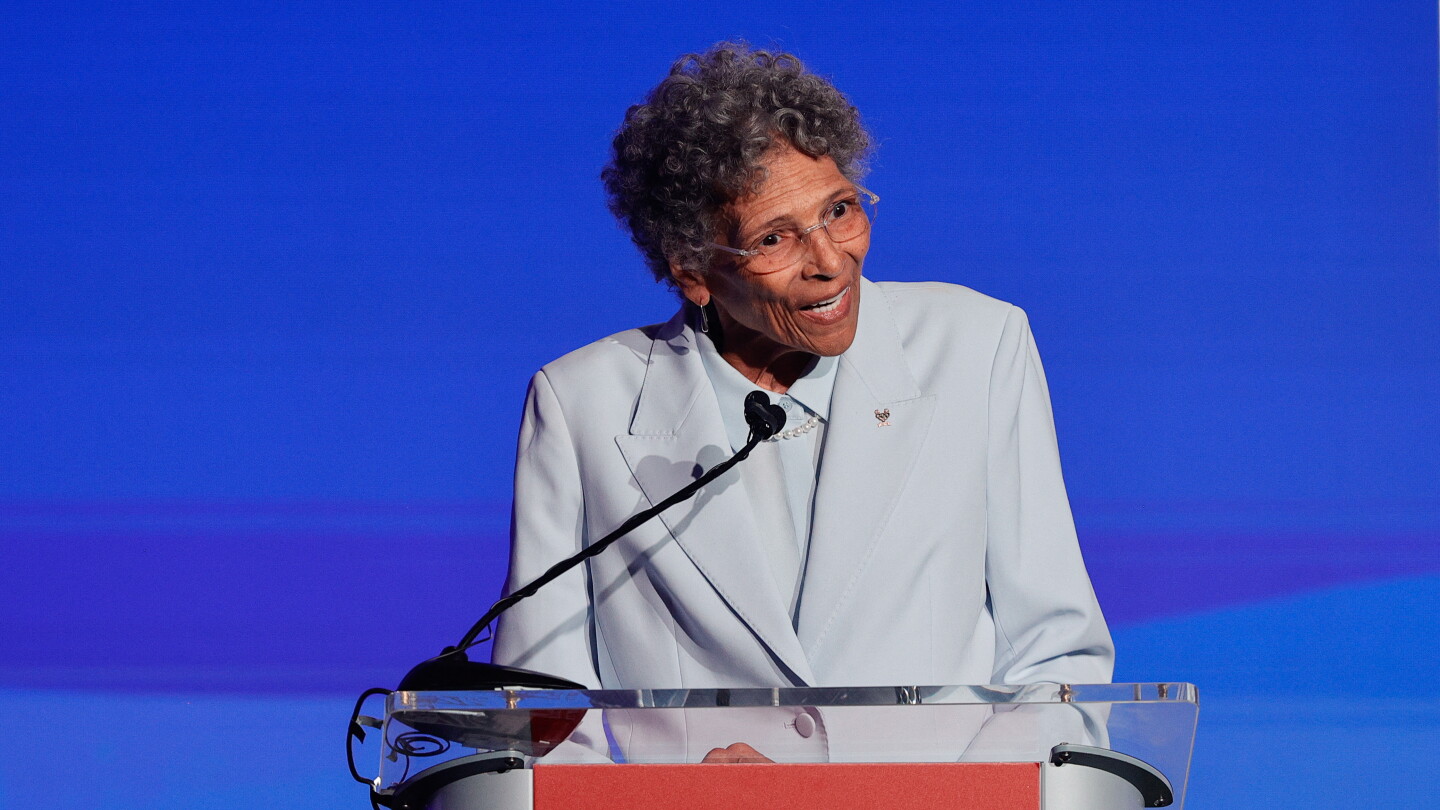
Anita DeFrantz, an Olympic rowing medalist who became one of the most influential people and a pioneering Black woman in the Olympic Movement over four decades, died Wednesday at age 74.
The IOC called DeFrantz “a trailblazer for women in the Olympic Movement” and said “her legacy of courage, leadership and commitment to equality will live on.”
“I feel an immense sense of loss at Anita’s passing,” IOC President Kirsty Coventry of Zimbabwe said. “Anita was a mentor, a friend and a true inspiration to me, and to so many others around the world. From my earliest days in the Olympic Movement, she showed me what courageous leadership looked like, and what was possible for women in sport. She broke barriers long before many of us had the opportunity to follow, and I will never forget that the path I have been privileged to walk was made possible by trailblazers like Anita.”
U.S. Olympic and Paralympic Committee CEO Sarah Hirshland called DeFrantz a “giant of the Olympic Movement.”
“Anita DeFrantz was one of the most consequential Olympians our nation has ever known,” Hirshland said. “To those of us fortunate enough to work alongside her, she was also a mentor, a truth-teller and a steady source of wisdom and grace.”
Hirshland said that DeFrantz’s “quiet strength, her sharp mind and her warmth” will be missed the most.
“She asked the hard questions, always with kindness, and always brought the conversation back to the athletes,” Hirshland said. “She made each of us, and this organization, better. Her legacy lives on in every Team USA athlete who speaks and is heard, and in every girl who finds her place in sport. On behalf of the entire Team USA family, we extend our deepest love and condolences to Anita’s family, friends and colleagues around the world. Thank you, Anita, for pulling for all of us.”
U.S. Rowing posted, “Though she is gone, DeFrantz’s legacy and contributions to rowing and Olympic sports will continue to resonate with our community for years to come. We remember her extraordinary legacy and extend our condolences to her family, friends, and the rowing community.”
DeFrantz went from winning an Olympic women’s eight bronze medal in 1976 to becoming an IOC member in 1986. She was the first American woman to hold IOC membership, fifth woman overall, and the first African American member.
In 1997, she became the first woman to serve as an IOC vice president. In 2001, she became the first woman to run for the IOC presidency (an election won by Belgian Jacques Rogge).
She also served as vice president of the 1984 Los Angeles Olympic Organizing Committee. For 28 years after those Olympics, she was president of the LA84 Foundation, which developed youth sports programs that defined the legacy of the Games.
DeFrantz, also a 1980 Olympic team member, challenged the U.S. boycott of the 1980 Moscow Games. She testified before the Senate Foreign Relations Committee, arguing that American athletes should be permitted to go, and sued the U.S. Olympic Committee over the decision. For her efforts, she was awarded the Bronze Medal of the Olympic Order by the IOC in 1980.
DeFrantz, born Oct. 4, 1952, grew up in Indianapolis with three brothers. She was introduced to rowing in the early 1970s as a Connecticut College sophomore.
A few years later, while a Penn law student, she was team captain as women’s rowing made its Olympic debut at the 1976 Montreal Games, earning a bronze medal in the eight. She called rowing the “noblest of sports” and the “ultimate team sport.”
“Unlike other sports, we can’t say, ‘OK, I need a couple of strokes off, I’ll get back with you,’” she said upon being inducted into the U.S. Olympic and Paralympic Hall of Fame in 2025. “We’re in it together, and that taught me so much.”
She loved the Olympic Movement, saying “it’s based on values, not entertainment, but the values of fair play and mutual respect.”
She advocated for athletes and fought for female representation, both for athletes and administrators.
When DeFrantz competed at the Olympics, there were 1,260 women to 4,813 men in Montreal. At LA 2028, there will be more female athlete quota spots than male athlete quota spots for the first time in Olympic history.
IOC membership went from five women and more than 80 men when DeFrantz joined in 1986 to 46 women and 60 men following elections during the Milan Cortina Winter Games.
In March 2025, DeFrantz traveled to Costa Navarino, Greece, to cast her vote in the election where Coventry became the IOC’s first female president.
“I was just really proud that I could make her proud,” a teary Coventry said on the day she was elected. “Women like her paved the way for women like me.”
In July 2025, Coventry returned the favor, traveling to Colorado Springs to introduce DeFrantz as she was inducted into the United States Olympic and Paralympic Hall of Fame.
An emotional handover during the Olympic Torch Relay in Milan, as Anita DeFrantz passed the flame to IOC President Kirsty Coventry ahead of the @milanocortina26 Opening Ceremony. #MilanoCortina2026
— IOC MEDIA (@iocmedia) February 6, 2026
👉 https://t.co/FX55kYEFwG pic.twitter.com/sRkm21grHJ