If you missed the NFC UDFA class rankings, from Monday, be sure to check those out. Today we’ll get started with a table of the top-50 reported UDFA guaranteed money signings this process. At the end of this column, there will be a final table showing how all 32 organization’s UDFA classes stacked up against one another.
2021 UDFA guarantees
| Rank | Name | Team | Guaranteed | Pos | College |
|---|---|---|---|---|---|
| 1 | Kenny Yeboah | NYJ | 200000 | TE | Mississippi |
| 2 | Marvin Wilson | CLE | 192000 | DT | Florida State |
| 3 | Isaiah Dunn | NYJ | 185000 | CB | Oregon State |
| 4 | Tim Jones | JAC | 180000 | WR | Southern Mississippi |
| 5 | Shane Buechele | KC | 175000 | QB | Southern Methodist |
| 6 | Josiah Bronson | NO | 165000 | DT | Washington |
| 7 | Drew Himmelman | DEN | 150000 | T | Illinois State |
| 8 | Matt Bushman | LV | 135000 | TE | Brigham Young |
| 9 | Brandon Smith | DAL | 132000 | WR | Iowa |
| 10 | Sadarius Hutcherson | TB | 130000 | G | South Carolina |
| 11 | Robert Jones | MIA | 130000 | T | Middle Tennessee State |
| 12 | Elijah Sullivan | SF | 125000 | LT | Kansas State |
| 13 | Justin Hilliard | SF | 125000 | LB | Ohio State |
| 14 | Malik Herring | KC | 125000 | DE | Georgia |
| 15 | Ryan McCollum | HOU | 125000 | C | Texas A&M |
| 16 | Shaun Beyer | DEN | 125000 | TE | Iowa |
| 17 | David Moore | CAR | 125000 | G | Grambling State |
| 18 | Kenny Randall | JAC | 120000 | DT | Charleston |
| 19 | Dillon Stoner | LV | 120000 | WR | Oklahoma State |
| 20 | Dylan Soehner | NO | 120000 | TE | Iowa State |
| 21 | Adrian Ealy | BAL | 115000 | T | Oklahoma |
| 22 | Blake Proehl | MIN | 115000 | WR | East Carolina |
| 23 | Ar’Darius Washington | BAL | 100000 | S | Texas Christian |
| 24 | Javon McKinley | DET | 100000 | WR | Notre Dame |
| 25 | Teton Saltes | NYJ | 93000 | OL | New Mexico |
| 26 | Jonathan Adams Jr. | DET | 90000 | WR | Arkansas State |
| 27 | Andre Mintze | DEN | 85000 | DE | Vanderbilt |
| 28 | Devery Hamilton | LV | 75000 | T | Duke |
| 29 | Dylan Moses | JAC | 70000 | LB | Alabama |
| 30 | Devon Key | KC | 65000 | S | Western Kentucky |
| 31 | Garrett Groshek | LV | 65000 | RB | Wisconsin |
| 32 | Anthony Hines | DAL | 55000 | LB | Texas A&M |
| 33 | Osirus Mitchell | DAL | 55000 | WR | Mississippi State |
| 34 | Jared Goldwire | LAC | 50000 | DT | Louisville |
| 35 | Tory Carter | TEN | 50000 | FB | Louisiana State |
| 36 | Deon Jackson | IND | 45000 | RB | Duke |
| 37 | Dicaprio Bootle | KC | 45000 | CB | Nebraska |
| 38 | Naquan Jones | TEN | 45000 | DT | Michigan State |
| 39 | JaQuan Bailey | PHI | 40000 | DE | Iowa State |
| 40 | Jake Burton | NYG | 40000 | T | California-Los Angeles |
| 41 | Damon Hazelton | HOU | 37500 | WR | Missouri |
| 42 | A.J. Parker | DET | 35000 | CB | Kansas State |
| 43 | Javian Hawkins | ATL | 35000 | RB | Louisville |
| 44 | Cary Angeline | ARI | 30000 | TE | North Carolina State |
| 45 | Amen Ogbongbemiga | LAC | 30000 | LB | Oklahoma State |
| 46 | Spencer Brown | CAR | 30000 | RB | Alabama-Birmingham |
| 47 | Lorenzo Burns | ARI | 25000 | CB | Arizona |
| 48 | Antonio Phillips | CIN | 25000 | CB | Ball State |
| 49 | Shakur Brown | PIT | 25000 | CB | Michigan State |
| 50 | Thomas Schaffer | CHI | 25000 | DT | Stanford |
[[ad:athena]]
In a job like mine, you do a lot of radio and podcast spots in April. That month, I got two questions almost every day: 1.) What is your overall analysis of the 2021 NFL Draft in comparison to recent classes?, and 2.) Who are the 49ers taking third overall?
Luckily, I answered correctly on question two. Here was my take on question one: Around the 32 franchises, the 2021 NFL Draft would feature less homogenized draft boards than any draft for at least the previous two decades -- likely leading to more “reaches” and “fallers” on draft day (the more homogenized the boards, the more predictable the draft), and a few more shockers falling completely out of the draft than we’re accustomed to seeing. I had a third take, but nobody was asking: I had a feeling this year’s UDFA class was going to be better than any recent UDFA class because of that.
The most important piece of information prospects hand to the NFL during the pre-draft process is their final season of tape. Game film, particularly from the last season, is the base context of a prospect’s eval. Without context, there is no truth. A prospect’s stats from the previous season don’t mean squat if you remove the vacuum from which they occurred. An incredible, out-of-this-world testing profile will not elevate a receiver lacking ball skills into the first round, nor a linebacker lacking instincts, no matter how incredible their recruiting pedigree, no matter how many games they started for a blueblood school (*Donovan Peoples-Jones and Baron Browning nod*).
In previous drafts, the vast majority of the prospect pool had played in double-digit games the previous season. The NFL had an extensive film catalogue to comb through. They could compare-and-contrast it to previous seasons to gauge development, and against the final-season tape of similar prospects. I believe the Bill Parcells rule stipulating that quarterback prospects start 30 college games had as much to do with giving the evaluator a complete dataset to evaluate as it did with correlating college experience to NFL success.
The more complete the dataset, the less projection that’s required (the less “guessing” that’s required, to use the pejorative). It’s not the hard data that evaluators disagree on. It’s the projection -- the missing pieces needing to be filled in. The more projection that’s required, the more evaluators are going to disagree.
“What I’m hearing from other scouts is, there’s a lot more viewpoints in the room,” one NFL scout told ESPN. “Maybe in a normal year, people are seeing the same player and they have the same grade. Now, you could have opinions all over the place. ... What are we going to value? The workout? Or limited tape, or a mixture of both? The testing numbers, and how those relate to the rest of the draft class? That’s going to be different for every team.”
This year’s class was full of prospects who didn’t play a down in 2020, from elite ones (Penei Sewell, Ja’Marr Chase, Micah Parsons) all the way on down to UDFA you’ll read about below. The class also had prospects that played anywhere from one 2020 game (Trey Lance) on up. So many games (opportunities to evaluate) lost. The expected 2021 NFL Draft dataset erased by opt-outs was enormous and unprecedented.
That alone would have made the 2021 class the NFL’s most difficult evaluation proposition of all-time. But then things got more difficult by degrees. One of the other key pieces of information prospects give the NFL during their pre-draft process is a quantified athletic profile.
That’s what the NFL Combine is for -- aggregating 200-plus athletic profiles in controlled conditions in one efficient work-weekend. The cancellation of the 2021 NFL Combine forced teams to use pro day testing numbers, which are notoriously fickle (this year, with added weight on the pro day tests, the NFL at least made surface-level efforts to ensure standard testing protocols).
It wasn’t just the teams who were hurt by the combine cancellation. “I was kind of upset when we didn’t have a combine because I felt like that national publicity would have raised my stock even more because it’s rare to see someone big like me be able to move the way I know how to move,” South Carolina CB Israel Mukuamu told ESPN. Mukuamu, who is 6-foot-4 and 205 pounds, didn’t run the 40 at South Carolina’s pro day because of a sore hamstring. Mukuamu ended up falling to the Cowboys in R6. In the ESPN article, dated April 13, Mukuamu lists Dallas as one of five teams that had given him good feedback during the process.
Even if the NFL could have ensured the veracity of all reported pro day times from each individual site -- there’s no way -- the conditions at each individual site were naturally different. And that in itself threw the entire dataset into question. And in a year where teams were sending scouts with stopwatches to get their own times from campuses instead of getting printouts of the NFL Combine’s laser times, 2021 was setting up to be a year where teams would also have a wider band of athletic composites on individual prospects.
I had a coach DM me after I posted the Thor500. A defender from his school had finished with a RAS composite score above 8.0, a fabulous overall workout only slightly tainted by a mediocre 40. The coach said the school had timed the defensive prospect .08 faster in the 40 than the NFL team conducting the workout, which ended up reporting it (and then it showed up on Kent’s RAS site). I’m not going to name the NFL team, but if I did, you might be apt to believe the school’s time.
If 32 teams showed up with stopwatches that day, they would have left with an inkblot of times falling somewhere between the school’s number and the team’s “official” number. Nearly one-tenth of a second apart, an enormous difference in the forty. Now consider the effect on the dataset that band-of-outcome being played out on every test for every prospect over the month-plus pro-day window leading up to last month’s draft.
This class, teams not only had to do more projecting than ever before, but a primary datapoint used to project future athletic performance was compromised in the way that happens when you move controlled experiments out of the lab and into the real world. This must have driven the analytically-inclined organizations crazy. Old-school front offices trying to get a sense of a prospect’s character amid a hazy evaluation probably weren’t thrilled with the Zoom calls in lieu of face-to-face meetings, either.
It’s impossible to quantify the exact degree all these changes had on the 2021 NFL Draft -- who rose, who fell, how different the 2021 NFL Draft board may have looked in an alternate universe. A world where the pandemic never happened and the full 2020 season was played as scheduled in front of sold-out crowds, nobody wearing a mask and nobody watching on television having a reason to wonder whether they should be. A world where Jamie Newman is Georgia’s starting quarterback.
By late-October, over 30 Power 5 prospects who eventually declared for the 2021 NFL Draft had opted-out. That number would swell as the weeks went on. The FCS moved to the spring, wiping out the entire 2020 season of almost every 2021 NFL prospect from that level (NDSU and QB Trey Lance played a one-off game in the fall before Lance left the team).
“It feels like we know less about this class of players than any class in recent memory,” New Orleans Saints general manager Mickey Loomis told ESPN. “Just because of the COVID restrictions, the restrictions on scouts getting into campuses -- as well as the fact that there were fewer games played in college football this year.”
The NFL really only caught one break this process: The NCAA’s 2021 pandemic eligibility waiver allowed graduated seniors to return to school. A huge number took advantage. Whereas 1,932 prospects declared for the NFL Draft last year, only 657 prospects declared for this one. So though we had a smaller data set on this class, and even though the data we did have was a little fuzzier than usual, at least the group of prospects to evaluate had been cut in one-third.
NFL transacting is itself a controlled environment. On the last weekend of April, teams picked under the same set of non-ideal circumstances. Nobody had ever seen anything like it -- except Gil Brandt, who has seen everything. “During the war years we had players go into the service and not play for a year, year and a half, and never can I remember a player who came back with the same status he left with,” said Brandt, who has scouted since 1955. “If you are a college student and you drop out of school for a year, it takes you a while to get your study habits back. In this case, I think it takes a while to get your work habits back.”
The conventional wisdom says that this UDFA class is weak, since the draft class was cut by more than half. And since so many prospects missed the season or part of it, triggering flags Brandt mentions above.
I believe the opposite is true. I believe this UDFA crop will end up giving the NFL more career value than at least the two UDFA classes that preceded it. In Round 1, you don’t want to pick high-variance prospects -- the risk/reward equation rarely makes sense. In UDFA, you want those high-variance prospects.
This draft class was, on paper, one-third the size of last year’s. But almost all of the prospects cleaved off that number were seniors whose eligibility had exhausted. Seniors who knew they had no chance to get drafted or signed. No senior taking advantage of the NCAA’s eligibility waiver to return for a super-senior season would have had a material effect on the 2021 NFL Draft. I don’t think this was a special draft class, but it sure wasn’t a bad one.
The New York Post correctly predicted in the days leading up to the NFL Draft after speaking to multiple NFL executives that during the draft “tiebreakers could go to players who were evaluated last season.” Senior Bowl executive director Jim Nagy made a similar prediction to Sports Illustrated: “I do think the prevailing mindset is if you have two players graded similarly on the board, if their cards are right next to each other, you’re taking the guy you’ve seen play football more recently.” That became the risk/reward prerogative of the teams on the clock.
This year’s UDFA class got a talent jolt from more draftable prospects going undrafted. It’s not just that: A larger percentage of prospects that I had UDFA grades on in this year’s class had incomplete profiles -- prospects with larger band-of-outcomes -- than ever before.
The inclusion of that high-variance group into this year’s UDFA, along with my assertion that the NFL did not pick the 259-best prospects in what was a pretty normal year in terms of talent, provided an unprecedented modern UDFA opportunity: The ability to buy-low -- the lowest-of-low acquisition costs -- on good athletes who had become undraftable due to unforeseen circumstance, not on-field play.
1. New York Jets
| Name | Rk | Pos | Ht | Wt | RAS | Comp |
|---|---|---|---|---|---|---|
| Kenny Yeboah | 173 | TE8 | 6'4 | 250 | 5.93 | Chris Herndon |
| Hamilcar Rashed | 214 | EDGE27 | 6'2 | 251 | 8.31 | Harold Landry |
| Mustafa Johnson | 274 | DL24 | 6'0 | 280 | 5.61 | Luther Maddy |
| Milo Eifler | 298 | LB32 | 6'1 | 228 | 7.86 | Juwan Simpson |
| Parker Ferguson | 305 | iOL31 | 6'4 | 290 | 6.5 | Jon Runyan Jr. |
| Brendon White | 316 | S25 | 6'1 | 215 | 6.42 | Josh Jones |
| Tristen Hoge | 363 | iOL37 | 6'5 | 306 | --- | Kurtis Gregory |
| Grant Hermanns | 399 | OT32 | 6'7 | 300 | 7.59 | Jackson Barton |
| Teton Saltes | 423 | OT35 | 6'5 | 300 | 7.95 | Terry Poole |
| Isaiah Dunn | 479 | CB53 | 5'11 | 189 | 8.93 | Richard Marshall |
| Michael Dwumfour | X | DL41 | 6'1 | 294 | --- | Ricky Walker |
| Jordyn Peters | X | S41 | 6'1 | 202 | 4.66 | --- |
| Chris Naggar | X | K-X | 6'1 | 184 | --- | --- |
Cornerback was arguably the team’s biggest pre-draft need. But because of the way the board fell -- and because New York gave up two third-rounders and a Day 3 pick to the Vikings to move up for Alijah Vera-Tucker -- the Jets ended up using three late-Day 3 picks between Nos. 150-200 overall on corner, stocking up on fliers instead of a sure-thing. Exiting the draft, TE and EDGE were the two biggest areas of need the Jets hadn’t addressed.
The Jets’ UDFA priorities were clear: Get one of the best players at those three positions that had fallen through the cracks. Turns out Gang Green was willing to shell out to make that happen. The Jets became the first team to give a $200k guaranteed UDFA deal, handing it to Mississippi TE Kenny Yeboah (the deal snapped the previous record of Jacksonville signing SDSU CB Luq Barcoo to $180k in guarantees last year).
Yeboah, the No. 12 overall player on my UDFA board, reunites with collegiate teammate WR Elijah Moore in the Big Apple. Hilariously, I comped Yeboah to Chris Herndon, the man he’ll now be competing against (along with Ryan Griffin).
The Jets then outright disrespected Barcoo by also breaking his guaranteed record for a UDFA corner, handing Oregon State CB Isaiah Dunn $185,000. The Jets like Dunn more than I do -- he was my No. 15 UDFA corner -- but he’s got the size and athleticism to stick and was better in 2018-2019 than he was in a five-game sample last fall.
New York also brought in Dunn’s college teammate, Hamilcar Rashed, to infuse young blood at EDGE. Rashed’s signing bonus hasn’t been reported; whatever guarantees he got will pale in comparison to Yeboah and Dunn.
Rashed is a tweener. His play, like Dunn’s, dropped off over a five-game 2020 schedule (Tony Pauline went so far as to say: “Rashed often looked disinterested in 2020.”). Even so, Rashed was a second-team AP All-American in 2019 when he led the FBS with 22.5 TFL and tied for third in the country with 14 sacks. Rashed posted an 83rd-percentile RAS athletic composite at his pro day workout. Small with poor agility drills, but equipped with speed and explosion. Indisputably worth bringing in for a negligible-cost look.
2. Baltimore Ravens
| Name | Rk | Pos | Ht | Wt | RAS | Comp |
|---|---|---|---|---|---|---|
| Ar’Darius Washington | 100 | S6 | 5'8 | 176 | 5.13 | Lamarcus Joyner |
| Nate McCrary | 286 | RB23 | 6'0 | 213 | 9.41 | Jon Williams |
| Tony Poljan | 288 | TE15 | 6'7 | 251 | 4.71 | Scott Chandler |
| Adrian Ealy | 299 | OT25 | 6'6 | 321 | 2.81 | Daryl Williams |
| Samuel Cooper | 323 | iOL33 | 6'1 | 305 | 7.55 | Kasey Studdard |
| Foster Sarell | 373 | OT29 | 6'6 | 318 | 4.48 | William Sweet |
| Blake Gallagher | 375 | LB41 | 6'0 | 224 | 2.41 | Beniquez Brown |
| Xavier Kelly | 434 | DL36 | 6'5 | 306 | --- | SirHenry Anderson |
| Barrington Wade | X | LB52 | 6'1 | 232 | 7.87 | Leroy Hill |
| Donte Sylencieux | X | WR-X | 6'1 | 186 | --- | --- |
TCU S Ar’Darius Washington is like a discount rack Tyrann Mathieu. A ball of muscle that plays ticked-off like a pit bull, Washington is an undersized do-it-all playmaker. Hailing from Louisiana’s Evangel Christian Academy, Washington has a tattoo on his hand with a world with a crown on it, just like Matthieu’s.
He looks up to the Honey Badger, studies the Honey Badger, and flashes Honey Badger’s sweet tooth flying to the ball. It remains stunning that Washington turned down his very first scholarship offer, from Mathieu’s alma mater LSU, to sign with TCU. But in Fort Worth, he got to play in Gary Patterson‘s hyper-aggressive 4-2-5 defense as one-half of the nation’s most vaunted safety duo alongside Trevon Moehrig.
If all goes well for Washington, he’ll become 90% of what Mathieu is as a safety/nickel hybrid defender. Coming out of college, Mathieu measured 5’9/186. Washington measured 5’8/176, with 29 ¼” arms (Mathieu has him by an inch-and-a-half in that category). Both players have large hands for their frames, perhaps in part explaining the respective ball skills. Washington tested slower than Mathieu in the forty (4.62 to 4.5) and 3-cone (7.06 to 6.87).
Those two tests are likely why Washington went undrafted: His tape otherwise should have overcome his size. In Washington’s defense, both his jumps were over the 73rd-percentile, per Mock Draftable, while both of Mathieu’s were under the 26th.
Where the two really jive is in the areas of their super computers and warrior ethos’. They both see the field extremely well and play fearless. Each wreaked havoc in the P5. In 2019, Washington was PFF’s highest-graded safety. I saw Washington as a fourth-rounder. Others were even higher. He was a second-rounder on PFF’s board.
Either way: Highway robbery as a UDFA. Even monetarily! Can you believe that Washington didn’t even get the most guaranteed money in Baltimore’s class? Washington got $100k in guarantees, the Ravens gave Oklahoma OT Adrian Ealy $115k. I ranked Ealy just inside my top-300.
Baltimore probably got caught in a bidding war and didn’t feel they had a choice. Ealy was one of only two top-300 OTs on my board that weren’t picked in the NFL Draft. And the Ravens, who traded Orlando Brown to the Chiefs right the draft to open a need at tackle, hadn’t been able to take one during draft weekend. Ealy should develop into a fine backup right tackle if he proves he can move well enough to hang in the pros.
I had heard the Ravens were sniffing around the inline TE class heavily in the pre-draft process. Baltimore is settled with its move-TE, Mark Andrews, but continues its quest to find the perfect complement in its run-heavy offense. Last offseason, the Ravens traded Hayden Hurst to the Falcons, then signed Jacob Breeland and Eli Wolfe as UDFA. Later, following Nick Boyle’s injury, Baltimore, disappointed with Luke Wilson’s play, brought in Eric Tomlinson.
Now, Baltimore is going to sink some developmental time into Tony Poljan, a Virginia tight end who used to be an enormous dual-threat Central Michigan quarterback. Poljan has an ideal frame, but his game has a raw and awkward feel, with sporadic flashes of ball skills as a receiver. I don’t see him developing into a strong blocker, so I’m not as bullish on Poljan cracking the roster over Tomlinson or Breeland as maybe others are.
Especially when you consider two factors currently outside the TE room: The Ravens picked the best fullback in the draft, Ben Mason, in the fifth-round, and will assuredly carry him on the roster alongside Patrick Ricard. The Ravens have also reportedly kicked around the idea of moving Miles Boykin to TE (though Boykin would probably back-up Andrews as opposed to mucking up Poljan’s situation). But depending on how things shake out at other positions, carrying multiple fullbacks and multiple move-TE may limit the Ravens to only one inline backup behind Nick Boyle -- neutering Poljan’s odds.
3. Jacksonville Jaguars
| Name | Rk | Pos | Ht | Wt | RAS | Comp |
|---|---|---|---|---|---|---|
| Dylan Moses | 147 | LB14 | 6'1 | 225 | --- | Mack Wilson |
| Tim Jones | 191 | WR24 | 6'1 | 203 | 9.03 | Kenny Stills |
| Kenny Randall | 267 | DL22 | 6'2 | 302 | 8.17 | Sharrif Floyd |
| Josh Imatorbhebhe | 291 | WR39 | 6'0 | 218 | 8.97 | D. Peoples-Jones |
| DJ Daniel | 318 | CB40 | 6'0 | 195 | 4.36 | Trumaine Johnson |
| Corey Straughter | X | CB66 | 5'10 | 184 | 1.24 | --- |
When you watch as much college football during the fall as I do -- it’s my job! -- and evaluate as many prospects during the spring, naturally you find yourself liking random off-the-beaten track prospects more than others. Tim Jones was one of those guys this class. My colleague Eric Froton and I brought him up on several pre-draft show for NBC Sports Edge as well -- Froton is a Tim Jones junky.
I didn’t expect Jones to get drafted, even though I had a conviction that he was a draftable talent. But the $180,000 guaranteed Jacksonville gave him as a UDFA -- No. 4 overall in the UDFA class and a top-5 figure all-time -- prompted a celebratory call to Froton. I couldn’t bypass the opportunity to let Froton guest-write a paragraph scouting report on our adopted son Tim Jones:
The former three-star recruit from Biloxi, MS arrived on the Southern Miss campus in 2017 and quickly made an impression, averaging 24.2 yards per catch on five receptions as a true freshman. He improved incrementally over the next three years, catching 70 percent of his targets while raising his production to elite levels in 2020 despite dealing with turmoil in the coaching ranks and three different starting quarterbacks. Though Jones (6’1/203) sustained a hamstring injury that limited him to six games, he played 58 percent of his reps on the outside after logging 90 percent of his reps in the slot during his three prior campaigns. The USM wideout increased his average target depth from 7.3 to 10.5 yards while drastically cutting his drop rate and earning a sparkling 134.7 passer rating when targeted. His pristine 88.3 PFF receiving grade is bolstered by a stellar 3.27 yards per route run that ranks 10th among 2021 draft wideouts. Jones’ pro day workout backed up those numbers, as he posted a 4.47 40-yard dash (81st percentile), 4.14 short shuttle (82nd), 40” vertical jump (96th) and 17 bench reps (83rd) for a 9.03 Relative Athletic Score which ranks in the top 90th percentile of all wideouts tested since 1987. Jones smooth hips and fluidity that allows him to weave through the secondary and excel between the numbers, where he secured 15-of-19 targets in 2020. He uses his sturdy frame to shield defenders on slants and break tackles in space while displaying dependable hands. Jones is tailor made for slot work in the NFL and has the talent to excel as a short-to-intermediate safety valve option for blue-chip QB Trevor Lawrence.
I was low on Alabama LB Dylan Moses pre-draft in comparison to others. Turns out the NFL was lower than all of us. Not only did Moses go undrafted, but he didn’t even garner enough of a bidding war post-draft to bag top-25 UDFA guaranteed cash. Moses is a former five-star recruit that led the championship-winning Tide with 80 tackles last season.
His tackle number flatters him -- Moses struggled in coverage and seemed zapped of north-south explosion against the run and as a pass-rusher in his 2020 return off an ACL tear. Moses also played through a torn meniscus last season, which couldn’t have helped matters. Turns out his medicals also wrecked his draft stock.
“It had nothing to do with what kind of football player he is,” Alabama HC Nick Saban said a week after the draft, addressing the topic of Moses going undrafted. “It was all based on medical grades by the teams, which, frankly, was a little surprising to me. My time in the league, when guys came back and played, that usually got (them) out of that ‘5’ medical grade, which is ‘undraftable’ -- it might have been a ‘4’ medical grade, which means a guy does have an injury that could be a problem in the future, but he’s come back and played with it, so we have to give him an opportunity. … I certainly think that’s where Dylan Moses should have fallen for sure, and should have gotten an opportunity, because he played all season long for us. And I think that should be a good enough indicator that he can play in the NFL.”
Later in his comments, Saban brought up that doctors had medically failed Drew Brees when, during his brief days as Miami Dolphins HC, the Fins were vetting Brees as a free agent. Instead, the Dolphins traded for Daunte Culpepper -- who, sadly and ironically, was the shot one medically. As for Moses, durability remains an enormous red flag, with on-field consistency flying at half-mast beside it. If there’s a developmental positive, it’s that Jacksonville is going to place Moses on the non-football injury (NFI) list and won’t be put to a decision on what to do with him until perhaps 2022.
4. Las Vegas Raiders
| Name | Rk | Pos | Ht | Wt | RAS | Comp |
|---|---|---|---|---|---|---|
| Matt Bushman | 130 | TE6 | 6'5 | 245 | 5.91 | Mark Andrews |
| Darius Stills | 211 | DL18 | 6'0 | 278 | 8.16 | Henry Melton |
| Trey Ragas | 236 | RB18 | 5'11 | 218 | 4.93 | Samaje Perine |
| Dillon Stoner | 387 | WR54 | 6'0 | 194 | 7.81 | Cole Beasley |
| Garrett Groshek | 412 | FB5 | 5'11 | 217 | --- | Darrel Williams |
| Devery Hamilton | 459 | OT38 | 6'7 | 301 | 8.17 | Alex Taylor |
| Max Richardson | 478 | LB50 | 5'11 | 223 | 6.72 | Dat Nguyen |
| DJ Turner | 485 | WR74 | 5'9 | 206 | 7.03 | Antonio Callaway |
| Shaun Crawford | X | S48 | 5'9 | 182 | 4.56 | --- |
| TJ Morrison | X | CB-X | 5'10 | 185 | --- | --- |
BYU TE Matt Bushman was one of my favorite under-the-radar prospects in the class. I had a fourth-round grade on him. In Bushman’s last two active years, 2018-2019, he dropped only two balls on 117 targets. He has the second-best ball skills of any tight end in this class behind Kyle Pitts. But because he’s 25-years old, and because he didn’t play last season after rupturing his Achilles, and because he’s a terrible run blocker, he went undrafted.
Bushman drew a bidding frenzy post-draft, garnering $135k guaranteed, No. 8 overall in the UDFA class. I’ve been extremely critical of Mike Mayock’s drafting, particularly in the early rounds, but he’s been very crafty with his UDFA signings early in his executive career.
Bushman averaged 13.0 and 11.8 ADOT in 2018-2019. And that wasn’t the greatest-show-on-turf 2020 BYU offense against the cake schedule, either. Bushman may have cracked 1,000 receiving yards had he been healthy last season. I think he may have been a Round 3 pick had he not gotten injured.
Bushman would have had a strong chance to play early for a team that didn’t have an attractive move-TE or big slot option on its roster. The Raiders are the opposite of that team. Prior to the second Kyle Pitts got drafted, the Raiders had the best move-TE in the NFL in Darren Waller.
Bushman came out in the same recruiting class as Mark Andrews -- he’s the same age as Andrews, close to the same size, close to the same athletic profile, close to the same game. He’s just arriving later, and off an injury. Bushman is extremely crafty against zone coverage and must be watched like a hawk.
Even in his younger days, he had a third-eye feel for finding the soft-spot with his hands up ready to catch. Though he may not be the swiftest side-to-side mover, Bushman is a proven winner at all three levels of the field. He caught 42 balls 10-or-more yards downfield between 2018-2019. He can stab balls outside his frame on the move and keep trucking. Very few tight ends in this class have the fluidity for that.
I’m fascinated to see Las Vegas’ plans for Bushman. It shouldn’t be difficult for him to beat out Derek Carrier and Nick Bowers to join Foster Moreau behind Waller on this year’s depth chart.
The Raiders also sunk top-31 UDFA guarantees into WR Dillon Stoner, OT Devery Hamilton, RB Garrett Groshek. Stoner probably reminds them a little of Hunter Renfrow, and Groshek probably reminds them a little of Alec Ingold. Unfortunately, the presence of the totems may make the 2.0s superfluous when cut days rolls around.
Two sleepers to keep an eye on: Active but severely undersized WVU DT Darius Stills, and ULL RB Trey Ragas, a talented small-school back who was stuck at a G5 running back factory behind two RBs who got picked in the NFL Draft.
5. Cleveland Browns
| Name | Rk | Pos | Ht | Wt | RAS | Comp |
|---|---|---|---|---|---|---|
| Marvin Wilson | 77 | DL6 | 6'4 | 303 | 5.45 | Grover Stewart |
| Romeo McKnight | 380 | EDGE38 | 6'4 | 251 | 7.9 | Rahim Alem |
| Tre Harbison | 487 | RB45 | 5'11 | 218 | 3.84 | Karlos Williams |
| Emmanuel Rugamba | X | CB56 | 5'11 | 198 | 2.32 | Alijah Holder |
| Kiondre Thomas | X | CB58 | 6'0 | 185 | 7.28 | Jimmy Moreland |
Florida State iDL Marvin Wilson shockingly dropped out of the draft after a poor 2020 season (that in hindsight he just should have opted-out of). Cleveland, in desperate need for interior players after deciding to value-shop on CB Greg Newsome and LB Jeremiah Owusu-Koramoah in the early rounds, moved aggressively to land a prospect that shouldn’t have been available to them in the UDFA ranks. Per the NFL Network’s Tom Pelisaro, the Browns “won a swift bidding war” by dropping $162,000 in guarantees. That ranked No. 2 among UDFA in guaranteed cash this cycle.
A five-star recruit who posted 42 sacks in high school, Wilson posted elite PFF grades of 90.1 and 90.7 in 2018-2019, ranking No. 6 in the country in iDL pass-rush win rate among qualifiers over that span. Wilson plays every down, and brings his motor to special teams work. He blocked two field goals against Georgia Tech and a punt against UNC last year.
Wilson was in the first round of every single “Too-Early 2021 Mock Draft” published after last April’s draft. He entered the 2020 regular season ranked No. 9 overall on PFF’s draft board. So how did he go undrafted eight months later?
You wanna see someone put 365-pound Mekhi Becton in a body bag?
— Thor Nystrom (@thorku) May 8, 2021
The NFL thought 259 prospects — including two long-snappers — were better than Marvin Wilson last weekend.
Mass insanity.
pic.twitter.com/Pbrr1nLWf9
A long injury wrap-sheet, a well-publicized spat with FSU HC Mike Norvell over the summer regarding Norvell’s depiction to the media of how he spoke to players about George Floyd’s death, and what was in essence three bad games in 2020 before a season-ending leg injury. Wilson was heating up before going down, with his two best games of the six he played coming at the end.
Wilson’s injury rap sheet is a long one: He tore the meniscus in his right knee during his senior year of high school, suffered a left MCL tear in 2018, a season-ending hand injury in 2019, and the season-ending leg injury last year.
There are questions about how long his career will last. But as a UDFA, that doesn’t really matter anymore -- he’s likely to more than return value on his guarantee through his first 10 active NFL games. Wilson’s game is based on power, counter moves and torque -- not raw athleticism. He’s going to make that team, and I think he cracks the rotation sooner rather than later. He’ll be a special teams menace until he does.
6. Tennessee Titans
| Name | Rk | Pos | Ht | Wt | RAS | Comp |
|---|---|---|---|---|---|---|
| Chandon Herring | 225 | iOL25 | 6'7 | 307 | 9.84 | Jackson Barton |
| Briley Moore | 230 | TE11 | 6'4 | 240 | 9.03 | MyCole Pruitt |
| Tory Carter | 263 | FB3 | 6'0 | 229 | 4.13 | Eddie Williams |
| Naquan Jones | 311 | DL26 | 6'3 | 313 | 1.21 | Daylon Mack |
| Cole Banwart | 337 | iOL35 | 6'4 | 298 | --- | Dan Feeney |
| Brady White | 354 | QB17 | 6'1 | 210 | 5.14 | Keith Wenning |
| Mekhi Sargent | 396 | RB36 | 5'8 | 208 | 3.64 | Matthew Dayes |
| James Smith | X | P2 | 6'5 | 231 | --- | Shane Tripucka |
| Blake Haubeil | X | K4 | 6'4 | 233 | --- | Daniel Carlson |
| Miller Forristall | 440 | TE21 | 6'5 | 241 | 5.94 | Cole Hikutini |
| Justus Reed | 442 | EDGE42 | 6'3 | 253 | 3.83 | Josh Carraway |
The Titans didn’t appear to have to shell out a ton for this UDFA class. But Tennessee got pretty good bang-for-its buck at the UDFA thrift store.
I particularly like the signing of Chandon Herring, who was a starter for a top-5 overall FBS offensive line last year. Herring posted an absurd 98th-percentile size-adjusted RAS athletic composite score at a muscled-up 6’7/307. He’s older for a prospect, having served a two-year church mission, followed by a redshirt season.
Herring may not have a lot of upside to untap, but he profiles right now as a backup guard with break-glass-in-case-of-emergency tackle use. Luckily, the Titans, short on depth behind Nate Davis at right guard, were looking for exactly what Herring provides. Expect him to crack the roster.
Speaking of strong testing numbers, Kansas State TE Briley Moore‘s RAS composite ranked No. 3 in this draft class at TE (and No. 92 of 927 TE prospects going back to 1987). Moore didn’t pop onto evaluators’ radars until later in his career because he began it at Northern Iowa, transferring to Kansas State in 2020 to avoid the FCS’ impending fall cancelation.
The Titans’ biggest reported expenditure of UDFA guaranteed money went to LSU FB Tory Carter. It’s easy to see what the Titans are picturing here. Carter would make for a punishing lead battering-ram for Derrick Henry.
Justus Reed played seven seasons at Virginia Tech and gave thought to an eighth that would have been provided by the NCAA’s pandemic waiver. I don’t like his odds of cracking the roster, and I’m not just saying that because he deprived us the comedy of getting to say “eighth-year senior” next season.
Different story for the two specialists. Like the Vikings, the Titans signed both a kicker and a punter to address systemic special teams issues at both spots. I particularly like the James Smith signing. The big Aussie averaged 43.6 yards per kick over four years at Cincy. Thought he had a shot to get drafted.
7. Kansas City Chiefs
| Name | Rk | Pos | Ht | Wt | RAS | Comp |
|---|---|---|---|---|---|---|
| Riley Cole | 213 | LB25 | 6'3 | 240 | 8.07 | Teddy Lehman |
| Shane Buechele | 232 | QB10 | 6'1 | 210 | 1.85 | Case Keenum |
| Malik Herring | 254 | EDGE29 | 6'3 | 275 | --- | Kony Ealy |
| Zayne Anderson | 350 | S28 | 6'2 | 206 | 8.24 | Deon Grant |
| Devon Key | 403 | S32 | 6'0 | 208 | 8.28 | Chris Clemons |
| Dicaprio Bootle | 441 | CB50 | 5'9 | 180 | 8.23 | Rashard Fant |
| Marlon Character | 462 | CB52 | 5'11 | 199 | 9.04 | Justin Bethel |
| Jaylon McClain-Sapp | X | CB64 | 5'10 | 183 | 3.49 | Dee McCann |
In the three years I’ve done these rankings, this is the first time that the Chiefs haven’t finished with a top-three overall UDFA class. With the depth of KC’s roster, you can forgive one little step-back UDFA showing. Which isn’t to say this is a bad class.
QB Shane Buechele and EDGE Malik Herring were both top-2 UDFA options at their respective positions. And each, in kind, got top-15 UDFA guarantee money out of the Chiefs. I also ranked Riley Cole as the No. 6 UDFA off-ball linebacker. The Chiefs have collected a bunch of front-seven bodies to compete for bench spots in camps, so both Herring and Cole are going to have to bring their lunch pails to camp.
Buechele’s signing sets the stage for a training camp Battle Royale between my two favorite UDFA quarterbacks of the last two classes, he and Anthony Gordon. With QB2 Chad Henne perhaps entering his last year with the Chiefs, that’s a competition to keep an eye on.
8. Pittsburgh Steelers
| Name | Rk | Pos | Ht | Wt | RAS | Comp |
|---|---|---|---|---|---|---|
| Shakur Brown | 207 | CB26 | 5'10 | 185 | 2.75 | Nate Hairston |
| Jamar Watson | 289 | LB31 | 6'2 | 241 | 4.13 | Azeem Victor |
| Mark Gilbert | 326 | CB42 | 6'0 | 186 | 7.2 | Dane Jackson |
| Donovan Stiner | 358 | S29 | 6'1 | 205 | 7.73 | Saquan Hampton |
| Calvin Bundage | 388 | LB42 | 6'2 | 221 | 2.86 | Alvin Bowen |
| Chase Behrndt | 390 | iOL41 | 6'3 | 324 | 2.3 | Jon Toth |
| Isaiah McKoy | 409 | WR57 | 6'2 | 200 | 2.36 | Jaelen Strong |
| Rico Bussey Jr. | 419 | WR60 | 6'0 | 186 | 6.21 | Ryan Grice-Mullen |
| Lamont Wade | 450 | S37 | 5'9 | 190 | 4.95 | Ahmad Black |
| Jaelin Fisher | 436 | iOL48 | 6'2 | 291 | 8.35 | Coleman Shelton |
| Roland Rivers III | --- | QB33 (2020) | 6'2 | 234 | --- | --- |
The most interesting name in Pittsburgh’s UDFA class is Michigan State CB Shakur Brown, whom I had a sixth-round grade on. I thought that was a very reasonable assessment, properly baking in a ding for Brown’s subpar athleticism. At his pro day workout, he ran a 4.6 at 5’10/186, which will likely confine him to slot duties in the NFL.
The good thing is that his feisty game and ballhawking style are strong fits as a nickel defender. In just seven games last year, Brown drew Ohio State’s Garrett Wilson, Indiana’s Whop Philyor, Penn State’s Jahan Dotson and Michigan’s Nico Collins -- and ended up leading the nation with 0.7 interceptions per game. The one area Brown struggled: Getting taken over the top by longer, faster, more physically dominant receivers. Moving inside in the pros and getting taken off the field situationally by hybrid defenders will mitigate that.
Brown lacks speed, and he made only 12 starts in college. But man was he impressive in those starts, posting PFF’s seventh-highest CB grade in the FBS last season (82.2) and the highest coverage grade in the Big Ten (84.2).
I also liked Pittsburgh’s flier on Duke CB Mark Gilbert, a former top-prospect who has battled knee problems throughout his career. Worth the flier to see if he’s miraculously done with them. Probably not, but UDFA is the space for dreaming. Once upon a time, Gilbert was in too-early Round 1 mock drafts.
Editor’s Note: Don’t forget to download the NBC Sports EDGE app to receive real-time player news and updates. Plus, it allows you to easily track your favorite players. Get it here!
9. Los Angeles Chargers
| Name | Rk | Pos | Ht | Wt | RAS | Comp |
|---|---|---|---|---|---|---|
| Amen Ogbongbemiga | 164 | LB19 | 6'1 | 231 | 5.13 | Tegray Scales |
| Forrest Merrill | 333 | DL29 | 6'0 | 322 | 2.02 | John Penisini |
| Hunter Kampmoyer | 458 | TE22 | 6'4 | 243 | 3.41 | Luke Stocker |
| Jared Goldwire | 466 | DL38 | 6'5 | 293 | 8.5 | Kheeston Randall |
| Darius Harper | 483 | OT39 | 6'7 | 300 | 8.25 | Charlie Heck |
| Ben DeLuca | 500 | S40 | 6'1 | 202 | 4.94 | Deon Bush |
| Eli Stove | X | WR79 | 5'11 | 194 | 2.26 | Stacy Coley |
| Kyle Spalding | X | OT44 | 6'6 | 299 | 2.12 | --- |
| Alex Kessman | X | K8 | 6'2 | 189 | --- | Dominik Eberle |
| Ryan Langan | X | LS-X | 6'2 | 185 | --- | --- |
In 2020, five of the top-nine teams in Rick Gosselin’s NFL special teams rankings made the playoffs. The Chargers finished dead last. The Chargers used UDFA to continue fixing the league’s worst special teams unit, work that’s been going on all offseason. The most overt of those signings were K Alex Kessman and LS Ryan Langan.
The Chargers would love for Kessman to put them to a decision on Michael Badgley, who converted just 24-of-33 field goal attempts last season. Badgley can no longer be trusted deep, which means his time as an NFL kicker is running out — all nine of his misses were from beyond 40 yards.
When firing a coach or breaking up with a girl, you always go for the opposite the next time around, and so it was with the Chargers’ signing of Kessman, whose 12-of-18 hit-rate (66.6%) on 50-plus yard field goals set an NCAA record. Kessman will tango with not only Badgley, but offseason signee Tristan Vizciano. With a new staff, it’s best-man-wins.
LAC’s other signings were made primarily with special teams in mind as well. Oklahoma State LB Amen Ogbongbemiga, the team’s most talented UDFA prospect, took over 500 special teams snaps in college (and made almost 200 tackles overall the past two seasons between his defensive and special teams work). He’s going to make the Chargers for the bump he’ll give the coverage unit alone.
Whereas I think Ogbongbemiga is a special-teamer early who could develop into a starter later, S Ben DeLuca and WR Eli Stove are both strictly special-teams propositions. But if you’re hellbent on improving those units, you mine as well bring in hungry kids willing and able to gun, cover and return.
Lastly, the Chargers weren’t able to address a need for iDL depth in the draft. So they took a couple fliers on Forrest Merrill and Jared Goldwire. Merrill is a squatty ‘80s throwback you ain’t movin’, Goldwire is his counterpoint, a long-limbed, stretched-out 6-foot-5, 293-pounder that tries to keep his distance with length.
10. Buffalo Bills
| Name | Rk | Pos | Ht | Wt | RAS | Comp |
|---|---|---|---|---|---|---|
| Olaijah Griffin | 242 | CB29 | 5'11 | 176 | 2.65 | Aaron Colvin |
| Quintin Morris | 344 | TE16 | 6'2 | 243 | 6.92 | Trey Burton |
| Tariq Thompson | 367 | S30 | 5'11 | 204 | 0.33 | Geno Stone |
| Nick McCloud | 400 | CB46 | 6'0 | 193 | 8.35 | Jonathan Zenon |
| Tre Walker | 425 | WR61 | 5'11 | 175 | 0.54 | Nyqwan Murray |
| Syrus Tuitele | 432 | OT36 | 6'5 | 311 | 5.27 | Erik Magnuson |
USC CB Olaijah Griffin is a heady corner with good length who PFF graded No. 12 among FBS CBs in coverage grade last year. He’s got slick feet, and he can play the ball. But he’s stick-thin, gets pushed around, has an injury history, and ran a 4.53 forty with a 26th-percentile athletic composite. Griffin, coming off a bout of COVID, also didn’t play nearly as well earlier in his career before his six-game run of strong play in 2020. I wasn’t surprised he didn’t get picked.
Bowling Green TE Quintin Morris is a former jumbo receiver who absolutely has the ball skills to hang in the NFL. But he’s a tweener without a home right now. He’s the size of a fullback with a wide receiver’s game. That worked in the MAC. Buffalo is going to have to see if it can find a utility for that skillset in the pros.
11. Denver Broncos
| Name | Rk | Pos | Ht | Wt | RAS | Comp |
|---|---|---|---|---|---|---|
| Warren Jackson | 332 | WR44 | 6'6 | 219 | 2.63 | D. Green-Beckham |
| Curtis Robinson | 346 | LB36 | 6'3 | 236 | 9.23 | Gerris Wilkinson |
| Drew Himmelman | 359 | OT27 | 6'9 | 323 | --- | Tyer Howell |
| Shaun Beyer | 361 | TE18 | 6'5 | 250 | 7.74 | Robert Tonyan |
| Nolan Laufenberg | 381 | iOL39 | 6'4 | 312 | 6.4 | Jon Feliciano |
| Andre Mintze | 402 | EDGE39 | 6'3 | 253 | 7.77 | Jackson Jeffcoat |
| Mac McCain III | 406 | CB47 | 5'11 | 186 | 6.62 | Will Redmond |
| David Curry | 456 | LB48 | 6'1 | 227 | --- | Devin Unga |
| Branden Mack | 500 | WR77 | 6'5 | 217 | 2.39 | Robert Meachem |
| DeVontres Dukes | X | WR86 | 6'3 | 216 | 4.65 | Brian Quick |
| Adam Prentice | X | FB7 | 6'0 | 255 | 5.67 | John Conner |
The organization that brought you Rod Smith and Chris Harris Jr. — and most recently Phillip Lindsay — had a quiet UDFA period in 2020. Which is understandable, given Denver’s 10-man 2021 draft class, and its pre-draft trade for QB Teddy Bridgewater.
The Broncos most aggressively pursued Iowa TE Shaun Beyer on Saturday night post-Day 3. That was telling of Denver GM George Patton’s read of the TE room. The Broncos have a keeper in Beyer’s former college teammate Noah Fant (if you’re going to shop for tight ends, Iowa City is the place to go — but Beyer was probably questioning his decision to move there in 2017-2018 when he was looking up at Fant and TJ Hockenson on the depth chart).
Behind Fant, question marks. Blocking inline TE Nick Vannett was cut before the draft. Broncos HC Vic Fangio told reporters NFL Draft weekend that TE2 Albert Okwuegbunam wouldn’t be a full-go off his ACL year by the start of July training camp. Fangio further stated the Broncos had a plan to ease Albert O back into work upon his clearance.
The only other two tight ends on the roster are Eric Saubert, a camp body, and Austin Fort, also coming off a season-ending injury, in Fort’s case, his second. Can you see why Denver pursued Beyer so aggressively? If I ran a sportsbook — lord if you hear my prayers — there are but a few UDFA every year that I would open as favorites to make their team’s 53-man roster… Beyer’s on that list this year.
He studied at TEU for the last four years and proved to be a strong athlete at 6’5/250 with a size-adjusted 7.73 RAS athletic composite, boasting above 60th-percentile composite explosion (jumps) and above 80th-percentile composite agility (3-cone/shuttle).
The flashes of athleticism aren’t a surprise when you consider the kid’s been competing in one sport or another since a young age. In high school, Beyer augmented his studies and burgeoning football career with basketball and wrestling in the winter, and high-jumping and hurdling for the track team in the spring.
Beyer’s 4.81 forty likely led to him going undrafted. But nobody, most especially Denver, is viewing him as a big slot. Which isn’t to say he can’t catch: Beyer arrived at TEU as a 6’5/200 wide receiver before stepping onto the conveyor belt and emerging four years later with 50 pounds of muscle packed on.
12. Cincinnati Bengals
| Name | Rk | Pos | Ht | Wt | RAS | Comp |
|---|---|---|---|---|---|---|
| Pooka Williams Jr. | 218 | RB16 | 5'10 | 175 | 5.36 | Dexter McCluster |
| Darius Hodge | 290 | EDGE34 | 6'2 | 248 | 7.62 | Oshane Ximines |
| Antonio Phillips | 393 | CB45 | 6'0 | 186 | --- | Kendall Sheffield |
| Drue Chrisman | X | P3 | 6'3 | 209 | --- | Dave Zastudil |
| Collin Hill | 438 | QB20 | 6'4 | 213 | 5.28 | T.J. Yates |
| Pro Wells | 488 | TE23 | 6'3 | 249 | 2.6 | Hunter Bryant |
| Riley Lees | 489 | WR75 | 6'0 | 192 | 5.9 | Jordan Shipley |
As a University of Kansas alumni and one of the country’s 12-remaining Jayhawk Football diehards, I watched a ton of RB Pooka Williams live over the last few years. He was basically the only thing to tune in for. Thoroughly enjoyed my three years with him. But in December, when I learned that Pooka was opting out, I tweeted the following:
Late-round guy or UDFA
— Thor Nystrom (@thorku) December 6, 2020
Not even sure what position he plays at next level — might be a slot
Tiny scatback who runs to beat of his own drummer and refuses to follow blocking pic.twitter.com/6qMGd1chzp
And that was even outside of Pooka’s Joe Mixon-lite off-field issues (Google it if you’re curious). All that said, there is absolutely talent here: Pooka is super explosive, a natural playmaker — so many times I saw him pull an explosive-play rabbit out of his hat from nothing (I also saw him dance his way into negative plays plenty, to be fair).
Pooka may well win a job behind starter Joe Mixon and backup Samaje Perine. His biggest utility to Cincinnati is his receiving chops — Williams had 66 receptions for 534 yards and four scores in 26 games over three seasons for the Jayhawks. I don’t know if Pooka will ever be able to shake his bad habits behind the line of scrimmage to become a reliable platoon back. However, he makes for a fascinating receiving back/slot receiver hybrid proposition on a team run by Joe Burrow.
In the latter half of 2019, LSU became the most dominant college football offense we’ve ever seen when Clyde Edwards-Helaire started motioning into the slot and the Tigers went five-wide. Burrow’s stated preference is five-wide football. Williams’ game may or may not suit playing behind the quarterback in the NFL — but he’s a killer athlete in space, and he’s got very good hands. Burrow should be able to help him along the way with the rest, if that’s the direction this ends up going (that’s my official suggestion).
13. Indianapolis Colts
| Name | Rk | Pos | Ht | Wt | RAS | Comp |
|---|---|---|---|---|---|---|
| Deon Jackson | 273 | RB22 | 5'11 | 218 | 8.94 | Justin Fargas |
| Tarik Black | 371 | WR52 | 6'3 | 213 | 9.56 | Keelan Doss |
| Isaiah Kaufusi | 407 | LB44 | 6'2 | 221 | 2.74 | Jordon Dizon |
| Tyler Vaughns | 429 | WR62 | 6'2 | 184 | 1.34 | Dante Pettis |
| R. Chiaokhiao-Bowman | X | WR80 | 6'2 | 204 | 4.04 | Stephen Guidry |
Indy’s NFL-long streak of 22-consecutive years with a UDFA making the active roster is in serious jeopardy. The Colts’ UDFA class, bereft of high-probability prospects and thin with only five signings and one tryout, got even thinner Tuesday with the release of Liberty LB Anthony Butler.
Butler was a marginal, low-ceiling prospect at a position the Colts didn’t need additional depth at. The bigger story here is the lackluster 2021 UDFA crop from an organization that has so prioritized the UDFA process in the past it built marketing slogans around it.
Would you believe Indy only gave a five-figure cash guarantee to one UDFA this year? It went to Duke RB Deon Jackson, who got $45k. The Colts probably thought they were going to get Jackson cheaper, but they got bid up. Jackson told reporters that “25 or more teams” called inquiring about his UDFA services.
The Colts are of course set long-term at RB1 with Jonathan Taylor. But the contracts of Taylor’s trio of backups -- Nyheim Hines, Marlon Mack and Jordan Wilkins -- all expire after next season. Jackson and his reps likely calculated Indy’s depth chart as the likeliest path to remaining on the active roster in two-year’s time.
Jackson had a workmanlike career at Duke and mostly went unnoticed by the NFL Draft community until he popped at his pro day workout with an 89th-percentile RAS athletic composite. Running a 4.42 forty at 218 pounds earned Jackson a 90th-percentile Speed Score.
The Colts’ three UDFA additions to its receiving corps were all ceremonial. Texas WR Tarik Black has a name, strong testing numbers, and starting experience at two blue-blood schools (Michigan transfer). But he’s also Mr. Glass who disappears too often on the field to justify his time off it.
USC WR Tyler Vaughns had a Benjamin Button college career. By the end of which his stature had shrunk to the degree that onlookers weren’t able to make him out on the LA Coliseum field as he was introduced for USC’s senior day. Northwestern WR Ramaud Chiaokhiao-Bowman is a tryout whose only shot of getting an offer to attend camp is proving he could have special teams utility.
14. Houston Texans
| Name | Rk | Pos | Ht | Wt | RAS | Comp |
|---|---|---|---|---|---|---|
| Carson Green | 231 | iOL26 | 6'6 | 320 | 8.29 | Luke Joeckel |
| Ryan McCollum | 339 | iOL34 | 6'5 | 305 | 5.02 | Max Tuerk |
| Marlon Williams | 437 | WR64 | 5'11 | 209 | 3.29 | Juwann Winfree |
| Damon Hazelton | 475 | WR71 | 6'3 | 208 | 6.38 | Travis Fulgham |
We always make fun of the Texans for having a terrible roster and no draft picks to fortify it. The UDFA sweepstakes is the one area, and the one area alone, where Houston’s hallowed-out roster turns into an advantage. No NFL team has fewer earmarked 2021 roster spots, no NFL team will be more incentivized in 2021 to roster prospects over veterans. No team could make the argument it has higher stakes in prospect development next fall. And did we mention Houston acquired the least talent of any team in the 2021 NFL Draft?
The Texans had the league’s easiest pitch this year. And as I argued above, I believe this is the most intriguing UDFA class of the past several years. If I ran the Texans, knowing how bad my predecessors screwed up my ability to remake the roster with the Laremy Tunsil trade, I would have set aside $1 million for the UDFA sweepstakes, and I would have gone after every single high-variance prospect that fell out of the draft that the NFL had limited information on.
My team is going to stink next year anyway — we’re tanking for Spencer Rattler — so I wouldn’t have minded housing any and all who showed any level of promise in camp (and manufacturing season-ending injuries to the extras as IR stow-aways for a year). I would have been explicitly clear about my plans to fill the roster with young upside projects my assistant coaches would devote all their time to while pitching to agents on the phone. I would repeat this line over and over again: “No NFL team in 2021 will give more snaps to rookies than us -- and remember, we didn’t pick before the third round.”
You’re telling me Marvin Wilson, Cade Johnson, Ar’Darius Washington, Charles Snowden, Javian Hawkins, David Moore and my guys Matt Bushman and Tim Jones aren’t coming to H-Town?! One million bucks would have gotten it done. That’s baking in going over the winning bid on each -- and we still have a little left over.
This is the way the Texans went about things: They signed one solid, draftable iOL who’ll likely make the team (Carson Green).... and (crickets). The three -- three! -- other signings were low-tier, low-ceiling prospects. The Missouri receiver is a drop machine, the UCF product didn’t pop until he was too old to be admitted into the student rec center.
The Texans couldn’t magically will their R1 and R2 picks back into their possession. But they absolutely could have thought outside the box to overcome their lack of draft capital and come out of NFL Draft weekend with far more talent than anyone could have dreamed possible without making any trades whatsoever. The bucket of eight prospects I listed above, on my draft board, that’s three third-round values, two fourth-rounders, and three fifth-rounders.
The bonehead trades get all the pub. It’s the lack of imagination at every turn that gets to me.
15. Miami Dolphins
| Name | Rk | Pos | Ht | Wt | RAS | Comp |
|---|---|---|---|---|---|---|
| Robert Jones | 210 | iOL21 | 6'4 | 307 | 6.85 | Mike Gandy |
| Jerome Johnson | 366 | DL30 | 6'2 | 296 | 4.46 | Kevin Wilkins |
| Carl Tucker | 469 | FB6 | 6'1 | 245 | 2.32 | Dan Kendra |
| Jaytlin Askew | X | CB68 | 5'9 | 180 | 3.28 | --- |
The Dolphins, courtesy of the aforementioned Laremy Tunsil deal, used top-3 draft capital in the NFL each of the past two years and got an unexpected bump of talent two years ago with my No. 2-ranked UDFA class — the one that produced immediate-contributors WR Preston Williams and CB Nik Needham.
With a roster already nearly 90-deep to take to camp, the Dolphins window-shopped the 2021 UDFA expo. The Dolphins did land one potential keeper in MTSU iOL Robert Jones. Jones, a two-year collegiate starter at RT, is headed inside at the next level. A former basketball player, Jones didn’t pick up football until his junior year of high school. I had a R6 grade on him because he played like a draftable position convert despite his inexperience and has an above-average frame and athleticism. Shrew developmental flier.
16. New England Patriots
| Name | Rk | Pos | Ht | Wt | RAS | Comp |
|---|---|---|---|---|---|---|
| Quinn Nordin | X | K6 | 6'1 | 193 | --- | Rhys Lloyd |
In my three years quantifying UDFA classes, the Patriots became the first organization to not sign a UDFA on Saturday night after the draft — and only the third team to sign a one-prospect UDFA class*. This is the organization that finished in the top-half of these rankings each of the last two years and recently found UDFAs David Andrews, Malcolm Butler, Jonathan Jones, J.C. Jackson, Randall Gay, Brandon King and Brandon Bolden.
*(joining the 2021 Redskins (RB Jaret Patterson) and the 2019 Panthers (RB Elijah Holyfield)… that year, Carolina signed several XFL free agents and explained their lack of UDFA activity by saying they’d filled those spots with XFL prospects).
Last Wednesday, New England brought in its aforementioned one-man UDFA class… drum-roll… Michigan K Quinn Nordin, my K6! Nordin connected on a not-good 72.4% of his FG attempts in college. He’s to compete with two-year starter Nick Folk and former NFL Draft bust Roberto Aguayo.
Why didn’t the Pats sign more UDFA? The excellent SB Nation Patriots blog Pats Pulpit tossed out two theories, though I’ve unfortunately already savagely shot down the first:
1) Shallow 2021 COVID draft pool — 398 eligible UDFA, far less than normal
2) Deep roster — The Patriots signed several NFL free agents and drafted eight players, leaving them with 82 on the 90-man
The Patriots’ streak of a UDFA making the roster for 17 straight-seasons, third-longest in the NFL*, is officially in jeopardy.
*(Chargers 24, Colts 22).
2021 NFL UDFA class rankings
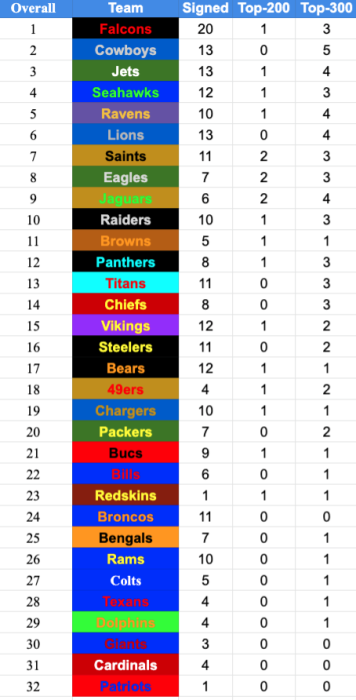
Thor’s NFC UDFA class rankings, UDFA prospect rankings overall, and sorted by position.