Anthony Richardson’s first three pro seasons have not gone as he or the Colts would have planned.
But it sounds like Richardson, the No. 4 overall pick of the 2023 draft, should be ready for the start of the offseason program in April after missing most of 2025 due to an orbital fracture from a freak pregame accident.
“He’s getting better,” General Manager Chris Ballard said during his scouting combine press conference on Tuesday. “I know he met with another specialist. He’s getting better. He’s been cleared to play football.
“I’m proud of him. I’m proud of Anthony, man. I mean, here’s a guy that’s had to deal with a lot of injury stuff that happens. Unfortunate accident with his eye. He doesn’t win the job, Daniel [Jones] wins the job. I think the one thing that I don’t know everybody appreciates about Anthony — I do and I know some of his teammates do — he’s a really good teammate. Positive, wants to do the right things. So, it’s trending in the right direction. Still got a ways to go, but he’s cleared to play. And the eye’s getting better. So, we’ll just work from there.”
Richardson briefly appeared in two games in 2025, playing just 14 offensive snaps.
While the Colts seem highly likely to decline Richardson’s fifth-year option this spring, Ballard maintains Richardson could still have a future with Indianapolis.
“I see a future, yeah. I’m not going to — kind of like with any player, you never know what’s going to happen. And things change,” Ballard said. “But, yeah. We like Anthony.”
Colts Clips


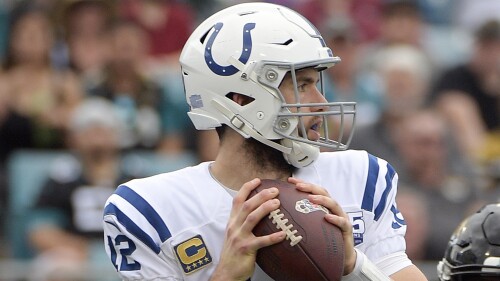


The Colts have two key offensive pending free agents who they’d like to retain going forward: quarterback Daniel Jones and receiver Alec Pierce.
General Manager Chris Ballard said at his scouting combine press conference that Indianapolis would prefer not to use the franchise tag for either player. But it’s an option if things don’t work out before both players hit the open market at the start of the new league year next month.
“It’s not what we want to do,” Ballard said. “It’s a tool we have. It’s not what we want to do, though.”
That’s part of why this week at the scouting combine is so critical, as agents come to town and start figuring out what the market will be for those pending free agents.
Ballard characterized discussions with both Jones and Pierce’s representation as “very positive.”
“We’ll continue to work this week and see if we can get something done,” Ballard said. “Look, when both sides are driven to get it done, it usually works out in the right way. I know four or five days doesn’t seem like a long time, but it can be in these situations.”
Jones stabilized the QB position for the Colts after years of inconsistent play at that spot, completing 68 percent of his passes for 3,101 yards with 19 touchdowns and eight interceptions before suffering a torn Achilles
Pierce, a second-round pick in 2022, has led the league in yards per reception over each of the past two seasons. He finished 2025 with a career-high 1,003 receiving yards and 47 receptions with six touchdowns.
The Colts have until March 3 at 4 p.m. ET to determine whether or not they’ll use the franchise or transition tag this offseason.
The Colts made a great move at quarterback last year, getting quarterback Daniel Jones on a one-year, $14 million deal. Now, they have a big decision to make.
Re-sign Jones, risk letting him become a free agent, or use the franchise tag?
The challenge when it comes to using the franchise tag is obvious. It’s not cheap. The projected 2026 franchise tag for the quarterback position is $47.3 million.
That’s a massive commitment, especially in light of Jones’s current health. He’s recovering from a torn Achilles tendon, with no guarantee that he’ll be 100 percent when the season starts.
On the other hand, they risk losing him to another team that would pay more than whatever the Colts might offer. And the Vikings, in theory, could be lurking.
Last year, the Vikings wanted to pair Jones with J.J. McCarthy. Jones believed that coach Kevin O’Connell would work his usual magic with McCarthy, making it unlikely Jones would play. In Indy, Jones received a full and fair chance to win the job from Anthony Richardson — and Jones did.
This time around, Jones may believe he has a chance to play in Minnesota.
The Vikings developed a high opinion of Jones during their limited time with him in 2024. Their opinion of him was sufficiently high that some believed Jones had a chance to leapfrog Sam Darnold during the playoffs, if the Vikings had managed to win the wild-card game against the Rams.
Regardless, Jones remains under contract with the Colts. They have a week to decide whether to tag him.
The transition tag is also available. It would cost $40 million for 2026, giving them only the right to match an offer sheet.
It all comes down to Jones’s true market. Would someone offer him $40 million per year? But for the Achilles injury, maybe.
That said, the Falcons gave Kirk Cousins $45 million per year in 2024, while he was recovering from the same injury. And the market, as Tua Tagovailoa once said, is the market.
The Colts need to figure out what the market for Jones may be, before deciding whether to apply the franchise tag.
The Colts have announced their coaching staff for the 2026 season.
Head coach Shane Steichen will have five new faces on that staff. The most significant addition is defensive line coach Marion Hobby. Hobby spent last season as a defensive analyst at his alma mater Tennessee and the former NFL defensive lineman has also been a position coach for the Bengals, Dolphins, Jaguars and Saints.
Strength and conditioning assistant Tyrell Brown, defensive quality control coach Jeremy Bruce, defensive quality control coach Dillon Doyle, and game management coordinator Aditya Krishnan are the other new hires. Performance science analyst Mikey Blazejowski, assistant defensive line coach Kalon Humphries, offensive quality control coach Diego Ortiz, and offensive quality control coach Brent Stockstill have new titles.
Defensive coordinator Lou Anarumo, offensive coordinator Jim Bob Cooter, special teams coordinator Brian Mason, linebackers coach James Bettcher, Harriet P. Irsay fellow Isabel Diaz, strength and conditioning assistant Zane Fakes, senior assistant special teams coach Joe Hastings, defensive backs coach Jerome Henderson, pass game coordinator/secondary coach Chris Hewitt, senior strength and conditioning coach Richard Howell, assistant to the head coach TJ Ingels, assistant linebackers coach Cato June, strength and conditioning assistant/performance therapist Sam Khym, tight ends coach Tom Manning, director of sports performance Mike Minnis, running backs coach DeAndre Smith, offensive line coach Tony Sparano Jr., passing game coordinator Alex Tanney, quarterbacks coach Cam Turner, assistant offensive line coach Mike Watt, and wide receivers coach Reggie Wayne return from the 2025 season.
Every year, the coaching carousel spins first. Then, the quarterback carousel whirls.
It’s coming soon. Veteran quarterbacks will be cut, traded, signed. Teams will reshuffle their depth charts with changes at the most important position on the team.
In a recent item about the potential contract prospects of Packers (for now) backup Malik Willis, some of the veteran options were listed. Here’s a look at the various teams that will have decisions to make regarding veteran quarterbacks currently on the roster, or to be added once the new league year begins.
Dolphins: They have a decision to make about Tua Tagovailoa. The Dolphins owe him $54 million in 2026. The two-year (or one-year, if they choose to rip the Band-Aid in one motion) dead-cap charge for cutting Tua would be $99.2 million. They need to decide what to do with Tua, and whether to add a veteran — like Willis. They’d surely love to find a way to trade Tua, even if it means selling some of the cap charge to another team by attaching a draft pick to Tua’s contract. And since they owe him every penny of his 2026 pay, they could choose to keep him around. (That would fully guarantee another $3 million for 2027, however.)
Jets: Justin Fields likely will be cut. Half of his $20 million salary for 2026 is fully guaranteed. They’ll likely be looking for a veteran, possibly on a short-term basis, to run new coordinator Frank Reich’s offense.
Steelers: They’re willing to wait for Aaron Rodgers, which would take them out of play for a veteran in the early days of free agency. Willis or Cousins could be intriguing options, if they find out before March 11 that Rodgers won’t be returning.
Browns: Who knows what they’ll do? Deshaun Watson is under contract for another year, at $46 million. Shedeur Sanders and Dillon Gabriel are, too. Will the new half-regime led by coach Todd Monken want a veteran from the outside?
Ravens: In the unlikely event the Ravens trade Lamar Jackson, they’d need a new quarterback — presumably one with starting experience.
Colts: Daniel Jones, who is recovering from a torn Achilles, likely will be back. Anthony Richardson has one year left on his rookie deal; he’s under contract for 2026 at guaranteed pay of $5.385 million. If Jones leaves, the Colts would need another veteran.
Raiders: They owe Geno Smith $18.5 million for 2026. Another $8 million becomes fully guaranteed on March 13. Would someone trade for him at $26.5 million? He could be cut. The Raiders also could keep him as the bridge to Fernando Mendoza, if they make him the first overall pick.
Vikings: They want a veteran who’ll compete with J.J. McCarthy. That could make it harder to attract a veteran who’ll want a commitment that he’ll be QB1. Based on McCarthy’s performance and durability in 2025, however, most veteran quarterbacks with reasonable confidence would believe they can win a fair and square competition. If they believe the competition will be both fair and square.
Falcons: They haven’t committed to Michael Penix Jr. being the Week 1 starter, and for good reason. Penix is recovering from his latest ACL tear. Cousins could, in theory, return after being released. That seems unlikely. Another veteran is possible for the new-look football operation led by Matt Ryan, Ian Cunningham, and Kevin Stefanski.
Cardinals: The moment Kyler Murray was placed on injured reserve with a foot injury that was supposedly healing, the message was clear — it’s over for Murray in Arizona. The Cardinals owe him $36.8 million for 2026, with another $22.55 million in 2026 pay and 2027 salary hitting the books early in the 2026 league year. If not traded, he’ll be cut. Willis could be an option for the Cardinals. Rodgers potentially could be a target, too.
With the Scouting Combine beginning soon, the carousel will start moving. Coaches and General Managers who take the podium on Tuesday or Wednesday will be asked pointed questions. Agents will meet with teams.
Four years ago, Malik Willis was favored to be the first quarterback in the draft. He wasn’t.
At pick No. 86, Willis went third among all quarterbacks, behind Kenny Pickett and Desmond Ridder.
It never really clicked for Willis in Tennessee, and he became expendable after two seasons. The Packers obtained Willis for a seventh-round pick not long before the start of the 2024 season.
While he has been the clear No. 2 to Jordan Love for the last two years, Willis has made the most of his limited opportunities.
In 11 appearances with four starts for the Packers, Willis completed 70 of 89 passes (78.6 percent) for 972 yards (10.92 yards per attempt), six touchdowns, and no interceptions. His passer rating was 134.64. He also has 261 rushing yards on 42 attempts (6.2 yards per carry) for three touchdowns.
Yes, the sample size is small. But, yes, the impact has been significant.
And he’s less than three weeks away from free agency.
Where he goes, and what he’ll get, becomes one of the more intriguing questions of free agency. The coming class of free-agent quarterbacks is headlined by Aaron Rodgers and Daniel Jones. One is 42, and the other is recovering from a torn Achilles tendon. Both are generally expected to return to their current teams (Steelers and Colts, respectively).
Other current free-agent options for quarterback-needy teams include Russell Wilson, Marcus Mariota, Joe Flacco, Tyrod Taylor, Pickett, Zack Wilson, and Jimmy Garoppolo.
The Kirk Cousins contract adjustment from January guarantees he’ll be cut on March 11 or 12, so he’s essentially a free agent. Kyler Murray and Tua Tagovailoa likely will be released, unless a trade can be worked out for either or both. The Jets also could move on from Justin Fields. And Mac Jones looms as a potential trade option, if the 49ers are willing to move him. (They say they’re not, but ‘tis the season for posturing.)
Then there’s Geno Smith, who already has $18.5 million fully guaranteed from the Raiders in 2026, with the remaining $8 million vesting on the third day of the 2026 league year. He could be available for trade, or he could be cut. (The Raiders also could keep him as the bridge to Fernando Mendoza, if they make him the first overall pick in the draft.)
Willis’s numbers are undeniable. Is he ready to be a full-time starter? And is a team ready to give him a starter-level contract?
As starter-level contracts go, the range is broad. The market tops, generally speaking, at $60 million per year. The bottom of the veteran starter market, as of last year, was $10.5 million for Russell Wilson (who started only three games). Fields has a $20 million average, and he received $30 million guaranteed on a two-year deal. (Fields also was eventually benched, after being publicly bad-mouthed by his thin-skinned owner.)
Sam Darnold, with only one viable suitor, received $33.5 million per year on a three-year deal from Seattle, which has quickly proven to be a steal. (In hindsight, he should have signed a one-year deal, like Jones did in Indy. With no other options, however, it wouldn’t have been easy to insist on a one-year commitment.)
Where will Willis fit? Much of it depends on the number of teams that pursue him. The Dolphins, who are now run by a pair of former Packers employees, are a team to watch — if they can wedge Willis’s contract into the cap wreckage of the Tua contract. The Cardinals, where Packers coach Matt LaFleur’s brother, Mike, is now the head coach, could make sense, too.
The Steelers could be an option, but they seem to be content to wait for Rodgers to make a decision. Which would take them out of play in the early days of free agency. The Vikings will be looking for a veteran to compete with J.J. McCarthy.
And don’t rule out the Ravens. If (and it’s not a big if but it’s still on the radar screen) they trade Lamar Jackson, they’ll need a quarterback, too.
Other teams that will or at least could be looking for a veteran quarterback include the Jets, Browns, Colts (if Jones leaves), and Falcons.
Someone surely will want Willis. The more teams that want him, the more money he’ll make.
The process will accelerate next week in Indianapolis, where every team will meet with every agent who represents every looming free agent in an annual swap meet of untraceable tampering that happens with no electronic footprints or popcorn trail.
Our guess is that Willis will land between $20 million and $30 million per year — unless a land rush emerges. If that happens, who knows? $35 million? $40 million? (While $40 million sounds like a lot, it’s still only 66.6 percent of the current market limit.)
Or maybe Willis will have the leverage and willingness to insist on a one-year deal that pays him a relatively modest salary but gives him another shot at free agency in 2027. (A no-tag clause would be even better, if not virtually impossible to finagle on a one-year deal.)
However it goes, it’s a story that isn’t getting the kind of attention it should, or that it will once teams start jostling for a chance to see whether Willis can do on a full-time basis what he did as a part-timer for the Packers.
His numbers suggest that he could be not just a capable starter but a potential superstar. With true franchise quarterbacks so hard to find, why wouldn’t someone roll the dice on the possibility of landing a player who could become one of the best quarterbacks in the league?
Colts wide receiver Alec Pierce set career highs in catches and receiving yards during the 2025 season and that sent him into a pivotal offseason on a positive note.
The 2025 season was the final year of Pierce’s rookie deal in Indianapolis and it sets him up to be one of the top wideouts on the open market when free agency gets underway in March. The Colts could keep him off that market by re-signing him, but they’ll have to offer him more than what Pierce believes he can get on the open market.
Time will tell how hard the team pushes on that front, but Pierce told SiriusXM NFL Radio that he’s expecting a big offseason one way or another.
“I think it’s gonna be a lot of good things in front of me,” Pierce said. “We’ll see, this next month might be crazy. We’ll see what ends up happening.”
Pierce has averaged 21.75 yards per catch over the last two seasons and his production as a big-play threat will land him a significant payday somewhere next month.
The NFL filed a grievance over the NFL Players Association’s annual report cards in order to keep the NFLPA from publicizing criticisms of teams and owners. The NFL won a ruling preventing the NFLPA from doing so.
Still, the 26-page ruling from arbitrator Scott E. Buchheit, a copy of which PFT has obtained, makes it clear that the next wave of report cards may be disseminated to all players.
The opinion also includes a full list of the criticisms about which the NFL complained from the 2025 report cards.
Here’s the full content of relevant portions of Buchheit’s written decision.
“As to the individual comments contained within the Report Cards that lead to the letter grades, the NFLMC has richly detailed that they do contain numerous criticisms. These include, but are not limited to, the following examples from the 2025 Report Card that are contained in its brief:
“New York Jets: The Union said Players complained that ‘management responded to feedback [from prior Team Report Cards] by making conditions worse,’ including cutting the food budget and not retaining a long-time dietician after poor food grades the prior year. The Union also graded owner Woody Johnson an F — the lowest owner rating in the league, 5.58 out of 10 — which, according to Players, resulted from his perceived unwillingness to invest in facilities. . . . Players cited ‘perceived top leadership issues, with some describing issues as “top-down problems”'—reflecting ownership concerns.
“Cincinnati Bengals: The Union again criticized treatment of families, stating that Players called it a ‘major concern’ and saying there is ‘little to no effort’ to support families. ‘One player describes the treatment of families as “‘almost disrespectful,”’ resulting in a grade of F-minus.
“Buffalo Bills: The Union dropped the Club in the overall rankings from prior years because ‘issues . . . previously raised [by Players] . . . have not been addressed and thus have become greater concerns[.]’ The Union claimed Players were concerned that ‘current [training] staffing is inadequate to help them recover,’ and ‘travel continues to be the worst part of their experience’ because they ‘do not have a comfortable amount of space when traveling and the travel schedule itself is a source of significant dissatisfaction.’
“Arizona Cardinals: The Union ranked the Club last overall based on Player feedback, criticizing the treatment of families (lack of family events, limits on pregame sideline access, poor in-game family accommodations), and a so-called deficient locker room, training facilities, and weight room. The Union stated that Players also faulted owner Michael Bidwill, saying he ‘slightly contributes to a positive team culture’ and is only ‘somewhat committed to building a competitive team[.]’
“Philadelphia Eagles: The Union highlighted that Players ‘are frustrated that mealtimes overlap with the organization’s business staff, leading to crowding and limited seats,’ and ‘feel they should get first class seats on team flights instead of the coaching staff.’
“Tampa Bay Buccaneers: The Union published that Players criticized the locker room, lodging ‘several complaints about cleanliness, including poor ventilation and a persistent bad smell.’
“Jacksonville Jaguars: The Union gave the Club an F for treatment of families; ‘Players believe that many changes need to be made,’ including more access to sideline passes, a family room during the game, and upgrades to the post-game family area.
“Kansas City Chiefs: The Union said Players ‘continue to express the need for renovation and upgrades to the locker room’ and criticized the home game hotel as the ‘lowest in the league,’ remarking that it is ‘outdated,’ the beds are ‘uncomfortable,’ and the floors are ‘dirty and sticky.’
“Carolina Panthers: The Union continued to cite Player criticisms of owner David Tepper for using ‘turf instead of grass, perhaps because it is cheaper to maintain,’ and complained about travel due to the ‘new coaching staff moving players from first class last season and placing them in smaller, coach seats.’
“New England Patriots: The Union gave the Club a failing travel grade and singled out the ‘team plane’ —'Players specifically responded that “our plane is the worst thing – size, space, [and] safety,”’ and ‘it is not conducive to preparedness for athletic performance,’ because, among other things, ‘it lacks Wi-Fi and still has ashtrays in the seats.’ One player also referred to the carpeting in the locker room as ‘dingy with pieces missing.’
“Indianapolis Colts: The Union stated that Players complained of travel arrangements, noting that they ‘don’t feel like they have enough personal space on flights. They want more access to first-class seating.’
Those are the full complaints from the 2025 report cards that were included in Buchheit’s decision. Eleven teams in all were mentioned, with three owners identified by name — Woody Johnson, Michael Bidwill, and David Tepper.
The complaints listed in the 26-page ruling come from not from the to-be-released report cards but from the report cards prepared and published in 2025. It’s inevitable, however, that one of the many NFLPA members who’ll receive the 2026 report card will disclose them, to someone. Once they’re leaked (to PFT or to another outlet), we’ll post them here in full.
UPDATE 11:46 p.m. ET: An earlier version of this article mistakenly characterized the complaints listed above as coming from the survey conducted in 2025, not from the report cards released in 2025. The 2025 surveys were not included in Buccheit’s opinion. They’ll eventually be released to the players but not published by the NFLPA. In past years, the report cards were released during the Scouting Combine.
The Colts are hiring Marion Hobby as their defensive line coach, Matt Zenitz of CBS Sports reports.
Hobby only became Arkansas’ defensive line coach in December.
He has 10 years of experience in the NFL, including four seasons (2021-24) in Cincinnati with current Colts defensive coordinator Lou Anarumo. Trey Hendrickson recorded a combined 35 sacks in the 2023-24 seasons.
Hobby spent the 2025 season at the University of Tennessee, his alma mater, serving as a defensive analyst for the Volunteers. He helped the Vols rank fifth nationally in sacks per game (3.0) and 13th in tackles for loss per game (6.8).
His other NFL experience includes stints with the Dolphins (2019-20), Jaguars (2017-18) and Saints (2006-07).
It’s convenient to drag the Vikings for not re-signing quarterback Sam Darnold a year ago. But the Vikings were far from alone.
Multiple other teams could have pursued Darnold as a free agent. They didn’t.
The Steelers opted for Aaron Rodgers. The Raiders traded for Geno Smith. (Tom Brady reportedly didn’t want Darnold.) The Jets overpaid Justin Fields (not that they could have brought back Darnold). The Colts went with Daniel Jones as the alternative to Anthony Richardson.
The Seahawks, after getting a third-round pick for Smith, pivoted to Darnold. They signed Darnold to a three-year, $100.5 million deal. He’s making $33.5 million per year, nearly half the amount of the open market.
He’ll make $27.5 million in 2026 and $35.5 million in 2027. Darnold received $37.5 million in 2025, with a cap number of only $13.4 million. His cap number increases to $37.9 million in 2026 and $41.9 million in 2027.
It was, and is, a steal for Seattle. One that, given his performance and the team’s achievements in 2025, justifies a new deal, much sooner than later.
The contract was a great one for the Seahawks. They bought low. The fact that Darnold grossly outplayed the deal counts as a good problem to have for the Seahawks.
Regardless, it’s time to pay the piper — if the Seahawks regard Darnold as the short- and long-term answer at the quarterback position.