I just love to see all of these talented starting pitchers making some noise early on. Nestor Cortes is shocking the world with his four-seam fastball/cutter combo, Jesus Luzardo has been taking steps in the right direction, Kyle Wright looks filthy, and Michael Kopech is starting to get more and more comfortable as a starter. It looks like we’re in store for a season that could be filled with pitching breakouts and a lot of these pitchers were easily attainable before the season began.
If I had to guess, I’d say that there will be even more pitchers who start to exceed expectations as the season progresses. And a lot of these pitchers could be sitting on waiver wires right now, waiting to be picked up. There will always be waiver wire breakouts and acting early enough to profit off these breakouts is how you win your leagues. In this week’s points league waiver wire piece, I highlighted a few pitchers who could help boost your championship chances.
Points League Options
(Players rostered in under 50 percent of ESPN leagues)
Matt Brash SP, Mariners (30 percent rostered)
When he was drafted 113th overall in the 2019 MLB Draft by the Padres, not everyone believed that Matt Brash would eventually become a starter. His violent delivery and inconsistent command of his breaking pitches didn’t instill much hope that he’d be able to be a perennial rotation arm. Moreover, when right-hander Taylor Williams was traded to the Padres in summer 2020 for Brash, Brash was listed as ‘the player to be named later’. In other words, a throw-in. Maybe Brash took that personally, because over his 97 ⅓ innings pitched as a minor leaguer in the Mariners’ system, he earned a 2.31 ERA (3.18 FIP), a 1.14 WHIP, and a 142/48 K/BB (23.2% K-BB). The Mariners believed that they’d seen enough and coming out of spring training, Brash was awarded with the fifth spot in the Mariners’ rotation to begin the season. Through his first three career MLB starts (15 innings), the 23-year-old right-hander has a passable 4.20 ERA (4.90 SIERA).
Armed with a devastating slider that some call a slurve, a four-seam fastball that has some late ride and can now touch 97-99 mph, a knuckle curve that has well above average vertical movement, and a developing changeup that he throws to his glove side and can be effective against left-handed hitters, Brash’s arsenal is full of putaway pitches. His fastball was sitting low-to-mid 90s to start his minor league career, but he reportedly thanks the canceled 2020 minor league season for his velocity gains. Apparently, he added some weight during 2020 while continuing to work on his mechanics, and this resulted in increased fastball velocity.
Additionally, because he throws all of his pitches with the same intensity, but with different grips, his fastball tunnels naturally with his secondary pitches, which makes it difficult for a batter to pick up on what Brash is throwing before it’s too late. However, Brash will likely continue to deal with inconsistencies with his command for the time being. As aforementioned, he has a violent delivery, and his high-movement pitches sometimes leads to him not being able to properly locate his offerings. He had a 11.3% walk rate in his minor league career and in his second MLB start, he issued six walks.
But over time, I can see his command becoming sharper and his production becoming more reliable. If Brash’s command does reach another level in time, he could easily become one of the most dominant pitchers in MLB. All in all, for 2022, it’s fair to expect a handful of more high-walk outings. He still makes for a strong waiver wire addition given his stuff and overall profile, but don’t expect high-end results every time he takes the mound. He’s still a work in progress – an exciting work in progress.
Austin Nola C, Padres (27 percent rostered)
It’s not often that I’ll recommend picking up a catcher, but I strongly believe that Nola possesses more fantasy value than some think. The older brother of Phillies’ star Aaron Nola, Nola was drafted 167th overall in the 2012 MLB Draft by the Marlins. He played in Miami’s farm system from 2012-2018 before signing a minor league contract with the Mariners in late-2018. Then, in 2019, he made his MLB debut. Over the first 238 at-bats of his MLB career, he slashed .269/.342/.454 with ten home runs and a stolen base. Given his ability to play all over the infield, the Padres decided to trade for the utility man in summer 2020 and as it currently stands, he’s the primary catching option in San Diego.
Nola’s always possessed a good eye at the plate, but his average bat speed, below-average sprint speed, and below-average game power (23 home runs over 2,687 minor league at-bats) have limited his offensive production up to this point. Beyond that, injuries, inconsistent playing time, and the shortened 2020 season have limited Nola to just 195 games played since he made his MLB debut in 2019. Fortunately, he’s now healthy and over the first 42 at-bats of 2022 – starting primarily at catcher – the 32-year-old is slashing .262/.327/.333 with a home run, a 6.1% walk rate, and a 14.3% strikeout rate. As per usual, he’s been hitting the ball hard (39.9% hard-hit rate over 499 career batted ball events) and he’s been making a lot of contact (career 83.3% contact rate). He doesn’t barrel the baseball often, but he’s more than capable of racking up hits that leave his bat at 95+ mph. If he continues to play regularly and if he can remain healthy, Nola could set career highs across the board in 2022. It’s unlikely that we see 20+ home runs, but a .275/10-20 finish is in the cards. If you’ve been looking for a reliable – albeit unspectacular – option at catcher, give Nola a look.
Jameson Taillon SP, Yankees (23 percent rostered)
After being forced to undergo his second career Tommy John surgery in summer 2019 – a couple years after being diagnosed with testicular cancer – Taillon’s perseverance was once again being tested. Thankfully, he survived his ordeal with cancer and in 2021, he made his return to the mound. Over 144 ⅓ innings pitched, he finished with a 4.30 ERA (4.33 SIERA) and a 1.21 WHIP. The results could’ve been better, but the fact that he was able to return to the mound and compete makes his 2021 season a success regardless of how he fared from a statistical standpoint.
Coming into the 2022 season, Taillon was expected to provide solid depth at starting pitcher for fantasy teams and through three starts (14 ⅔ innings), he has a 3.07 ERA (3.04 SIERA) and a 20.3% K-BB. He’s yet to allow more than two earned runs in a start and he’s been attacking the zone, especially with his fastballs, curveball, and slider, which has led to a 13/1 K/BB. Taillon has never been a true strikeout artist, and he likely never will be, but his high-spin, mid-90s four-seam fastball was key for him in 2021 and it’ll have to be key for him again in 2022. He understands how to locate it routinely at the top of the strike zone – which is the best way to use high-spin fastballs – and it helps set the tone for the rest of his pitches. His four-seam fastball command hasn’t been as sharp as last season through 14 ⅔ innings, but he’s still managed to produce nonetheless. As the season progresses, Taillon should continue to provide 5-20 points a start, with the occasional poor outing. I know that he doesn’t possess the most upside, but you simply cannot have enough reliable starters on your points league rosters.
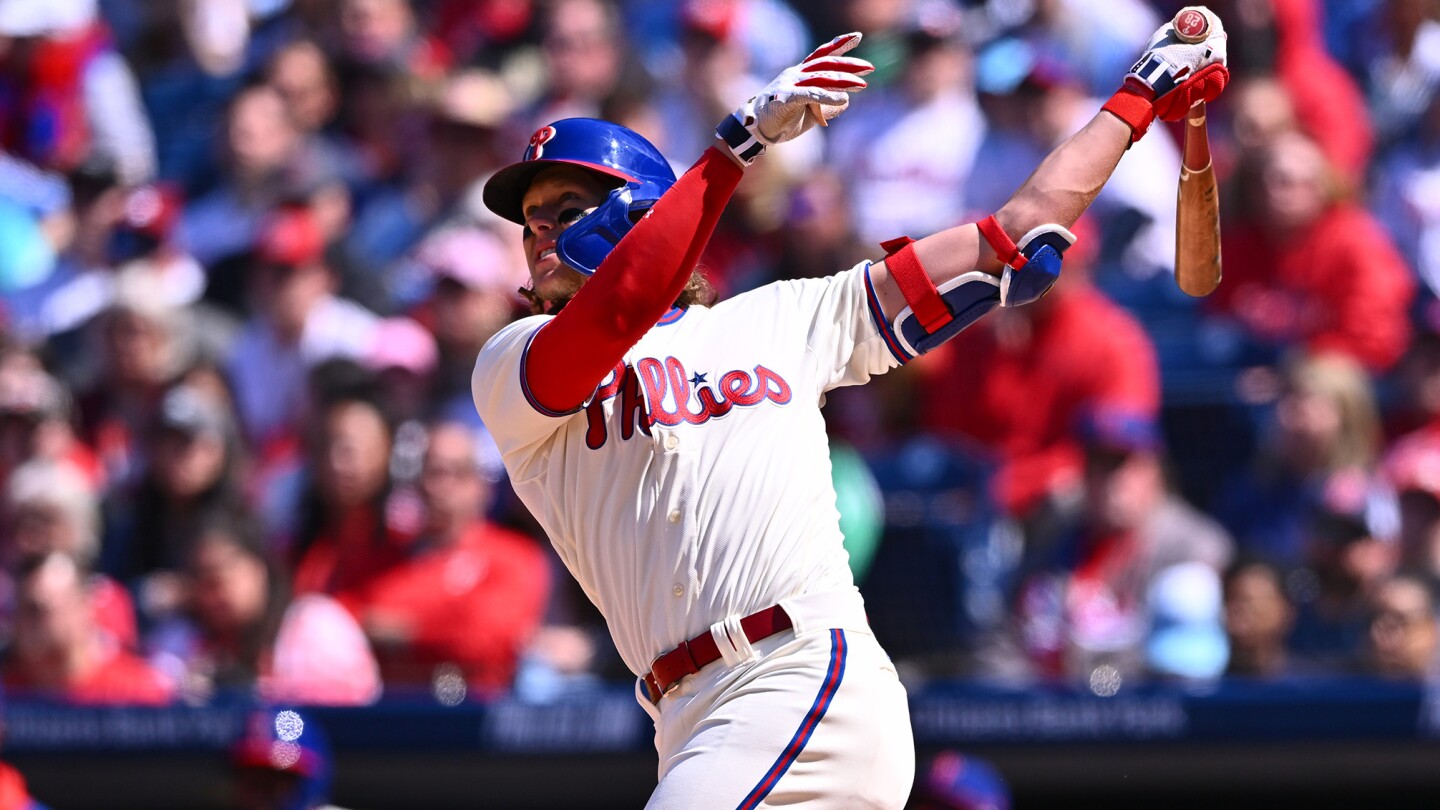
Alec Bohm 3B, Phillies (18 percent rostered)
Yes, his defense at third base isn’t the best – and that might be me just being polite. But through his first 13 games of the season (36 plate appearances), Bohm is slashing .393/.417/.571 with a home run and a 4/4 K/BB. His quality of contact skills have remained above average (53.6% hard-hit rate and 10.7% barrel rate over 28 batted ball events) and it’s becoming more and more clear that Bohm’s bat needs to be in the lineup.
Drafted third overall in the 2018 MLB Draft by the Phillies, there’s always been high expectations surrounding Bohm. His above-average bat speed, control of the strike zone, and bat-to-ball skills help him regularly make loud contact while demonstrating strong plate discipline skills. Furthermore, he’s never been a pure power hitter. He takes what’s given to him and hits it hard. Additionally, he doesn’t chase many pitches outside of the zone thanks to solid pitch recognition skills, which allows him to hone in on the pitches he likes and put them into play. In short, he has a rather conventional plate approach that’s backed by above-average natural tools.
Because of his conventional approach, he doesn’t try to sell out for power, which has resulted in him having a 5.3° average launch angle and a 52.9% groundball rate through the first 427 batted ball events of his career. If he ever decides to change his approach and intentionally add more loft to his swing, he’ll easily eclipse 20 home runs over a full season. But for now, Bohm’s current approach will likely lead to an above-average batting average with 10-20 home runs over a full season. Nevertheless, if you’re looking for a third baseman who has true breakout potential, take a chance on Alec Bohm.
Deep Points League Options
(Players rostered in under 10 percent of ESPN leagues)
Rowdy Tellez 1B, Brewers (9 percent rostered)
It’s always been about power for Rowdy Tellez. It’s easily his best tool, but a questionable hit tool, below-average defensive skills, and a lack of speed given his large physique (6-foot-4, 255 pounds) have limited his opportunities to play regularly at the MLB level. Fortunately, his defense at first base has improved as he’s gained more experience and to start the 2022 season, he’s made 13 starts at first base for the Brewers.
Offensively, he’s already smacked three home runs over his first 44 at-bats. His .227 batting average isn’t ideal, but his .297 expected batting average tells us that he’s deserved better. In most points leagues, home runs are the highest-scoring batted ball event. A lot of batters who have high-end power upside tend to also have poor plate discipline skills that result in a lot of strikeouts. But that’s not who Rowdy Tellez is. Over 981 career major league plate appearances, he has a 23.5% strikeout rate. And through his first 47 plate appearances of 2022, his strikeout rate is sitting at 19.1%. A 23.5% strikeout rate is still slightly below average, but when you observe the strikeout rates of batters who have similar power upside, it doesn’t look too bad. If Tellez can reach around 400 at-bats this season, he could set a career high in home runs. Don’t overlook the 27-year-old slugger.
Chris Paddack SP, Twins (8 percent rostered)
After Chris Paddack finished with a 3.33 ERA (3.83 SIERA), a 0.98 WHIP, and a sparkling 153/31 K/BB (21.5% K-BB) in his rookie season (140 ⅔ innings), many expected him to only continue to improve moving forward. They couldn’t have been more wrong. Over his last 176 ⅓ innings pitched, he has a 4.95 ERA (3.96 SIERA), a 1.25 WHIP, and a 164/34 K/BB (17.5% K-BB). It’s clear that he’s still been able to limit free passes (5% walk rate over 317 career innings) given his above-average command, but why hasn’t he been able to limit runs like he did in his rookie campaign? Simply put, his four-seam fastball was a very hittable pitch in 2020-2021.
His fastball had a .413 weighted on-base average against it in 2020 and a .373 weighted on-base average against it in 2021. His command of the pitch wasn’t as sharp from 2020-2021 as it was in 2019 and because he was still primarily a two-pitch pitcher, he became a more predictable pitcher. What’s more, his first-strike percentage decreased in 2020-2021 when compared to 2019, meaning that hitters were able to sit on his fastball when Paddack fell behind in counts. With a limited arsenal, your command has to be pinpoint — especially your fastball command — otherwise you’ll start to become a more predictable pitcher. Then, when you think about how his fastball has below-average spin and doesn’t have elite velocity, you start to see that Paddack has to use his fastball almost perfectly to be consistently effective.
Now a member of the Twins, Paddack has given up five earned runs over his first two starts of the season (nine innings). He hasn’t walked a batter (7/0 K/BB) and he hasn’t been giving up much hard contact (32.2% hard-hit rate). The most notable change is that his curveball has a career-high 21.5% usage rate. Giving batters another pitch to worry about will only make Paddack become a more effective pitcher. On top of that, he’s been commanding his pitches well. I can envision a scenario where Paddack becomes a very useful bench piece in points leagues. And given his current rostership percentage, there’s a good chance that he’s sitting on the waiver wire in your leagues right now.