$1,000,000 up for grabs. Download the NBC Sports Predictor app and play SN7 for FREE! Get started here!
Welcome to the Friday Walkthrough. Every week I’ll be outlining critical fantasy football context for the upcoming slate of games.
At the end of the article, I’ve included an extensive list of the stats used as well as what they are, why they’re useful, and where they came from.
Byes: None
Already Played: Already Played: None
—
Rams at Ravens, 1 PM Eastern, Sunday
Rams Implied Team Total (from PointsBet): 26
Matthew Stafford struggled against the Vikings, turning in his second-worst week in EPA* per play (which measures efficiency) and completion percentage over expected (which measures accuracy).
The Rams are usually dependent on Stafford to win games. They have a 4% pass rate over expected this season, which is tied with the Packers for the fifth highest in the league. Meaning, accounting for game script and situation, the Rams are a pass-first, borderline pass-heavy team.
But Los Angeles still managed to put up 30 points in Week 16 and pull out a win by pivoting to a run-first approach, finishing the week with a -3% PROE.
This week, the bad news is that a similar pivot to the run is unlikely to work. The Ravens rank fifth in EPA allowed per rush and ninth in Pro Football Focus’ run defense grades. They’ve faced a middle-of-the-road rushing schedule and are a legitimate run defense.
The good news is that Baltimore is extremely vulnerable through the air. The Ravens rank dead last in EPA allowed per rush, 18th in pass rush grade, and 27th in coverage grade. After Joe Burrow‘s Week 16 explosion against them, the Ravens have now allowed as many 15+ yard passes as the Jets—which ties them for the most allowed in the league.
Stafford may have struggled against the Vikings, but he ranks fifth in EPA per play this season. He’s plenty capable of taking advantage of an extremely favorable matchup.
Cooper Kupp obviously has a massive ceiling if Stafford gets back on track. He has an absurd 3.13 yards per route run, which leads the NFL. He also has a 33% target share and a 33% air yard share, which ties him with A.J. Brown for the NFL’s third-highest weighted opportunity rating (WOPR).
This week, Kupp’s 8.6 aDOT doesn’t make him the best bet to beat the Ravens downfield, where they are weakest. But Kupp can still have a massive week as the engine of the Rams passing attack even if Stafford is connecting with other receivers deep. As Joe Burrow showed last week, a talented quarterback can support multiple weapons against this secondary.
Odell Beckham looks like a spike week in waiting. He has just 7.3 yards per target since joining the Rams, which is very poor for his 14.1 average depth of target (aDOT). But YPT is not very sticky and is mostly an indicator of target depth. Targets per route run is a much more stable metric, and Beckham is earning targets on 20% of his routes, which is a very strong rate for his 14.1 aDOT. The bottom line is that Beckham is earning downfield targets at a high rate and is now facing a defense that can’t stop downfield targets. He doesn’t need a spike in volume to have a huge week; he just needs to be efficient in an ideal matchup.
Van Jefferson is also set up well as a deep threat. Jefferson has a very similar 14.2 aDOT and could benefit from the plus matchup as well. But his target profile is decidedly worse than Beckham’s, with a 15% target rate to Beckham’s 20%. But like Tyler Boyd showed last week, the third option in a strong passing game has a high ceiling in this matchup.
Tyler Higbee is in play as a TD-dependent option. But he only has a 5.3 aDOT, so he won’t be part of the downfield fun. And he only has 1.00 YPRR, so he’s not likely to be efficient, even as an underneath option.
Sony Michel will be in for a more difficult matchup than against the Vikings, but last week showed that the Rams are willing to lean on him. And with Darrell Henderson out with a knee injury, the Rams have no choice but to rely on him as their workhorse RB this week. Michel handled 90% of snaps in Week 16, with Henderson taking 7% of snaps. He should be an absolute workhorse against the Ravens and profiles as a volume-based RB1.
*(Expected Points Added, EPA, is an efficiency metric that calculates the expected points of a game situation compared to the previous play. This measures how much each play added or subtracted from a team’s point expectation. I exclude garbage time for all EPA data in this article and used adjusted EPA per play, which caps the penalty for negative plays. Data courtesy of rbsdm.com)
Ravens Implied Team Total (from PointsBet): 20.5
Lamar Jackson looks unlikely to play this week, putting Tyler Huntley in line for another start. Huntley was excellent against the Packers in Week 15, finishing fourth in EPA per play and fifth in CPOE. But he was far less impressive against the Bears and Browns and ranks 33rd in EPA per play and 19th in CPOE for the season.
He’s going against a challenging Rams pass defense that ranks sixth in EPA allowed per dropback, first in pass rush grade, and 14th in coverage grade. As a result, Huntley will have a tough time fully recapturing his Packers-game magic.
But Huntley won’t stop running. Despite playing less than four complete games, Huntley ranks QB17 in rushing yards. And in his last three games, he’s averaging 53 rushing yards per game. We can count on Huntley to use his legs.
We can also count on Huntley to lock onto Mark Andrews. Huntley has been the leading passer in three games for the Ravens, and Andrews has seen target shares of 34%, 30%, and 32% in those games. Huntley has also targeted Andrews deep, allowing him to post air yard shares of 61%, 24%, and 52%. This is news to exactly no one, but Andrews is an elite tight end.
Huntley has also been targeting Marquise Brown at a high rate. Brown has seen target shares of 31%, 20%, and 38% with Huntley. Oddly, Huntley hasn’t targeted Brown deep nearly as often as Andrews, with aDOTs of 7.2, 13.3, and 4.4. Brown didn’t suddenly become slow, so this is likely small sample size noise. His season-long 23% target rate is identical to Andrews’, and Brown has a deeper 11.9 aDOT than Andrews’ 10.8. Andrews looks to have better chemistry with Huntley, but Brown looks like an interesting contrarian pivot in this game.
The Rams are stout against the run, ranking sixth in EPA allowed per rush and first in run defense grade. That’s not great news for Huntley, and it makes both of the Ravens’ committee running backs poor bets.
Eagles at Washington, 1 PM Eastern, Sunday
Eagles Implied Team Total (from PointsBet): 24.5
The Eagles are firmly a run-first team, with a negative PROE in every game since Week 7. But the Eagles have been slightly less run-heavy over the previous two weeks, with one of those games coming against Washington, their opponent this week.

screen_shot_2021-12-28_at_5.42.14_pm.png
It makes sense that the Eagles were open to passing against Washington in Week 15. Washington is the NFL’s third-biggest pass-funnel, behind only the Buccaneers and Ravens.
Teams are passing against Washington because they can’t stop it. Washington ranks 28th in EPA allowed per dropback and 30th in coverage grade. Their pass rush (currently ranked 12th) has also declined since losing Chase Young.
Jalen Hurts ranks just 26th in EPA per play and 30th in CPOE, so he may not take full advantage of the matchup. But he should see a boost in both efficiency and volume this week.
DeVonta Smith is coming off a nice week and would be the biggest beneficiary of a strong day from Jalen Hurts. Smith has a respectable 1.71 YPRR, and his deep threat 14.9 aDOT gives him the ability to have a nice game even if the Eagles remain a low volume passing attack. He profiles as a high-end WR3.
Dallas Goedert is running extremely hot with an 11.7 YPT on an 8.4 aDOT, making him a riskier bet than Smith. Goedert also ran a route on 70% of dropbacks last week, down from 88% in Week 15. The team may be interested in seeing what it has in Tyree Jackson, who ran a route on 17% of dropbacks last week. Goedert now faces a negative regression headwind and has risk of another sub-elite route rate. He’s still a solid season-long option but makes for a risky DFS play.
The Eagles will likely remain run-first, but they will be without their starting running back. Miles Sanders is out with a broken hand, leaving
Jordan Howard in line to start. But Howard is questionable with a stinger. If Howard sits, Boston Scott becomes very interesting. Kenneth Gainwell played just 3% of snaps against the Giants. Scott played 32% of snaps with B.T. Sanders and Howard exiting the game. Scott hasn’t played particularly well this season, but it seems clear that he’s well ahead of Gainwell. He’s a strong volume-based play if he has the backfield to himself. The Eagles rank second in adjusted line yards (Football Outsider’s run blocking metric), and a workhorse back with an elite offensive line on a modest favorite is an enticing option.
If Howard plays, he profiles as more of an RB2 fill-in. Scott is likely to have a committee role, and it’s tough to see Howard hitting a ceiling without running very hot on goal line opportunities.
Washington Implied Team Total (from PointsBet): 20
Washington’s coaches have tried their best all season to get the most out of Taylor Heinicke. Heinicke ranks third in play action rate behind only Tua Tagovailoa and Lamar Jackson. Washington also utilizes RPO on 16% of their plays and motion on 53%, both of which are well above league average.
These bells and whistles helped hide the fact that Heinicke is a limited quarterback. But Heinicke’s last two games have come against Dallas’ elite pass defense; they did not go well.

screen_shot_2021-12-28_at_6.06.02_pm.png
Ron Rivera has stated that we’ll probably see Kyle Allen in Week 17, which makes sense given how bad Heinicke has been over the last two games. But Heinicke has been very solid when facing less formidable defenses than the Cowboys. He ranks 20th in EPA per play this season, which is not good. But even after the last two weeks, he doesn’t profile as a total disaster, ranking between Teddy Bridgewater and Baker Mayfield.
The Eagles defeaTed Washington in Week 15, but with Garrett Gilbert at quarterback. Heinicke has a good chance to rebound here, with this matchup setting up Washington for a run-first, play-action-heavy game plan.
The Eagles are competent against the pass, ranking 14th in EPA allowed per dropback, fourth in pass rush grade, and 12th in coverage grade. But the Eagles have faced an easy slate of passing matchups, and Heinicke should be able to play well enough to keep his job here unless Washington is set on seeing Allen this week.
If Washington can muster some efficient quarterback play, there’s a good chance that Terry McLaurin can come back to life this week. McLaurin is down to 1.72 YPRR, which is well below his typical elite efficiency. But McLaurin has an elite 22% target rate for his 14.5 aDOT. McLaurin just needs competent quarterback play to rehab his poor 7.9 YPT. He’s in play as a high-end WR3.
With John Bates and Ricky Seals-Jones now splitting what was once a one-man role, Washington’s tight end is off the fantasy radar.
The Eagles rank 10th in EPA allowed per rush and 18th in run defense grade, so they’re competent. But Philadelphia has had an easy schedule and is unlikely to shut Washington down on the ground.
Although, the Eagles will have an easier time of it than they thought they might, with Antonio Gibson on the Covid list. Gibson will be replaced by Jaret Patterson. Patterson has a tiny sample this season but has yet to flash in any real way. And he will likely be in a committee with JoNathan Williams and Wendell Smallwood. Patterson has a path to RB2 value, but he also has a path to getting boxed out of goal line work by Williams and receiving work by Smallwood. He’s a desperation RB2 option but has more ceiling than those plays usually come with.
Dolphins at Titans, 1 PM Eastern, Sunday
Dolphins Implied Team Total (from PointsBet): 18
I think it’s fair to say that Tua Tagovailoa is a somewhat limited quarterback. But the things he does well, he does very well.
Tagovailoa ranks QB37 in aDOT; only Jared Goff and Mike White are more shallow passers; only Matt Ryan and Daniel Jones have attempted deep passes at a lower rate.
If a quarterback doesn’t throw deep, he needs to be highly accurate, and Tua is. Tagovailoa ranks fourth in CPOE; only Aaron Rodgers, Kyler Murray, and Joe Burrow have been more accurate this season.
The Dolphins have built their offense around Tagovailoa. They have a 3% pass rate over expected and rank seventh in situation-neutral pass rate. To some extent, they don’t have much choice. Miami ranks 30th in adjusted line yards and 31st in EPA per rush. Even if the Dolphins prefer not to lean on Tagovailoa, they’ll likely continue to implement a pass-first approach outside of cupcake rushing matchups.
Credit to the Dolphins coaches, by the way, for calling play action for Tagovailoa at the highest rate in the league, despite a bottom-of-the-barrel rushing attack. Faking the run is still beneficial even if the run game isn’t much of a threat.
The Titans are solid against both the run and the pass, ranking 11th in EPA allowed per rush and 12th in EPA allowed per dropback. But teams are attacking them primarily through the air, averaging a 3% pass rate over expected against them and shifting 3% to the pass. After being run-first over the last two weeks, the Dolphins will likely get on board with a pass-first script in this matchup.
Additional volume is excellent news for Jaylen Waddle, who is coming off 12 targets and a 46% target share against the Saints. Waddle also ran a route on 100% of dropbacks. There is zero doubt he is the Dolphins’ WR1. Waddle is now up to 1.83 YPRR, which is very strong but not elite. Although, given Waddle’s 7.0 aDOT and his 25% target share, it’s hard not to be excited about his PPR floor; his playmaking ability and the potential for a target volume surge provide a ceiling. He looks like a locked-in WR2.
DeVante Parker and Mike Gesicki are less appealing options than Waddle, but Parker leads the team with a 34% air yard share, and his 12.6 aDOT puts him in play as a FLEX option.
Gesicki ran a route on 93% of dropbacks last week and was targeted 20% of his routes with an 8.7 aDOT. He’s a sneaky good play this week as a low-end TE1.
The Dolphins backfield has devolved into a committee with Duke Johnson and Phillip Lindsay in an early-down timeshare and Myles Gaskin in a receiving role. Unfortunately, this usage robs all three backs of their fantasy value.
Titans Implied Team Total (from PointsBet): 21.5
Ryan Tannehill hasn’t been hyper-efficient this season, as he has been in years past, but he’s been solid. He ranks 11th in EPA per play and ninth in CPOE.
From 2019-2020 Tannehill ranked third in EPA per play behind only Patrick Mahomes and Aaron Rodgers. Even with A.J. Brown back, he isn’t likely to get back to those heights this year. The Titans are simply not running play action like they used to.
Tannehill ran play action on 36% of his dropbacks in 2020; he’s down to 27% this year. The Titans also remain a run-first team, which limits Tannehill’s volume. They have a -7% pass rate over expected, which is the lowest in the NFL. They also rank 31st in situation-neutral pass rate. Without hyper-efficiency, Tannehill’s path to spike weeks is narrower than it used to be.
Fortunately, the Dolphins are a pass-funnel. Teams are averaging a 2% pass rate over expected against them and are shifting 2% to the pass. So Tannehill should at least see a small bump in volume. Tannehill is also well suited to handle the Dolphins pass defense.
Miami ranks third in EPA allowed per dropback but has had an extremely easy schedule that includes the Panthers, Saints, Jets (twice), Jaguars, Texans, and Giants. Seven of their 15 games have come against bottom seven passing offenses. And the thing about Miami’s defense is that it is ideally suited to feast on weak quarterback play.
The Dolphins lead the NFL with a 43% blitz rate. Since losing to the Bills in Week 8, the Dolphins have faced Tyrod Taylor, Lamar Jackson, Joe Flacco, Cam Newton, Mike Glennon, Zach Wilson, and Ian Book. Book, Glennon, and Wilson rank bottom five against the blitz. Joe Flacco is the only one of those quarterbacks with a top 20 ranking in passer rating against the blitz.
Readers whose memories are somehow still functional in Week 17 will remember that the Jets specifically started Flacco because they trusted him against the Dolphins’ blitz. Flacco succeeded and ranks first in passer rating against the blitz this season—demonstrating rather clearly that the Dolphins are plenty vulnerable to quarterbacks with some veteran savvy.
Tannehill ranks 17th in passer rating and 10th in YPA against the blitz. There’s some risk that the Dolphins force mistakes, but Tannehill also has potential to expose a fraudulent Dolphins pass defense that hasn’t faced a credible quarterback since Lamar Jackson in Week 10. If the Dolphins are indeed frauds, Tannehill’s high YPA against the blitz could lead to big plays—especially if paired with (fingers crossed) a high play action rate.
If the Titans actually do expose the Dolphins, Tannehill is not who we will be talking about on Monday. Instead, we’re going to be discussing A.J. Brown.
Brown is tied with Cooper Kupp for third in WOPR; only Davante Adams and Justin Jefferson account for a larger share of their offenses. Brown also has an ultra-elite 2.52 YPRR. And the wild thing is that Brown is actually running cold with an 8.3 YPT, well below expected for his 12.1 aDOT. Still, while I don’t buy the Dolphins as an elite defense, they are respectable. So Brown’s floor is a little lower than ideal this week, but his ceiling is undoubtedly elite.
D’Onta Foreman fell into a three-man committee in Week 16, with just 34% of snaps and 43% of backfield attempts. Jeremy McNichols led with a 42% snap share, and Dontrell Hilliard mixed in for 21%. Foreman also lost two red zone carries to McNichols. Foreman can be used as a desperation RB2 but should ideally be left on benches this week.
Jaguars at Patriots, 1 PM Eastern, Sunday
Jaguars Implied Team Total (from PointsBet): 12.5
Trevor Lawrence is coming off his second-most efficient week of the season and his most accurate week as well. He finished ninth in EPA per play against the Jets and fifth in CPOE. Zach Wilson ultimately out-dueled Lawrence to get the win, but Lawrence had the more promising game in terms of assessing each quarterback going forward.
Although, Lawrence is likely to take at least a couple steps back this week. After failing to beat the Jets, he’s traveling to New England to face a Patriots defense coming off a home loss. This isn’t going to go well.
The Patriots rank 10th in EPA allowed per dropback and sixth in coverage grade. They rank just 20th in pass rush grade, but they aren’t afraid to blitz and rank a more respectable 12th in pressure rate. Lawrence ranks just 30th in EPA per play and 35th in CPOE this season; he’s not well-positioned to win a game of chess with Bill Belichick. The betting market wholeheartedly agrees, giving the Jaguars a laughable 12.5 implied team total.
If you’re planning to play Dare Ogunbowale this week - please reconsider. Yes, Ogunbowale had 19 expected points last week after James Robinson tore his Achilles. But Ryquell Armstead wasn’t active, and the Jaguars really had no choice but to lean on Ogunbowale against the Jets. He’s now in a much more difficult matchup and is unlikely to see a workhorse role again.
Ogbunbowale’s 15.2 PRR points in Week 16 were the most of his career, and he has been active in 36 games over the last three seasons. We’ll likely see the Robinson workload split 2-3 ways this week, and it’s there’s no guarantee that Ogunbowale will have the biggest share.
Patriots Implied Team Total (from PointsBet): 29
Due to insanely windy conditions, Mac Jones beat the Bills with just three pass attempts in Week 13. But he had to face a Bills offense that was clicking in Week 16, so he actually had to drop back to pass. Jones did not have a good day, finishing 24th in EPA per play and 28th in CPOE.
But a subpar performance against a high-quality defense doesn’t change the fact that Jones is having a promising rookie season. He ranks 18th in EPA per play and sixth in CPOE.
Jones now moves from a Bills defense ranked first in EPA allowed per dropback to the 30th ranked Jaguars defense. The Jaguars rank 25th in pass rush grade and 24th in coverage grade; given Jones’ accuracy, he shouldn’t have much trouble against them.
Jakobi Meyers is the only Patriots wide receiver who is in play. He has 1.52 YPRR, which isn’t good, but his 22% target rate for his 9.8 aDOT is very solid. He’s not a particularly exciting option, but at some point, his target share and Jones’ accuracy should combine for a nice week. And it could be the week when the betting market is giving them a 29 point implied team total.
To that point, Hunter Henry is in play here as a bet that he scores a TD. He leads the Patriots with nine TDs, and they should be in scoring position a decent amount this week.
The biggest limiting factor on the Patriots’ passing game is likely to be their pass rate. Teams have generally prioritized throwing against the Jaguars, shifting 2% to the pass. But Jacksonville ranks just 24th in EPA allowed per rush and 29th in run defense grade, so the Patriots should have plenty of success with a run-heavy game plan as well.
The Patriots have been run-heavy all season, with a -5% pass rate over expected. Only the 49ers and Titans are more tiled to the run. So while it’s possible they have a slight lean to the pass, it’s more likely they’ll lean on Damien Harris and Rhamondre Stevenson this week.
Harris was excellent in Week 16, delivering 14 points above expected on a 14.3 expected points workload. And he’s honestly been outstanding all season. Harris ranks RB5 in NFL next gen’s success per attempt metric and RB3 in breakaway percentage. But with Rhamondre Stevenson back in the fold, Harris will likely see a split workload. Stevenson doesn’t have Harris’ breakaway ability, but he’s consistent, ranking RB10 in success/attempt; Stevenson also has a better tackle breaking profile, ranking RB7 in elusive rating; and he’s a better pass catcher, ranking RB4 in YPRR. Both backs are boom/bust RB2s but are bets that the 16.5 favorite Patriots roll the Jaguars.
Buccaneers at Jets, 1 PM Eastern, Sunday
Buccaneers Implied Team Total (from PointsBet): 29
The Buccaneers have a 9% pass rate over expected, second to only the Chiefs (10%). Entering Week 16, they hadn’t been run-first in a single game all season. However, that changed against the Panthers. With Chris Godwin, Mike Evans, and Leonard Fournette out of the lineup, the Buccaneers posted a -5% PROE against a run-funnel Panthers unit.
The Buccaneers now get a Jets defense that teams can do whatever they want against. The Jets rank 31st in EPA allowed per dropback and 29th in EPA allowed per rush. The Jets have also had an extremely easy schedule, particularly against the run, which understates how bad their defense is.
If the Buccaneers had gotten this matchup at full strength, there’s little doubt that they would attack aggressively through the air. They still might. The Jets are allowed 15+ yard passes at the highest rate in the league. We should see Brady challenge the deep middle with Rob Gronkowski, and Breshad Perriman‘s return will provide the Buccaneers with another deep threat.
Antonio Brown had an unreal 50% target share and 53% air yard share against the Panthers. He was targeted more shallowly than usual, with a 9.9 aDOT. But given that he was targeted on 52% of his routes... a 9.9 aDOT is amazing. Well, it’s the target rate that’s truly amazing, but really the whole situation was extraordinary. Brown also led the team with an 84% route rate and looked poised for a huge Week 17. But his outlook is now in doubt after he tweaked his ankle on Friday and was declared a game-time decision. Brown still has a volume-based ceiling, but it’s hard to envision him having a gigantic game unless his ankle injury is overblown.
Brown’s injury could incentivize the Buccaneers to let Mike Evans test out his hamstring. Evans has a 13.5 aDOT and would be in play in this matchup, even though a snap count must be assumed if he plays.
Rob Gronkowski was targeted just twice against the Panthers, but he had an 81% route rate and still has an elite 22% target rate. He remains an elite TE1 play. Don’t get cold feet after last week.
Ronald Jones looks set to carry the load again. If the Buccaneers play balanced or slightly pass-heavy, that isn’t a problem for Jones. He might not be involved on those plays, but Jones is best situated to deliver big games when the Buccaneers’ offense is rolling. If he sees a handful less carries but sees increased goal line usage, fantasy managers will be delighted with that trade. Jones’ main path to failure is that a given game script flips negative. Jones ran a route on only 28% of dropbacks against the Panthers, and in pure passing scripts, he will disappear completely. But with the Buccaneers as 13 point favorites, there is little risk of that this week. Jones is still TD-dependent, but he had an 18.2 expected points workload against the Panthers. He has a clear path to that workload once again and could post improved efficiency in a decidedly better matchup. He looks like a low-end RB1.
Jets Implied Team Total (from PointsBet): 16
Like Lawrence, Zach Wilson finally had a good week. In fact, Wilson was even more efficient than Lawrence, ranking seventh in EPA per play. But unlike Lawrence, Wilson’s accuracy remained a concern. His -5.4 CPOE was 23rd on the week and behind Josh Johnson and Tim Boyle. And shockingly... Wilson has yet to have a positive CPOE in a single game this season. Only four quarterbacks have started 3+ games and have failed to post a positive showing in CPOE: Mike Glennon, Taysom Hill, Trevor Siemian, and Zach Wilson. Wilson is 0-for-11 on delivering an accurate week; this is by far the worst showing in the NFL this season and not exactly the level of accuracy you want to build a franchise around.

screen_shot_2021-12-28_at_6.55.34_pm.png
Wilson’s matchup this week is far more difficult than last week’s faceoff with the Jaguars. Despite being a pass funnel, the Buccaneers are respectable against the pass. They rank 18th in EPA allowed per dropback, 21st in pass rush grade, and are tied with the Bills for first in coverage grade. The Jets can take to the air all they want; they’re going to have a tough time supporting any reliable fantasy production.
The one wide receiver of interest is Braxton Berrios, who acts as a bet that the Jets embrace this pass-funnel matchup. Berrios has been targeted on 21% of his routes, so he could soak up volume. But 21% isn’t that high. Corey Davis had the same rate this year. But Davis was targeted at an average of 13.3 yards downfield. Berrios has an aDOT of just 4.6. With poor quarterback play, Berrios has a PRR floor but a low ceiling as a true underneath option.
The Buccaneers are a pass-funnel partly because they are very strong against the run. The ranks first in EPA allowed per rush and 11th in run defense grade. They’ve had an easy schedule against the run and aren’t a shutdown unit, but the Jets will be limited in what they can do on the ground.
In Michael Carter’s two games back from injury, he has had a clear lead in snaps, with a 64% snap share to Tevin Colemans’ 37%. But Coleman has had nearly many attempts with a 46% share of backfield attempts to Carter’s 50%. However, Carter has a clear lead as a receiver with a 12% target share to Coleman’s 3%. With the Buccaneers likely to push the Jets as 13 favorites, Carter is the far more exciting option as a PPR RB2.
Raiders at Colts, 1 PM Eastern, Sunday
Raiders Implied Team Total (from PointsBet): 18.75
Derek Carr lost Henry Ruggs after Week 7, and his play took a minor hit, but he ultimately continued to play very efficiently. Since Week 13, however, Carr has been playing without Ruggs and Darren Waller. The effect has been stark.

screen_shot_2021-12-30_at_11.35.06_am.png
Carr ranks 22nd in EPA per play over that span, just behind Tim Boyle. Of course, Boyle has a small sample and isn’t a fair comp... but Carr also ranks behind Jared Goff over the last four weeks, so bear with me. Stylistically, Carr has become rather Lions-esque over the last four weeks. He’s entirely dependent on his slot receiver and running backs to move the ball downfield. And while he technically has deep threats in the offense, he rarely goes to them. Without Darren Waller—his turbo-charged version of T.J. Hockenson—he’s been forced into a game manager role with reduced volume.
The Raiders haven’t gone full Lions in terms of building their offense around the run. But they’ve dropped significantly in pass rate. From Weeks 1-7, they had a 4% pass rate over expected, in line with the Rams and Packers’ season-long rate. Since Week 13, they’re down to 1%, in line with the Cardinals and Jets.
Carr is going up against a difficult Colts defense, and as a 7 point underdog, he could be forced to the air. The Colts rank eighth in EPA allowed per dropback, 18th in pass rush grade, and 13th in coverage grade.
Carr probably won’t deliver a highly efficient day, but Hunter Renfrow could be in for a high-volume day. Renfrow has 1.99 YPRR and is being targeted on 23% of his routes. Both of those are great numbers, but Renfrow is being targeted very shallowly with a 6.5 aDOT. As a result, he’s unlikely to be able to keep up his current efficiency. Renfrow can continue to be relied on as a solid PPR producer, but his ceiling looks relatively low this week.
The Colts are even better at defending the run, ranking ninth in EPA allowed per rush and fourth in run defense grade.
Over the last three weeks, Josh Jacobs ranks RB14 in expected points per game and has a 12% target share. He’s a three-down back, but not an every snap back, with a 70% snap share. He’s an RB2 in this tough matchup.
Colts Implied Team Total (from PointsBet): 25.75
Carson Wentz couldn’t practice this week, but the Colts plan to start him once he clears the minimum five-day Covid isolation period, which he will do before Sunday. Wentz’s lack of practice shouldn’t be a massive problem since the Colts will be looking to run their offense through Jonathan Taylor instead.
The Raiders are one of the biggest run funnels in the league. Opponents are averaging a -3% pass rate over expected and are shifting 4% to the run. Only the Chargers and Panthers are more significant run funnels.
The Raiders aren’t terrible against the run, ranking 19th in run defense grade. But they rank fifth in pass rush grade, and teams appear to be shifting to the run to mitigate the Raiders’ ability to generate pressure.
Johnathan Taylor struggled a bit in Week 16, behind a makeshift offensive line that entered the week down three starters and then lost staring LT Eric Fisher and fill-in guard Chris Reed during the game. Taylor will have starting center Ryan Kelly and starting guard Quenten Nelson back this week. He may also have Fisher back, who is questionable. The Colts’ offensive line ranks seventh in adjusted line yards this season, and they are an elite unit when healthy.
And Taylor, of course, is also elite. He ranks RB1 in success/attempt, RB2 in breakaway percentage, RB9 in elusive rating, and RB14 in YPRR. He has an elite ceiling every week, but particularly with his offensive line coming back together as he faces a run-funnel.
The Colts’ passing game is in more doubt. Wentz isn’t a lock to clear the Covid list, which could leave them starting Sam Ehlinger. And the Raiders’ ability to generate pressure presents a difficult matchup for a backup quarterback.
The Raiders don’t just rank well in pass rush grade. Despite blitzing on a league-low 11% of plays, they also rank sixth in pressure rate. They blitz nearly 4x less than the Dolphins, who lead the league with a 43% blitz rate. The fact they’re still generating pressure at a 51% clip speaks to the strength of their defensive line.
With the Colts’ offensive line still not at full strength, we’ll likely see limited passing volume against such an intense pass rush. But the Raiders are also vulnerable in coverage. They rank 22nd in EPA allowed per dropback and 20th in coverage grade.
The problem for the Colts is that the Raiders are good at limiting deep passes, allowing 15+ yard passes at the fourth-lowest rate. Wentz is a decent deep passer but ranks 30th in adjusted completion percentage on short throws and won’t be dinking and dunking his way down the field. And Ehlinger seems unlikely to be highly consistent either. As a result, only Michael Pittman is in play this week, as a bet that he continues dominating targets.
Pittman ran a route on 100% of dropbacks in Week 16 and has a borderline-elite 1.98 YPRR fully supported by his target profile. He’s not a true target dominator, but his 26% target share is very good, and he gets used at a variety of depths, with a 10.8 aDOT. He profiles as a low-end WR2.
Chiefs at Bengals, 1 PM Eastern, Sunday
Chiefs Implied Team Total (from PointsBet): 27.75
Patrick Mahomes is back to elite efficiency after his much-discussed mid-season slump. Mahomes’ two most efficient weeks were Week 14 against the Raiders and last week against the Steelers.

screen_shot_2021-12-30_at_1.42.51_pm.png
The Steelers played Cover-2 at the ninth highest rate that week, but apparently, the decades-old coverage scheme is no longer limiting a generational quarterback talent. Weird.
The Bengals play Cover-2 at roughly the same rate as the Steelers do, and they are a similarly capable pass defense. The Bengals rank 11th in EPA allowed per dropback, 24th in pass rush grade, and 11th in coverage grade. Mahomes ranks fourth in EPA per play this season and 12th in CPOE. So he’s likely to be highly efficient against Cincinnati.
But efficiency isn’t enough for elite fantasy performances; we also need volume. Last week the Chiefs had a -5% pass rate over expected, their first time going with a run-first game plan all season. As we’ll get to in detail, the Chiefs defense has made significant improvements over the second half of the season. If the Chiefs now plan to win with ball control and defense, that’s going to be a massive bummer.
i will never be the same if mahomes' chiefs wins a super bowl with defense and running.
— Denny Carter (@CDCarter13) December 12, 2021
But keep in mind that the Steelers are a major run funnel. Teams are shifting 4% to the run against them. In fact... since Week 10, four of the Chiefs’ six games have been against top-five run-funnel defenses (the Raiders (twice), Steelers, and Chargers). So it’s hard to give Mahomes too much grief for being highly efficient over this stretch while frequently falling short of dominant performances.
The Bengals provide Mahomes an opportunity to be highly efficient... on high volume. Teams are shifting 3% to the pass against the Bengals, tied with the Packers, Titans, and Washington for the third biggest shift in the league.
Mahomes at high volume could mean huge things for Tyreek Hill and Travis Kelce. Hill was struggling through the after-effects of Covid in Week 16, with just a 63% route rate. If Hill can run a full complement of routes this week, he has a massive ceiling. Hill has an elite 26% target rate and leads the Chiefs with ha 27% target share. If he’s healthy and Mahomes gets cooking, it could be a vintage Tyreek week.
Kelce is also coming off the Covid list but wasn’t able to clear before last Sunday. His health is a minor risk, but he practiced this week, and his upside is very enticing. Kelce has a very strong 22% target share; he can have a huge week in his usual role. Kelce’s 7.6 aDOT remains lower than ideal, but that won’t matter much if Mahomes is in shootout mode.
If Hill isn’t at full strength, we should see more of Byron Pringle once again. He ran a route on 88% of dropbacks, running well ahead of Demarcus Robinson (63%), Mecole Hardman (50%), and Josh Gordon (25%). Pringle has 1.40 YPRR and is likely to disappoint if Hill is back to full health.
The Bengals aren’t great against the run, ranking 19th in EPA allowed per rush and 16th in run defense grade. But with Clyde Edwards-Helaire out for this game, the Chiefs are unlikely to attack heavily on the ground. And honestly, Edwards-Helaire’s absence could help the Chiefs offense if they use their running backs more in the receiving game this week. Darrel Williams ranks RB14 in YPRR, while Edwards-Helaire ranks just RB51. Williams can operate as an element of the passing game as the lead back, boosting the passing offense.
Bengals Implied Team Total (from PointsBet): 23.25
Joe Burrow ranks eighth in EPA per play, third in CPOE, and is coming off a 525 passing yard explosion against the Ravens. With a 51 point total, there’s optimism from the betting market that we are in for another high-scoring game environment here.
One issue for the Bengals is that the Chiefs’ pass defense suddenly looks like a potentially elite unit. The Chiefs have been trending in the right direction for over a month. They’re now coming off their second-strongest week of the season against the Steelers.

screen_shot_2021-12-30_at_12.36.42_pm.png
But their matchup with the Steelers was important on another level as well. Week 16 was just the third time all season that the Chiefs have played a bottom-10 passing offense. The Chiefs’ other bottom 10 opponents were Giants and Ravens. They played the Giants in Week 8 before the offense devolved into a Mike Glennon/Jake Fromm dumpster first; they played the Ravens in Week 2 when Lamar Jackson was fully healthy.
When the Chiefs face the Bengals this week, it will be the sixth time they’ve played a top 10 passing offense and the eighth time they’ve played a top 12 passing offense.
Given their difficult schedule, it’s important to note that the Chiefs’ defense isn’t improving simply because their schedule has gotten easier. On the contrary, their schedule has been consistently difficult all season.

screen_shot_2021-12-30_at_12.37.49_pm.png
With the Chiefs’ defense getting better as their schedule strength remains stable, it really does appear like they’ve transformed into one of the NFL’s better pass defenses.
The Chiefs also appear well-positioned to stop the Bengals at what they do best. Over the first 10 weeks of the season, the Chiefs were blitzing heavily, ranking seventh in blitz rate. Burrow is excellent in that environment, ranking third in passer rating against the blitz. But the Chiefs’ surge in defensive play has coincided with a major drop in their blitz rate; they rank just 21st since Week 11.
The Chiefs were also allowing big plays at a high clip over the first 10 weeks, with the third-highest rate of 15+ yard passes over that span; only the Jets and Lions were worse. Burrow ranks 11th in deep ball rate and has two elite deep threats in Ja’Marr Chase and Tee Higgins. He would have feasted against the version of the Chiefs that was blitz-heavy and getting burned deep. But since Week 11, the Chiefs are allowing deep passes at the fifth-lowest rate.
It’s entirely possible that the Chiefs defense reverts to its early-season form here. And even if it doesn’t, the Chiefs’ offense could push the Bengals into a passing script that delivers elite fantasy value on high-end volume. But there is also a path to failure here if the Bengals’ offense struggles to hit big plays through the air against a surging pass defense. That risk is magnified because the Bengals remain run-heavy and slow.
After I excoriated the Bengals for being run-heavy on 1st-and-10 and limiting Burrow’s potential... they accepted my feedback and got better. (That’s exactly what happened, and I won’t be convinced otherwise).
The Bengals entered Week 16 with a -7% pass rate over expected on 1st-and-10 and a -2% PROE overall. But they optimized for beating up on a very weak Ravens secondary and delivered a 13% PROE on 1st-and-10 and a 15% PROE overall in Week 16. In other words, they entered Week 16 with a Browns-esque 1st-and-10 philosophy and then played the Ravens with a Bills mindset. It was beautiful.
The Bengals were still fairly slow-paced. They ranked 18th in average seconds remaining on the play clock. The Bengals rank 28th on the season in play clock remaining and 28th in situation-neutral seconds per play. So in weeks where they don’t fully embrace the pass, Bengals games can get ugly. But the fact that they just had so much success through the air does create upside for a similar game plan this week.
Tee Higgins is starting to pull away from Ja’Marr Chase as Burrow’s clear No. 1 target in the offense. He leads Chase slightly in target share, 25% to 23%, and trails him slightly in air yard share, 38% to 35%. But Higgins doesn’t always have an elite route rate. Over the last four weeks, he’s had route rates of 96%, 83%, 97%, and 88%. Chase is far more consistent, with route rates of 100%, 98%, 100%, and 94%. On a per route basis, Higgins is a significantly stronger play, with 2.35 YPRR to Chase’s 2.19. That said, Chase’s YPRR is still elite, and he is a lock to be on the field for 90%+ routes. Higgins has the higher absolute ceiling because on weeks when he is an every snap player, his per route profile gives him week breaking upside like we saw last week. But Chase is hardly a low-ceiling play. With a 14.1 aDOT, he could be Burrow’s path to big plays this week.
Tyler Boyd nearly had an incredible Week 16 but had a TD overturned on replay. Even without that second score, Boyd posted 3-85-1, dropping a 21.3 YPT. Boyd is now up to a 9.7 YPT, which is below Chase’s 10.9 and Higgins’ 10.0... but Boyd’s per-target efficiency is at the most risk of declining. He has just an 8.1 aDOT. As an underneath option, who has just a 17% target rate, he’s a risky option. As Boyd showed last week, he can be a part of the fun if the offense goes nuts. But in less frothy scenarios, he’s far less exciting than Higgins or Chase.
C.J. Uzomah has just a 4.7 aDOT and a 13% target rate. He looks to be entirely TD-dependent, but he can get there if this game shoots out.
Joe Mixon is likely better off if the Bengals go pass-heavy this week. The Bengals are unlikely to run away with this game, so a run-heavy script is more likely going to slow down an otherwise high-scoring affair than it is to help Mixon hit his ceiling.
Mixon has had 25+ expected points on three occasions this season. Two of those games were in blowout wins—Week 12’s run-heavy win over the Steelers and last week’s pass-heavy win over the Ravens. But the third came in the Bengals’ shocking shootout loss to the Jets. The Bengals had an 8% pass rate over expected in that game, and if the Chiefs can push them into comeback mode like the Jets somehow did, Mixon has a path to an elite workload. Mixon ranks RB11 in expected points per game this season and RB10 over the last three weeks. He’s a low-end RB1 with high-end upside.
Giants at Bears, 1 PM Eastern, Sunday
Giants Implied Team Total (from PointsBet): 15.25
Joe Judge has stated that we will see both Mike Glennon and Jake Fromm this week, as we blurbed on Wednesday. As someone (who might have been me) wrote then, Joe Judge‘s approach to this rotation will inevitably devolve into a haphazard tilt spiral.
In case there’s any doubt about how bad a Glennon/Fromm platoon will be, this chart sums it up.
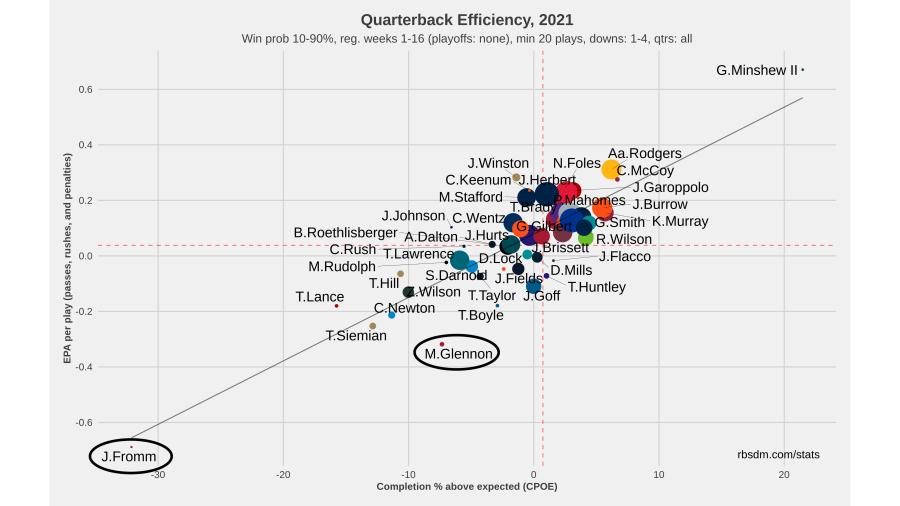
fromm.png
The Bears have a middling pass defense. They rank 26th in EPA allowed per dropback, 23rd in pass rush grade, and 23rd in coverage grade. But they’ve had the most difficult passing schedule in the league. So they shouldn’t have much trouble playing well against Glennon and Fromm.
The Bears are weaker against the run than the pass, ranking 32nd in EPA allowed per rush and 30th in run defense grade. However, the Bears have also had the most difficult schedule against the run, so they’re not total pushovers.
The Giants are still very likely to attack through the rushing game. Over the last three weeks, they’ve had PROE of -8%, -12%, and -3%. The Bears are a run funnel, with teams shifting 2% to the run against them. The Giants will really be overthinking things if they don’t try and control this game on the ground. The issue is that the Giants will likely be using two running backs even if they have a run-heavy game plan.
Over the last three weeks, Saquon Barkley has played 49% of snaps, with Devontae Booker at 47%. Barkley is leading 66% to 31% in share of backfield attempts, but Booker is stealing far too much work within the context of a failing Giants offense. Even worse, Booker has a 10% target share to Barkley’s 11% over the last three weeks. It’s unclear if this is a bid to preserve Barkley’s health in a lost season or something else, but in either case, it’s lowering Barkley’s floor and ceiling. Barkley should at least be part of a rushing attack with boosted overall volume. He’s not the most exciting option, but he’s in the mix as a bet that he can hit big plays in a plus matchup.
Bears Implied Team Total (from PointsBet): 21.75
Andy Dalton will get the start for the Bears and will somehow be the best quarterback on the field by a mile. Dalton ranks 22nd in EPA per play and 32nd in CPOE. He’s on his last legs, but he should be in good field position a fair amount and could keep the offense moving against a Giants defense ranked 23rd in EPA allowed per dropback.
If so, Darnell Mooney has some WR3 appeal. Mooney has a 20% target rate with ha 12.0 aDOT, which gives him a very solid target profile. He’s played about as efficiently as one could expect and has a 1.64 YPRR.
David Montgomery is more interesting if the offense is functional. He had 36.8 expected points in Week 16, which is an absurd workload, and obviously, led the week. Montgomery ranks RB10 with 16.9 expected points per game this season, and he could see both a spike in workload and efficiency against a Giants defense that ranks 31st in EPA allowed per rush and 23rd in run defense grade.
Falcons at Bills, 1 PM Eastern, Sunday
Falcons Implied Team Total (from PointsBet): 14.5
Ryan had been in a bit of a slump entering Week 16 but bounced back against the Lions, finishing 12th in EPA per play and sixth in CPOE. Ryan ranks a respectable 17th in EPA per play and 17th in CPOE this season.
But Ryan is now moving from a Lions defense that ranks 29th in EPA allowed per dropback to a Bills defense that ranks first; the Bills also rank 17th in pass rush grade and are tied with Buccaneers for first in coverage grade.
But the Bills pass defense might be fraudulent. They have had the third easiest schedule against the pass, one only slightly more difficult than the Dolphins’ cupcake schedule.
As we’ll get to, the Bills are not going to have any trouble scoring on the Falcons, so at some point, the Falcons will have to start throwing. If they come into Sunday with a game plan built around keeping pace with the Bills, they could have more success than expected against a Bills defense that hasn’t fully earned its reputation.
Kyle Pitts leads Falcons receivers with 2.05 YPRR and has a strong 21% target rate for his 11.4 aDOT. Frankly, just the fact that he’s a tight end with an 11.4 aDOT makes him a borderline-elite option. He leads all full-time tight ends in aDOT. Rob Gronkowski (10.9) and Mark Andrews (10.8) are the closest. He and Ryan are starting to click, and he’s now up a 9.7 YPT. He’s a locked-in TE1.
Russel Gage has a solid 1.78 YPRR, fully supported by his target profile. With an 8.4 aDOT, he’s less exciting than Pitts. But Gage has only played 50% of his snaps in the slot this season and isn’t a true underneath option. He has upside if the Falcons are forced into comeback mode or if they attack the Bill through the air from the outset.
Of course, the Patriots have laid out a run-heavy, ball-control approach to playing the Bills. This approach has some merit because the Bills are less stout against the run. They rank 17th in EPA allowed per rush and 13th in run defense grade and have had an easy schedule against the run that is inflating those rankings. They’re not terrible against the run, but it’s clearly the path of least resistance against them.
Excluding the Patriots in the wind, teams are shifting 1% to the run against them. But, obviously, the Patriots did beat them with three dropbacks, so we can’t totally discount the -57% pass rate over expected that New England dropped on Buffalo in Week 13.
The Falcons have had a slight lean to the run with a -1% pass rate over expected. Their defense is unlikely to hold up well enough to support a true run-heavy game plan, but they could limit play volume by leaning on their backfield for as long as they can get away with it.
At this point, Cordarrelle Patterson can be considered a true running back. He logged just eight snaps at wide receiver in Week 16, which continues a downward trend, in his shift to a true running back. Over the last three weeks, Patterson only has a 55% snap share, with 53% of backfield attempts and 12% of targets. He’s in play as an RB2 but will need to get in the end zone to find a ceiling this week.
Bills Implied Team Total (from PointsBet): 29.25
Speaking of fraudulent defenses, the Falcons defense looks bad but might be awful. I noted this last week, and sure enough, Tim Boyle was competent against the Falcons, finishing 21st in EPA per play and 19th in CPOE.
The Falcons rank 27th in EPA allowed per dropback, 32nd in pass rush grade, and 24th in coverage grade. And the Falcons schedule really has been wild. They’ve played the Panthers (twice), Saints, Jets, Lions, and Jaguars. Meaning, they’ve somehow gotten six games against the five least efficient passing offenses in the NFL.
Meanwhile, the Falcons have played just four games against top 10 passing offenses: the Buccaneers (twice), the 49ers, and the Cowboys. Those teams have averaged 38 points against them, which makes the Bills’ 29.25 implied team total... look light.
Josh Allen has struggled with passing efficiency this season, ranking 15th in EPA per play. But Allen has been fairly accurate, ranking 10th in CPOE, ahead of Patrick Mahomes, Tom Brady, and Justin Herbert. And Allen is also coming off of his second-most efficient game of the ceiling against a far more formidable Patriots defense. So he could be in for a very big game here if the Falcons can come even a little bit close to keeping pace with him.
Pace is the key word here because both the Bills and Falcons play fairly quickly. The Falcons rank ninth in situation-neutral pace, and the Bills rank 11th. The Bills rank 20th in average play clock remaining while winning, but 13th when tied or trailing, so if the 14.5 point underdog Falcons can somehow play from ahead—even for a stretch—this game could get nutty. The Falcons rank ninth in play clock remaining when winning, so they’ll likely keep things moving with a lead.
High-end passing efficiency will be enough for at least one Bills wide receiver, and volume could bring more along for the ride. Obviously, Stefon Diggs is the top option each week, but he stands out more than usual with the roles of the Bills’ other wide receivers in flux.
Diggs has 1.93 YPRR, which is good, but he could be having a much better season if he wasn’t running cold with an 8.0 YPT. Diggs has been targeted on 24% of his routes with an 11.9 aDOT, which gives him an elite target profile. He hasn’t connected with Allen nearly as often as expected, but he maintains an extremely high ceiling this week.
Behind Diggs, it gets messy at wide receiver, but Gabriel Davis looks like the best bet of the bunch. Emmanuel Sanders looks in real jeopardy of missing Week 17 with a knee injury and may not be at full strength even if he plays. Davis is coming off the Covid list but has been practicing in full. He leads non-Diggs receivers with 1.81 YPRR and can deliver a nice week on a few plays with his 14.0 aDOT. He is a strong bet for a true full-time role if Sanders is out.
Isaiah McKenzie was tremendous in Cole Beasley‘s absence, but it’s hard to imagine that Beasley doesn’t regain the majority of his previous role. At the same time, the Bills seem likely to mix in McKenzie more often than before Week 16. So Beasley is in play, but he’s a high-risk option.
Dawson Knox continues to be 2021 Logan Thomas. He has just 1.23 YPRR, but he ran a route on 90% of dropbacks against the Patriots, and that kind of involvement is rare for a tight end. He’s a TD-dependent option, but there could be more than a couple passing TDs in this game.
Devin Singletary took a major hit in snap share in Week 16, with Zack Moss active. After averaging 87% of snaps in Weeks 14-15, he dropped to 68% in Week 16, with Moss active. Singletary’s actual workload wasn’t affected much. His share of backfield attempts dropped from 87% to 80%, but his target share actually increased from 10% to 14%. But Moss still lowers Singletary’s floor. Keep in mind that the thesis of the Singletary play is that he isn’t particularly good, and his backfield isn’t all that valuable... but he gets all the work. Having another back mixing in for 33% of snaps creates a lot of downside risk for that bet. Nevertheless, Singletary still looks like a solid RB2 with Moss in, and a high-end RB2 if Moss is healthy scratched.
Texans at 49ers, 4:05 PM Eastern, Sunday
Texans Implied Team Total (from PointsBet): 16
Davis Mills has been shockingly competent since taking back over as the Texans starter. Over the last three weeks, Mills ranks 11th in EPA per play and 15th in CPOE.
Mills has a chance of staying hot this week against a 49ers defense that is somewhat vulnerable through the air. The 49ers rank 25th in EPA allowed per dropback. However, that rating understates their ability on defense a bit. They’ve had a tough schedule, and their ninth graded pass rush and 17th graded coverage grade probably come closer to capturing their strength. Still, the 49ers can be thrown on.
Brandin Cooks is the only wide receiver of interest here. He has a borderline-elite 1.97 YPRR, which is quietly one of the more impressive accomplishments of the year, given the state of the Houston offense for much of the season. With Mills coming on a bit, Cooks has a chance for a nice game in his return from the Covid list.
Although he’s not there yet, Brevin Jordan is starting to approach DFS punt territory. He ran a route on 61% of dropbacks and had a 24% target rate. He also has a 24% target rate this season, which ties him with Cooks for the highest on the team. He’s not quite in play this week, but I’ve played worse tight ends in deep dynasty leagues this year, and I can’t wait to play him in Week 18.
Houston isn’t generally all that interested in throwing the ball. They have a -3% pass rate over expected and rank 30th in situation-neutral pass rate. The Texans’ approach to neutral and positive game script has led to them posting a -10% PROE in their two-game win streak. If the 12 point underdogs get a lead in this game, they’re a safe bet to run at a high rate.
But just because the Texans would like to run the ball a lot this week doesn’t mean that they’ll be efficient while doing so. The 49ers rank second in EPA allowed per rush and sixth in run defense grade. And even after running all over the Chargers, the Texans rank 32nd in EPA per rush. They also rank 32nd in adjusted line yards. They did well against the run-funnel Chargers, but they’ll fare far worse here if they attempt to roll out last week’s game plan.
The Texans rushing attack should be concentrated again, at least. With David Johnson on the Covid list, Rex Burkhead should operate as the lead back. Against the Chargers, he saw 62% of snaps, 65% of backfield attempts, and 7% of targets. He’s in play as an RB2 fill-in as long as Johnson isn’t activated.
49ers Implied Team Total (from PointsBet): 28
Trey Lance looks likely to start for the first time since Week 5. That start... did not go well. Neither did his half of play in Week 4. From Weeks 4-5, Lance ranked 35th (dead last) in both EPA per play and CPOE. He looked like a more mobile version of Drew Lock.
But you really can’t undersell that mobility. While delivering what was literally the worst quarterbacking in the league, Lance finished as QB20 in both Week 4 and Week 5—despite playing just one half in Week 4.
The Texans’ defense isn’t bad, but it’s nowhere near as challenging as the Cardinals’ defense that Lance flopped against. The Cardinals rank fourth in EPA allowed per dropback; the Texans rank 24th. The Texans also rank 31st in coverage grade. They have a solid pass rush that ranks 13th in PFF’s grades, but fantasy managers will trade a few sacks for getting Lance on the move more often.
If Lance displays similar accuracy to his last start, he can flop regardless of opponent. But this matchup gives him a solid ceiling. Even if passing volume is low, Lance can get there through big plays with his legs and arm. Lance ranks third in deep ball rate, behind Drew Lock and Russell Wilson. He looked like Lock in his first start. Hopefully, he can look a little bit closer to Wilson this week.
But even if Lance is playing well, the 49ers are extremely likely to be run-heavy this week. They have a -6% pass rate over expected. Only the Titans are more tilted toward the run. In Lance’s Week 5 start, they went ultra run-heavy with a -9% PROE. That game was against a run-funnel Cardinals defense, but they’re facing an even bigger Texans run-funnel this week. Teams are shifting 3% to the run against the Texans, and the 49ers should be among the most run-heavy teams this week.
It looks likely that Elijah Mitchell will be back this week, and we should expect a big workload for the rookie. The 49ers have been consistent in leaning on Mitchell whenever he is active. He ranks RB18 with 14 expected points per game this season and was up to 23.4 points per game in his last two outings. The 49ers are sure to lean on the run game here, and we could see a huge workload for Mitchell if he’s healthy enough to handle it.
In what will likely be a very run-heavy environment, big plays will be critical for the 49ers’ receivers. Fortunately, this is one of the most efficient groups of skill players in the league. Deebo Samuel has 3.01 YPRR, which is second to only Cooper Kupp (3.13). And George Kittle‘s 2.61 is tied with Justin Jefferson for seventh-best among all players. Brandon Aiyuk has just 1.44 YPRR and is a risky bet in a low-volume environment. Samuel’s hybrid role gives him multiple paths to value and makes him a WR1. Kittle remains an elite TE1.
Broncos at Chargers, 4:05 PM Eastern, Sunday
Broncos Implied Team Total (from PointsBet): 19
I just spent the 49ers’ writeup praying that Trey Lance wouldn’t play like Drew Lock... so I think you know where I stand on Mr. Lock. The Broncos are on the same page. To the point that last week they tried something crazy: game-manager Lock. And while game-manager Lock looks like even more of a bummer than gunslinger Lock... it went kind of ok, and we’re likely in for another week of it here.
Lock finished 22nd in EPA per play and 16th in CPOE against the Raiders. That’s not great by any means, but Lock was 43rd in both EPA per play and CPOE entering Week 16. That was on a small sample, but Week 16 was still a huge improvement.
The Broncos pulled off game-manager Lock against a Raiders run-funnel defense, and they now get the Chargers, who are an even bigger run funnel. This is a helpful setup with all Broncos starting wide receivers potentially missing this game with Covid. (Sutton is not confirmed yet).
The Broncos ground game seems likely to hold the only fantasy value in this offense, assuming there’s any to be had. Javonte Williams and Melvin Gordon have been dead even with 22 attempts each over the past two weeks. Williams has led 56% to 46% in snaps share and looks to be the 1A in this offense ever so slightly. With a potentially disastrous passing game, the only path to value here is big plays, making the talented rookie the more interesting option. Williams is a bet on talent play in a good matchup. He’s in play as an RB2.
Chargers Implied Team Total (from PointsBet): 27.5
Last week, I mentioned in my writeup of Justin Herbert that he’s been inconsistent this year. Given that he just lost to the Chargers, one might assume that Herbert turned in a dud of a Week 16. He did not.
Herbert ranked eighth in EPA per play and 11th in CPOE in Week 16, and as a reminder, those numbers exclude garbage time. And despite missing Jalen Guyton and Mike Williams, he had a solid 7.8 aDOT. To the extent that the Chargers’ offense blew it against the Texans, it looks like it was because they took their foot off the gas.
The Chargers had a 3% pass rate over expected against the Texans, down from their 5% PROE this season. The Texans are a run-funnel, so we can’t really blame the Chargers for this approach. But it ultimately was not ideal, with the Texans putting up 41 points on the other side.
This week, the Chargers might be skittish about rolling out a similar game plan. But if the 7.5 favorites get out to a big early lead, we could see plenty of running in this game because the Broncos can be run on. They rank 20th in EPA allowed per rush and 21st in run defense grade.
If that scenario plays out, it’s worth noting that the Chargers are a fast-paced team. They rank seventh in situation-neutral pace and sixth when leading by 7+. They also rank fourth in average play clock remaining while leading and second overall.
Austin Ekeler ranks RB8 this season in expected points per game and RB8 in YPRR. As a receiving specialist who is also a workhorse back, he can have a big game in any game script. And so, in a sense, the Chargers front running would actually be a bit disappointing.
Ekeler still has a very high ceiling in that game environment. The Chargers have a 27.5 implied team total. If that scoring flows through Ekeler, he can win the week. But there may not be much need to pass much to him here, and so his path to hitting his ceiling is a bit thinner than usual—assuming the Chargers play from ahead.
However, if the Broncos can push back, we could see a good amount of passing volume this week. And the Chargers are going against a below-average Denver defense that ranks 17th in EPA allowed per dropback, 31st in pass rush grade, and 21st in coverage grade. If the Broncos can get them passing, things could get fun.
With Jalen Guyton out with Covid last week, the Chargers backfilled his role with another undrafted deep threat. Jason Moore doesn’t have Guyton’s sub-4.4 speed, but he played the same role on the outside with a 15.0 aDOT. Guyton’s return to the offense should be a boost for Keenan Allen. Guyton’s speed can help open things up for Allen in the intermediate areas of the field. And while Moore flashed an ability to draw targets, Guyton has an abysmal 9% target rate. His presence is a plus for everyone else in the offense.
Allen has 1.88 YPRR, which is good, but he’s running cold with a 7.8 YPT. If Guyton and Mike Williams provide a boost to the offense, Allen could be better off trading a target or two for increased efficiency.
Mike Williams still has a 1.92 this season, which leads all full-time Chargers, including Austin Ekeler. After his hot start it’s been a frustrating stretch, but he remains a low-end WR2.
Cardinals at Cowboys, 4:25 PM Eastern, Sunday
Cardinals Implied Team Total (from PointsBet): 23
Kyler Murray‘s accuracy has dropped off dramatically since his ankle injury. From Weeks 1-8, he ranked second in CPOE; since returning in Week 13, he ranks 27th. His efficiency has also taken a big hit. He ranked sixth in EPA per play from Weeks 1-8; since Week 12, he ranks 28th.
Murray’s play to start the season was so strong that he still ranks seventh in EPA per play and second in CPOE this season. He’s definitely in a slump, but he’s slumping from what was an MVP level of play.
Unfortunately, Murray is going against what is now, without a doubt, the NFL’s best pass defense. The Cowboys rank second in EPA allowed per dropback and have had a far more difficult schedule than the first placed Bills and third-placed Dolphins.
The Cowboys have a strong pass rush that ranks eighth in PFF’s grades and is generating pressure at the 10th highest rate. And that’s paired with a secondary that ranks seventh in coverage grade and is allowing 1st down passes at the second-lowest rate.
The silver lining for Murray is that the Cowboys do allow plays downfield. They’ve allowed the ninth most 15+ yard passes this season. The Cowboys are also somewhat dependent on the blitz, which is a strength of Murray’s. The Cowboys blitz at the 11th highest rate, but Murray ranks fifth in passer rating against the blitz.
So while the Cowboys are not an ideal matchup, Murray could certainly still succeed here. And if Murray finds success this week, there’s upside for a lot of points in this game. The Cardinals rank sixth in situation-neutral pace, and the Cowboys rank first. If this game is back and forth, or if the Cardinals are playing from behind, there could be quite a bit of passing volume.
Christian Kirk is the Cardinals’ clear WR1. He’s led all wide receivers in route rate in each of the last two weeks and has racked up 21 targets. Unfortunately, Kirk has been inefficient over the last two games with a 7.8 YPT against the Lions and a 6.1 YPT against the Colts. This is far from an ideal get-right spot, but Kirk leads all Cardinals wide receivers (including DeAndre Hopkins) with 1.87 YPRR and should be heavily involved if Murray has a good game.
Zach Ertz is functionally the Cardinals’ WR2. He ran a route on 95% of dropbacks last week and leads the team with 24 targets over the last two weeks. Ertz has a 21% target rate since joining the Cardinals, and he has a path to double-digit targets for the third straight week if the Cardinals are pass-heavy.
Last week, A.J. Green was up to an 86% route rate, leading Antoine Wesley (77%). Green has a 12.8 aDOT and is in play as a FLEX, as a bet on Murray hitting some big plays.
The texture of this game could be quite different if the 6 point underdog Cardinals play from ahead. The Cardinals rank second in average play clock remaining when trailing and fourth when tied. But the Cardinals rank 16th in average play clock remaining when winning and 12th in seconds per play when leading by 7+. They don’t sit on the ball when ahead like Washington. But, if the Cardinals get a multi-score lead, it will likely slow down this game considerably because the Cardinals are also quite comfortable running when ahead.
In their Week 1 win over the Titans, the Cardinals had a -4% pass rate over expected. They were also -3% in their victory over the Rams, -6% over the Texans, and -7% over the Bears. Overall the Cardinals are slightly tilted toward the pass with a 1% pass rate over expected, and they’ve won plenty of games where they were pass-heavy. But the combination of a slower pace and a likely shift to the run makes Arizona’s passing game a lot less interesting if the Cardinals play from ahead.
But the run game, of course, would be just fine with that outcome. And if the Cardinals are in position to establish it, they should be effective. The Cowboys rank 16th in EPA allowed per rush and 28th in run defense grade.
It’s unclear if the Cardinals will have James Conner this week. If they only have Chase Edmonds, it’s a bit harder to imagine them running their offense through the run game, even if ahead throughout. If Conner is able to play through his heel injury, he should form a 1/2 punch with Edmonds, and both backs look like solid RB2 options. But if Conner misses, Edmonds is a very exciting play. Conner’s absence will obviously mean a bigger share of the backfield for Edmonds, but it could also mean a bit more passing, which could go a long way in helping this game to hit its ceiling. Edmonds had 26.7 expected points last week, the third-highest of Week 16, and a truly elite workload. He’s a locked-in RB1 if Conner misses.
Cowboys Implied Team Total (from PointsBet): 29
Dak Prescott is having a very solid season, ranking 13th in EPA per play and seventh in CPOE. He’s not near Kyler Murray‘s level of play this season but has been the far better of the two since Murray’s Week 12 return.
Prescott is in a similar spot to Murray this week in terms of defensive matchup. The Cardinals aren’t to the level of the Cowboys as a pass defense, but they’re impressive in their own right. Arizona ranks fourth in EPA allowed per dropback, sixth in pass rush grade, and 16th in coverage grade.
But the Cardinals are even more dependent on the blitz than the Cowboys, ranking third in blitz rate. Impressively, the Cardinals can blitz without giving up big plays; they’ve allowed 15+ yard passes at the third-lowest rate. Still, Prescott is well suited to make them pay for blitzing him. Prescott ranks 10th in passer rating against the blitz and leads the NFL with 18 TD passes when blitzed.
And just like the Cardinals, if the Cowboys can move the ball efficiently, they could put the pedal to the floor. Dallas ranks first in situation-neutral seconds per play and first in average time remaining on the play clock. The Cowboys, for some reason, slow down when trailing by 7+, ranking just 20th in seconds per play. So for ideal passing game volume, we want the Cowboys in a back and forth script.
The Cowboys’ blowout of Washington obviously skewed the route rates of their receivers, but, notably, CeeDee Lamb was tied with Amari Cooper with an 81% route rate, with Michael Gallup at 77%. Lamb had been at just 70% the week prior. If Lamb is going to get the same opportunity as Cooper and Gallup, he’s the best bet of the three, by far. Lamb has an elite 2.15 YPRR and has a very strong 24% target rate for his 10.9 aDOT. The only thing holding him back from being the Cowboys’ unquestioned top receiver is the Cowboys’ occasional head-scratching choice to use him as a part-time player.
Amari Cooper is second on the team with 1.68 YPRR and is starting to separate a bit from Michael Gallup with a 19% target rate to his 18%. However, Gallup still has a very similar profile with a 12.4 aDOT to Cooper’s 12.3. Gallup has an extremely poor 7.4 YPT, but otherwise, he looks like a version of Amari Cooper with a slightly lower target floor.
Dalton Schultz had a 77% route rate against Washington, just 2% behind Gallup and 4% off the team lead. He was at 90% in Week 15, and he’s in play as a bet that this game lands on one of several upside scenarios. Unfortunately, Schultz is somewhat TD-dependent because his 18% target rate and 7.3 aDOT don’t provide a ton of yardage upside. Although this game environment could be up-tempo enough to overcome that.
Obviously, this game can shoot out if both offenses score evenly. But there’s a second path to this game shooting out: the Cowboys playing from ahead. The Cowboys are likely to be run-first in that script, but they’ll be quick about it, unlike the Cardinals. The Cowboys rank 10th in seconds per play when leading by 7+ and first in play clock remaining when winning. A positive Cowboys game script would set up the Cardinals for plenty of passing volume on the other side and likely mean a ton of scoring here. It would also set up Ezekiel Elliott for a big day.
The Cardinals are also fairly stout against the run, ranking eighth in EPA allowed per rush. They rank just 23rd in run defense grade but have faced a difficult rushing schedule, so the grades likely understate their strength. Still, Elliott most easily hits his ceiling when things are clicking for the offense overall. He doesn’t need to necessarily drive the offense, so much as capitalize on an efficient day from the passing game and defense. He looks like a volume-based low-end RB1.
Panther at Saints, 4:25 PM Eastern, Sunday
Panthers Implied Team Total (from PointsBet): 15.5
Nothing says #longestseasonever like a second go-round with Sam Darnold quarterbacking the Panthers. But here we are. Darnold will start against the Saints. He ranks 31st in EPA per play and 34th in CPOE. He’s going against a Saints defense ranked fifth in EPA allowed per dropback and eighth in coverage grade. It will be a struggle for Darnold until he inevitably is pulled for Cam Newton, and then he’ll struggle as well.
The Saints do at least rank 26th in pass rush grade, and so perhaps Darnold will have enough time to aggressively target D.J. Moore, who is the only path to fantasy value in this passing game.
In Sam Darnold‘s nine starts, Moore posted 2.02 YPRR; he’s down to 1.68 since Week 10. Moore wasn’t exactly clicking with Darnold; he had an 8.0 YPT, which was inefficient for his 11.4 aDOT. But Moore was being targeted on 25% of his routes, making him a solid WR2. Since Week 10, Moore’s YPRR has dropped to 1.68 because his YPT has cratered to 6.9. Moore has also seen his target rate drop slightly to 24% and his aDOT drop to 10.2. But for the most part, Moore is playing the same role in the offense he did when Darnold was his quarterback. It’s just that his ability to deliver value on his targets has been severely impacted by P.J. Walker and Cam Newton being under center. Darnold’s return offers upside for mediocre per-target efficiency, putting Moore back in the WR2 mix.
When the Panthers run the ball, it’s also unlikely to go well. The Saints rank third in EPA allowed per rush and second in run defense grade. And even if the Saints weren’t an elite run defense... Chuba Hubbard has struggled mightily this season. The rookie ranks RB50 (dead last) in success/attempt, RB41 in breakaway percentage, RB50 in elusive rating, and RB36 in YPRR. He’s barely in play as an RB2 fill-in, and Ameer Abdullah actually looks more interesting. Over the last three weeks, Abdullah’s 12% target share gives him minor appeal as a PPR floor play.
Saints Implied Team Total (from PointsBet): 22
Taysom Hill will be back under center this week, ending a dark chapter of Ian Book puns. Hill will be playing the Panthers for the first time this season, with Jameis Winston starting against them back in Week 2. The Panthers’ defense is formidable, particularly against the pass; they rank ninth in EPA allowed per dropback, 11th in pass rush grade, and 15th in coverage grade.
But the Panthers are weaker against the run, ranking 21st in EPA allowed per rush and 20th in run defense grade. Given Taysom Hill‘s skill set, it might ultimately not be a bad matchup for him. He ranks 35th in EPA per dropback and 37th in CPOE this season. Only Trevor Siemian and Cam Newton have been less accurate. So Hill isn’t going to play well. But he could have enough rushing equity to deliver value.
The only skill player in play this week, as usual, is Alvin Kamara.
With Mark Ingram back over the last two weeks, Kamara has led 60% to 48% in snaps. But he’s had a bigger 60% to 33% lead in share of backfield attempts. And critically, Kamara has dominated with a 23% target share to Ingram’s 5%. Kamara has averaged just 14.7 expected points over the last two weeks, but he’s now getting a Panthers defense that is tied with the Chargers for the biggest run funnel in the league. He’s also getting Hill back at quarterback, who should help keep the offense on track. Kamara is a boom/bust play this week... but he’s a boom/bust RB1.
Lions at Seahawks, 4:25 PM Eastern, Sunday
Lions Implied Team Total (from PointsBet): 17
Whether Jared Goff or Tim Boyle is at quarterback this week will matter to some extent... but it won’t fundamentally affect how this offense will operate.

boyle.png
Boyle has been both less efficient and less accurate than Goff, but not by a significant margin. Of course, we have a small sample on him, so it’s certainly possible there’s more downside on the way. But we only care about one receiver here anyway, and Boyle just peppered him with 10 targets.
Amon-Ra St. Brown clearly is not just a product of Jared Goff‘s propensity for throwing to the slot receiver. He posted a 31% target share and two carries with Goff out. The passing offense is designed around him, and the Lions are finding ways to get him the ball. St. Brown now looks a bit like Hunter Renfrow. He’s played 78% of his snaps in the slot this season and has a 6.7 aDOT. But like Renfrow, if the Lions get going through the air, it will almost certainly flow through St. Brown, which sets him up for a volume-based PPR ceiling.
D’Andre Swift may cut into St. Browns receiving work slightly, given that Swift appears to be ready to go according to his hype man, Dan Campbell.
When a coach literally gets giddy talking about how his running back is “fresh” and “a sight for sore eyes”... that’s generally a good sign.
Swift will be facing a Seahawks defense that ranks seventh in EPA allowed per rush and third in run defense grade. They have a reputation as a team that can be run on, but it’s more the case the Seahawks aren’t a great defense overall and rarely force opposing offenses out of rushing scripts.
The Seahawks rank 20th in EPA allowed per dropback, 29th in pass rush grade, and 28th in coverage grade. So the Lions have a decent chance of being efficient through the air. But the Lions rank 32nd in situation-neutral pass rate, so if the 7.5 point underdogs can keep this game close, we should see plenty of Swift as part of what could be a non-disastrous offensive performance.
Swift ranks just RB41 in success/attempt and RB43 in elusive rating. He’s the type of back that might get buried by a more old-school coaching staff. Instead, he has a coach who loves the run like an old-school guy but also goes for it aggressively on 4th down and seems to understand the value of big plays in the run game. Swift ranks RB13 in breakaway percentage and RB11 in YPRR. He’s one of the NFL’s premier big play threats out of the backfield, and that ability is why he’s been able to overcome... less than ideal offensive circumstances. He’s a high-end RB2 in his return, despite being a part-time rusher in a Tim Boyle offense.
Seahawks Implied Team Total (from PointsBet): 24.5
Since returning from his finger injury, Russell Wilson ranks 27th in EPA per play and 18th in CPOE. He’s been playing like a less mobile, slightly more accurate Jalen Hurts.
This week he gets what should be a get-right spot. The Lions are a competent run defense, ranking 18th in EPA allowed per rush, but they’re more susceptible against the pass where they rank 29th in EPA allowed per dropback. But the Seahawks have a -1% pass rate over expected and generally have to be pushed to pass, as evidenced by their 22nd ranking in situation-neutral pass rate. It’s all too likely that the Seahawks get a small lead here and then milk it with the run game. #LetRussLeave
Still, if the Seahawks play this game with the passing matchup in mind, both DK Metcalf and Tyler Lockett have high ceilings. Although, with potentially windy and rainy conditions, they also have low floors.
Lockett and Metcalf both have elite target profiles, but Lockett is crushing with an 11.1 YPT, and Metcalf is a major disappointment with an 8.1 YPT. Both receivers are deep threats; Lockett has a 15.8 aDOT with Metcalf at 13.3. That is key this week, as the Lions are extremely vulnerable to the deep pass. Only the Jets are allowing 15+ yard passes at a higher rate. Metcalf leads Lockett in target rate 24% to 21%, and both players are in play as WR2s this week.
Gerald Everett has also emerged as a viable cheap tight end. He has just 1.35 YPRR and a weak 16% target rate—oh, and his 4.9 aDOT is comically shallow. But Everett had an 83% route rate last week. He’s fully TD-dependent, but he’s a full-time player in a decent game environment.
Over his last three games, Rashaad Penny ranks just RB38 with 9.8 expected points per game. That feels impossibly low, and that’s because, in some ways, the metric is skewed. Penny leads the league in breakaway percentage and hasn’t needed a huge workload because he’s hitting big plays. His workload would actually look more valuable if he’d played slightly worse and was caught from behind on his long runs. In a sense, Penny is robbing himself of additional carries by finishing his long runs. But... Penny also has just a 51% snap share, 68% of backfield attempts, and a 5% target share. He’s basically Swift without the receiving work, and it creates a very narrow path to value. He’s run that path beautifully so far, but the Lions are solid against the run, and he has a low floor if he doesn’t hit big plays this week. He profiles as a boom/bust RB2.
Vikings at Packers, 8:20 PM Eastern, Sunday
Vikings Implied Team Total (from PointsBet): 14.5
With Kirk Cousin out this week with Covid, we’re now looking at Sean Mannion at quarterback. He’s going against a solid Packers defense that ranks 16th in EPA allowed per dropback, second in pass rush grade, and eighth in coverage grade.
With this matchup not being a cakewalk, and a backup quarterback under center, Justin Jefferson would likely be better off with Adam Thielen in the lineup. A lost target or two would be worth the added benefit that Thielen brings in terms of moving the offense downfield. But with Thielen out for the season, there’s no doubt that Jefferson will dominate target share.
Jefferson has a 30% target share and a 48% air yard share and already leads the league in WOPR. A further increase in targets could be wild. But the value of his targets are about to take a big hit with Mannion under center. He remains a WR1, but he’s has a lower floor than we’re used to.
The Packers are good against the run, ranking third in run defense grade, and opponents are shifting 3% to the pass against them. As 13 point underdogs, the Vikings are extremely unlikely to deliver Dalvin Cook a high volume rushing day. The star rusher will need to be efficient to deliver a big week.
Cook ranks fourth in breakaway percentage and could overcome even a disastrous game environment if he’s at the top of his game. He remains a low-end RB1 as a bet on talent.
Packers Implied Team Total (from PointsBet): 27.5
Aaron Rodgers is far more polarizing than he was 12 months ago, but his quarterbacking hasn’t gotten any worse. He ranks first in EPA per play and first in CPOE, and he jumps off the charts.

rodgers_17.png
Rodgers now gets a decent Vikings defense that ranks seventh in EPA allowed per dropback, 15th in pass rush grade, and 18th in coverage grade. But Rodgers had no trouble against them in Week 11, throwing for 385 yards and four TDs, with his final pass of the game going 75 yards for a TD.
As usual, though, the Packers had to be pushed to score. And despite Rodgers’ big game, the Vikings won. We don’t have to wonder if the Packers took any lessons from that bitter loss; we know they didn’t. The Packers rank 31st in play clock remaining since Week 12. They’re 32nd on the season but haven’t gotten any faster-paced since losing to the Vikings. The slow-paced Colts just got even slower.
Now the slowpokes face a Sean Mannion-led offense that is extremely unlikely to push them. That, unfortunately, limits the Packers receiving options to Davante Adams, whose massive target share makes game environments almost irrelevant. Adams has a 33% target share and a 38% target share and is second to only Justin Jefferson in WOPR. Overall passing volume will likely be down this week, but Adams can still have a huge game.
Assuming the Packers play from ahead throughout, AJ Dillon is interesting as a bet that they used him to salt away the game. The Vikings rank 30th in EPA allowed per rush and 15th in run defense grade. AJ Dillon went for 4.8 YPC against the Vikings in Week 11, but he managed just 11 carries due to game script. The Vikings are a run funnel, and although the Packers have a 4% pass rate over expected, they’ve had no problem salting away leads with the run. Aaron Jones should be the 1A while the game is close, but that might not be very long. As a result, I have a slight preference for Dillon this week.
Browns at Steelers, 8:15 PM Eastern, Monday
Browns Implied Team Total (from PointsBet): 22.5
Baker Mayfield has had a rough season, ranking 20th in EPA per play and 26th in CPOE, and the Browns are reportedly considering other quarterback options for 2022. They’ll also be looking to sideline Mayfield this week.
The Steelers are a clear run funnel. Teams are averaging a -4% pass rate over expected against them and are shifting 4% to the run. The Browns already have a -4% PROE this season, so they have potential to be quite run-heavy this week.
The Steelers are just 26th in EPA allowed per rush, and a heavy dose of Nick Chubb is likely to keep the Browns offense move sufficiently well, as well as preventing a repeat four-interception game from Mayfield.
Over his last two games, Nick Chubb has a 63% snap share but 89% of backfield attempts. D’Ernest Johnson has a 35% snap share but just 11% of backfield attempts. Johnson is getting more work as a receiver, with a 9% target share, which is to say, Johnson is playing a reduced version of the Kareem Hunt role. With that in mind, a limited Hunt returning for this game probably won’t shift things much from what we’ve seen recently unless Hunt cuts into the 8% target share that Chubb has managed over the last two weeks. This matchup sets Chubb up as a locked-in RB1 whether or not Hunt is active. The Browns are sure to lean on him as their primary method of attack. He has an elite ceiling if they also mix him in on screen passes.
Steelers Implied Team Total (from PointsBet): 18.75
With this being Ben Roethlisberger‘s last home game for the Steelers, I’ll refrain from making fun of how bad his season has been. There’s no need to point out that he was less efficient than Andy Dalton and Daniel Jones. What would be the point in that? And this is hardly the time to mention that he was less accurate than Davis Mills and Jacoby Brissett. What would even be the point of that? The guy has had a great career; let’s leave it at that.
The Browns defense is not an ideal guest for a going away party. They rank 13th in EPA allowed per dropback, seventh in pass rush grade, and fifth in coverage grade. But as usual, Roethlisberger will at least have a concentrated target tree.
Diontae Johnson has a 29% target share and a 36% air yard share; he remains well ahead of Chase Claypool, who is at just 19% and 33%. But these per-game stats overstate the difference between Johnson and Claypool’s importance to the offense. Since his infamous 1st down point, Claypool has had 61% and 74% route rates, with Johnson at 100% and 100%. And prior to Week 15, Claypool was playing through injury and had route rates of 66% and 57%. Diontae Johnson was... once again at 100% and 100%. But way back in Week 12... both Claypool and Johnson had 98% route rates. If Claypool is out of the doghouse, his 21% target rate with his 12.5 aDOT makes him nearly as big a part of the offense as Johnson. If not, Johnson is the clear WR1 in Pittsburgh.
The Browns are also competent against the run, ranking 14th in EPA allowed per rush and 10th in run defense grade. Najee Harris is unlikely to be efficient this week. But it would be a surprise if he didn’t see borderline-elite volume. He ranks second over the last three weeks with 19.1 expected points per game. And he ranks second on the season with 20.8 expected points. Harris needs all the volume he can get because he’s not very efficient. He ranks just RB39 in success/attempt, RB50 breakaway percentage, and RB34 in YPRR. But Harris is starting to pop in elusive rating, where he ranks RB14. He profiles a lot like Alexander Mattison when used as a workhorse.
Sources
To write this article I relied on the following stats, metrics and grades.
- Implied Team Totals are calculated using the lines at PointsBet.
- Expected Points Added per Play (EPA/Play).
- Efficiency metric based on how much a play improved a team’s likelihood of scoring.
- I use this metric primarily for QB efficiency, but also for defensive efficiency.
- Data from Ben Baldwin’s rbsdm.com
- All EPA/play referenced in this article has garbage time filtered out.
- I do this by setting win probability filter to between 10-90%.
- Completion Percentage Over Expected
- QB accuracy metric
- Data from rbsdm.com
- All CPOE referenced in this article has garbage time filtered out.
- I do this by setting win probability filter to between 10-90%.
- Pass Rate over Expected
- Measures passing decisions against what would be expected given the game situation.
- Situation Neutral Pass Rate
- Measures pass rate on downs and in situations when a team truly has the choice to pass or run.
- Situation Neutral Seconds per Play
- Seconds between plays in neutral game script.
- Faster play generally means more plays, which provides more opportunity for fantasy scoring.
- Adjusted Line Yards
- Run blocking stat that has been correlated with elite fantasy running back seasons.
- Snaps and Snap Share
- Probably the single most important stat for running back opportunity.
-
- Teams check in and out of runs with only one back on the field. Being on the field is critical.
- Data from Pro Football Focus, AddMoreFunds and RotoViz
-
- Target Share and Air Yard share
- The combination of these is called WOPR. Created by Josh Hermsmeyer, this metric scales from 0-1.
- Data from Pro Football Focus and RotoViz
- Routes run per dropback
- Snap share for receivers... since I’m not concerned with who is playing run-blocking snaps.
- Data from Pro Football Focus
- Yards Per Route Run
- A YPRR of 1.8+ is good and anything 2+ is very good.
- This metric is particularly useful for young wide receivers whose role could grow as a result of strong play.
- It can also help identify truly elite wide receivers.
- It filters out in-game injuries and blowouts much better than target share does.
- Data from PFF
- Target per Route Run
- TPRR and Yards per Target combine to make up YPRR.
- TPRR is especially useful for tight ends.
-
- Some offenses and quarterbacks prioritize throwing to the tight end much more than others.
- Some tight ends are far better at getting open than others.
- TPRR is much more stable than YPT, so in small samples especially, I’d rather know who is drawing targets than what happened afterward.
-
- Expected Fantasy Points.
- Both RotoViz and PFF have similar Expected Points metrics that adjust opportunity based on the context of each play.
- I am referencing PFF’s metric unless otherwise stated.
- A number of other PFF stats including Time to Throw, Play Action Rate, Pressure Rate, Screen Passes and Defensive Grades.