Special Offer: Get an edge on draft day with our 2021 Draft Guide that is packed with hundreds of player profiles, rankings for various formats, projections, tiers, mock drafts, custom scoring, our ADP Trend Report tool and more. And don’t forget to use promo code PRESEASON15 to get 15% off annual subscriptions, but act fast because this offer ends Wednesday, September 8. Click here to learn more!
Every Friday, Zach Lowe writes an article for ESPN about five things he liked or disliked from that week’s NBA games. It’s one of the best series in sports and a lifesaver for people like me who don’t keep up much with pro basketball during the regular season. That’s where I got the idea for this column, although I must preface by saying I won’t be able to match Lowe’s quality because he does truly incredible work. And instead of me talking about what I liked and didn’t like, it’ll be a breakdown of the most actionable and under-the-radar numbers from the past week.
With the explosion in popularity of fantasy has come an onslaught of content. You can go to any sports website and find the most notable happenings from the previous week, who you should target on the waiver wire, and which players are mispriced in DFS for the following week. That analysis is necessary, but you can only say the same thing in so many different ways. And that’s kind of how it has to be since we’re all analyzing the same slate of games every week.
The goal with Strength in Numbers is to communicate that information with stats. Every Tuesday, we’ll analyze the most actionable takeaways from the week in a concise, numbers-filled format.
Without further ado, let’s break down the 2021 preseason.[[ad:athena]]
1. New England ranked 31st in team pass attempts last season. In Cam Newton starts, they averaged just 26.9 passes per game. It was even worse in the red zone, where they threw the ball 31% of the time – easily the lowest rate of the past five years. For reference, the second-lowest mark since 2016 is 40%. To make matters worse for Patriots skill-position players, Newton was the one getting the rushing work once they got in scoring range. He ranked third in the NFL in red-zone carries (22) and sixth in red-zone rushing attempt market share. In the 10 games for which Damien Harris was healthy, Newton out-carried him 15-3 inside the opponent’s five-yard line.

It’s not like the decision to start Mac Jones transforms this offense into a pass-heavy juggernaut, but the rookie unlocks upside for literally every single skill player. With Newton, this was one of the most run-heavy attacks in the league. Not only that, but Patriots RBs didn’t even benefit because they weren’t getting the goal-line touches. The decision to release Newton – rather than just bench him – also eliminates the possibility of a Taysom Hill-type red-zone package.
James White ranked third among RBs in target share (14.1%) last season. The Patriots’ inclination toward the run hid the fact that he remained as involved as ever. Harris (and potentially rookie Rhamondre Stevenson) are now in line for high-value carries near the goal line, whereas you could pencil Newton in for that role previously.
Jakobi Meyers and Nelson Agholor were the Patriots’ clear top-two receivers during the preseason with Kendrick Bourne operating as the WR3. Meyers was quietly efficient in 2020, averaging 2.24 yards per route run on the whole and 2.14 in 3-WR sets. Jonnu Smith and Hunter Henry will be plenty involved after signing big contracts this offseason.
2. During the first eight weeks of 2020, the Bills threw the ball 56% of the time in neutral game script, the 17th-highest rate in the league. In Weeks 9-17, that number climbed to 67% (second). In the playoffs, they threw the ball 69% of the time across 100 neutral-script plays. In their preseason finale this year, Buffalo dropped back on all 12 snaps with the offensive starters.
The Bills were gifted another year of Brian Daboll when no team hired him as their head coach this offseason. They should be among the most pass-heavy teams in the league once again, which is great news for Josh Allen and his supporting cast. Interestingly, Buffalo got progressively more aggressive with calling pass plays as the year went on, and that trend continued in their preseason finale when they called 12 passes on 12 snaps. When asked for his thoughts on a balanced offense earlier this summer, Daboll explained he’s not worried about balance as long as the offense is clicking:
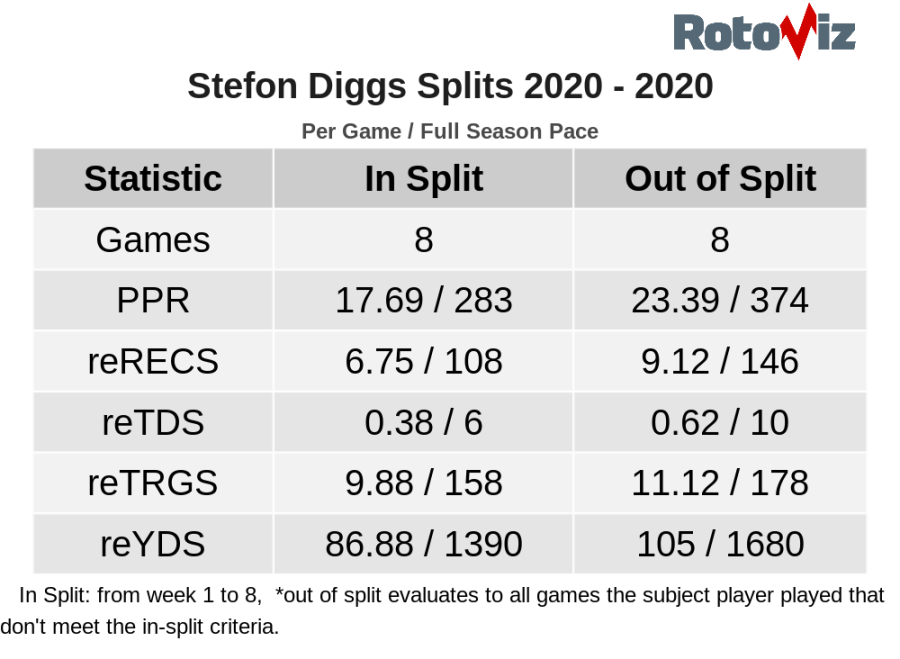
The uptick in passing volume partially explains why Stefon Diggs exploded in the second half last year. All indications are that Buffalo will continue to throw at a high rate this season, making the 27-year-old wideout an enticing option in the first round of fantasy drafts. Of course, it’s not going to be all Diggs. Emmanuel Sanders, Cole Beasley, and Gabriel Davis should vie for the WR2 job, and whoever captures that role should have some relevancy.
The Bills distributed running back snaps fairly evenly between Devin Singletary and Zack Moss during the preseason, but they split playing time by drive rather than role. In their final preseason game, Singletary played all 12 snaps on the first drive and 15-of-18 on the first two drives before Moss came in and dominated snaps until the starters came out (Moss played 16-of-18 snaps in the second quarter). It was a similar story in Buffalo’s second preseason game when Singletary played the first 10 snaps and 18 of the first 20 before taking a backseat to Moss. At the moment, we don’t have much clarity on who leads this competition. Buffalo doesn’t run much, but the strength of the offense creates upside if one of them emerges, whether that be through performance or injury. Both are strong prospective options, but neither profile as a viable option in Week 1.
3. On 66 Trevor Lawrence snaps this preseason, James Robinson played 33 and Carlos Hyde played 28. However, the Jaguars ran the same rotation every game: Robinson would play two drives, and then Hyde could come in. For example, Robinson played 10-of-10 snaps on the first two drives in Jacksonville’s preseason finale. Hyde was then in on the following eight plays. In the Jaguars’ first preseason game, Robinson got one more drive later in the game. In their other two games, he didn’t come back in after the first two drives.
Such a rotation means the Jags’ backfield outlook is still cloudy unless they truly plan to rotate drives in such an equal manner during the regular season. Raw snap counts likely understate how much work Robinson will get compared to Hyde, especially since the former dominated early snaps before subbing out for good in two of Jacksonville’s three preseason contests. Still, the Jaguars have shown they don’t intend to ride Robinson as the previous staff did last year. The new administration signed Hyde and then spent a first-round pick on Travis Etienne despite having more pressing needs. They also signed Duke Johnson to the practice squad on Monday.
The Jaguars elevating Johnson to their active roster and using him as their satellite back would be devastating for Robinson. As things currently stand (with Johnson on the practice squad), the Illinois State product is in line to handle the majority of high-value touches after averaging 5.7 yards per target as a rookie – nearly a full yard better than Hyde’s career-best across seven NFL seasons (4.9). We don’t have much actual information on who Urban Meyer prefers as the goal-line back, but Robinson converted 5-of-6 carries from inside the five-yard line in 2020. He also has the requisite size coaches tend to look for in a short-yardage back. However, the Johnson signing is even more signal that the Jags don’t want to rely solely on Robinson, and Johnson’s potential role as a pass-catcher would siphon away high-value opportunities.
4. Giovani Bernard played zero early-down snaps during the preseason. He played 10 snaps with the starters (Tom Brady or Blaine Gabbert, depending on the game) total. All 10 came on third or fourth down. Meanwhile, Ronald Jones and Leonard Fournette split early downs fairly evenly with Jones getting 11 snaps and Fournette getting nine across two games together. Even in the Buccaneers’ second preseason game when Jones and Fournette didn’t play, Bernard ceded early-down work to Ke’Shawn Vaughn and remained limited to passing-down work.
After suffering a high ankle sprain last week, Bernard practiced on Sunday and Monday, indicating he should be good to go for the season opener on Thursday. He’s an intriguing PPR option in best ball because his role as the third-down back seems secure. His lack of a ceiling hurts his value in managed leagues, but he’s still a fine pick in the final rounds.
Bernard’s passing-down monopoly also limits the upside of Jones and Fournette. Jones had already been phased out of the Bucs’ passing offense by the second half of last season – he had zero targets across three playoff games – but Fournette averaged 4.1 targets across 11 healthy regular-season games. They will split carries and rely on goal-line work for fantasy relevancy.
5. Tevin Coleman only played in one preseason game. In that game, he handled 10-of-19 snaps with the starters. Ty Johnson got the remaining nine. In the two games Coleman didn’t play, Ty Johnson out-snapped Michael Carter 27-21 with the starters. Take a look at their first-team snap counts by game:
| Preseason Game | Coleman | Johnson | Carter |
|---|---|---|---|
| 1 | n/a | 13 | 9 |
| 2 | 10 | 9 | 0 |
| 3 | n/a | 14 | 12 |
The Jets spent a fourth-round pick on Carter and wasted no time getting him involved at practice, as reports came out during mandatory minicamp in June that the rookie was running with the first team. That smoke dissipated during the preseason when Carter ran as the clear RB3 behind Coleman and Johnson.
With that being said, his ADP has cratered as a result of his preseason usage. Once an eighth-round pick, the North Carolina product now frequently slips into the double-digit rounds. His Week 1 role may be limited, but Coleman and Johnson are not prohibitive to a breakout campaign if Carter has the talent. Whether he’s skilled enough to overtake them is a different question entirely. The 22-year-old placed third in the FBS last season in yards per carry and posted a 99th-percentile Breakaway Rush Score (via RotoViz), but the NFL showed what they thought of him when they let him drop to Round 4. He’s an intriguing late-round play because the Jets’ current top-two backs (at least based on preseason usage) don’t exactly inspire confidence, and Carter has a promising profile as a pass-catcher with upside for more. Just don’t expect him to be viable in Week 1.
Quick Hits
Ordinarily, this section will be for stats I think are worth mentioning but not important enough to write up fully. Today, I’m going to use it to list off some of my other favorite stats from the offseason.
- In nine fully healthy games with Justin Herbert last year, Austin Ekeler got 50.4% of the Chargers’ RB carries and 2-of-10 goal-line carries. He still averaged 19.4 PPG in PPR. Justin Jackson looks like the direct backup to Ekeler with Joshua Kelley and rookie Larry Rountree holding more defined roles as bigger-bodied backs. That’s what we saw when Ekeler went down in 2020. In five games with Ekeler out and Jackson healthy, Kelley out-carried Jackson 7-2 in short-yardage and goal-line situations.
- Joe Mixon ranked third among running backs in PPR weighted opportunity (which measures the value of a player’s workload at league-average efficiency) per game last season before he got hurt. He also got more work as the season progressed. Cincinnati let Giovani Bernard – who has never had fewer than 43 targets in a season – walk this offseason.
| Week | Snap Share | Targets |
|---|---|---|
| 1 | 59% | 2 |
| 2 | 50% | 4 |
| 3 | 72% | 3 |
| 4 | 83% | 6 |
| 5 | 76% | 8 |
- Jamaal Williams has never had an NFL season with fewer than 25 catches. Dating back to his days at Boston College, new Packers RB2 AJ Dillon has never had a campaign with more than 23 receptions. Dillon will steal carries from Aaron Jones, but Jones – who just signed a big extension this offseason – should see his biggest receiving workload ever, especially since the Packers failed to add a pass-catcher of consequence during the offseason (much to the dismay of Aaron Rodgers). The key will be whether Jones retains goal-line work over the bigger Dillon.
- In eight career games without Julio Jones, Calvin Ridley averages 11.1 targets and 150.5 air yards per game. 2020 air yards per game leaders:
| Rank | Player | Air Yards per Game |
|---|---|---|
| 1 | Calvin Ridley (without Julio Jones) | 155.9 |
| 2 | Calvin Ridley (with Julio Jones) | 120.1 |
| 3 | Tyreek Hill | 114.2 |
| 4 | Stefon Diggs | 107.1 |
| 5 | DK Metcalf | 105.4 |
| 6 | D.J. Moore | 103.0 |
- D.J. Moore’s average depth of target was 9.0 as a rookie. It increased to 11.1 in 2019. And finally ballooned to 13.2 in 2020. However, the Panthers drafted size-speed freak Terrace Marshall in the second round of the 2021 NFL Draft. Marshall will mostly work out of the slot and could operate in a downfield role, which would allow Moore to revert back to his bread and butter as a post-catch threat. Either way, Moore has thrived regardless of role, posting two consecutive seasons with exactly 1,215 yards from scrimmage.
- In Weeks 1-9 last season, Cole Kmet averaged 0.9 targets per game and never played more than 47% of snaps. Over his final seven games, he notched 5.1 targets per game and never played fewer than 70% of snaps.
- When healthy, Keenan Allen averaged 12.2 targets, 8.5 receptions, and 82.6 yards per game with Herbert in 2020. His low aDOT (7.3) means his targets are less valuable than most, but that level of volume is unreal. He averaged 20.9 PPR points per game with Herbert under center, which would’ve ranked third among wideouts.
- The Bengals leaned pass-heavy regardless of Mixon’s health, but they became legitimately one-dimensional once their lead runner went down. In Weeks 1-6, their neutral-script pass rate was 61%. In Weeks 7-11 (with Joe Burrow, without Mixon), that number jumped to 69%.
- In seven games without Michael Thomas last season, Alvin Kamara had a 19.4% target share. Without him, he got 25.5% of targets. The Saints’ WR1 is Marquez Callaway. Their TE1 is Adam Trautman, Nick Vannett, or Juwan Johnson.
- The 49ers used Brandon Aiyuk in a different role when Deebo Samuel was healthy. When Samuel played more than 50% of snaps, Aiyuk notched 14.8 air yards per target. When Samuel failed to reach that threshold, that number dropped to 7.0. Four of Aiyuk’s five highest-aDOT games came with Samuel on the field.
- Kyler Murray averaged 264.4 passing yards (on 7.5 yards per attempt), 1.9 touchdowns, and 0.8 interceptions per game before suffering a minor shoulder injury. He also had 9.2 carries per game at 6.7 yards per carry. Afterward, he averaged 248.0 passing yards (6.4 YPA), 1.4 TDs, and 0.8 picks along with 7.8 carries per game (5.1 YPC).
Thanks for reading! Check back next Tuesday for the Week 1 edition of Strength in Numbers.