When veteran defender Jamal Adams joined the Vikings, the team assigned him a traditional linebacker number: 54. He recently switched to 32.
And while he’s still officially listed in the team’s online roster as a linebacker, the change means Adams will be playing plenty of safety — his original NFL position.
Adams anticipates being deployed at both positions.
“I was telling some people inside the training room, just to have somebody believe in me again, and to know I can go back there and play the safety position, it feels great,” Adams said, via Lindsey Young of Vikings.com. “I can kind of do it all in the back end. I just want to be versatile and do anything I can to help the team.
“The key is winning. So whatever they need me to do, I’m going to do. That’s what I’m here for.”
Adams reiterated prior comments regarding the long road back to full health after tearing a quad tendon in Week 1 of the 2022 season.
“When I got hurt in ’22, and then . . . those two or three years, I felt like I lost a little bit off my career,” Adams said. “So for me, it’s like a rebirth. There was a lot of adversity I went through, and I knew eventually I was going to make it out of that hole, but it was going to take time — and it took longer than I expected. But mentally and physically, I had to rebrand myself, be better on and off the field as far as my mentals and how I approached the game.
“I have a different perspective. It’s a different perspective on not only football but just life. Just being grateful and being happy where I am. Being where my feet are and just embracing the opportunity.”
Adams’s versatility fits perfectly with the Brian Flores defense, which uses chaos and unpredictability to rattle nerves and create mismatches. Adams could end up being a key piece of the Minnesota attack.
Vikings Clips




The Wilfs have owned the Vikings for 21 years. They don’t plan to end their tenure any time soon.
Earlier this year, local speculation emerged that the Wilfs could sell based on a massive drop in spending from 2025 to 2026. The team quickly got the word out that it’s not, and won’t be, for sale.
“The business side of it is not what got us into the Minnesota Vikings,” co-owner Mark Wilf told reporters on Thursday. “We love football. We’re honored and privileged to be stewards of an incredible franchise, and our ultimate goal is to bring championships to the fans of the Minnesota Vikings, who really deserve it. And that’s what we’re about, and that’s the excitement, and we’re long term, we’re a family that is going to hopefully be part of the Minnesota Vikings for a very, very long time.”
Wilf also said that the Vikings “aren’t focused on” the possibility of selling a piece of the team to any of the approved private-equity funds.
The Wilfs have successfully built a new stadium, one that has hosted a Super Bowl. By all indications, the Vikings continue to make plenty of money, each and every year.
The on-field success has been limited, to say the least. Since the Wilfs bought the team from the late Red McCombs in 2005, the Vikings have won only three playoff games: one in 2009, one in 2017, and one in 2019. The Vikings have made it to the playoffs only eight times in the 21 seasons that the Wilfs have owned the team, with back-to-back playoff years only once (2008 and 2009).
“Ultimately, it’s about not just playoff wins, but championships,” Wilf said. “And that is the ultimate measure. We know that. We try to be patient as an ownership, and that’s what our — that we know is the ultimate success. But, of course, patience isn’t infinite. We understand that, but I feel really good about the direction of this football club, and we’re going to get those benchmarks checked off here.”
The biggest benchmark — winning a Super Bowl — has never been checked off by the Vikings. Since the team’s last Super Bowl appearance 50 years ago, the Vikings have gone 0-6 in the NFC Championship.
While the Wilfs aren’t cheap, talk is. Yes, Mark Wilf said the right things on Thursday. It all comes down to whether the organization can find a way to consistently contend, and whether it can ever get back to a Super Bowl and finally win one.
For most Vikings fans who lived (and died) with a team that did very well, but not well enough, in the 1970s, the dream has been to witness the confetti fall of purple helmets just once in their lifetimes. For those who are still alive, the realization has begun to creep in that it’s not going to happen before they’re blowing the great Gjallarhorn in the sky.
When the Ravens rewarded receiver Zay Flowers with a new deal that carries a new-money average of $35 million per year, plenty of other receivers surely took notice.
The most obvious raised eyebrows belong to Rams receiver Puka Nacua and Cowboys receiver George Pickens. Nacua, who’s making $5.767 million in the final year of his rookie contract, has other issues that are complicating a long-term deal. Still, with each new big-money receiver deal that’s done, the absence of one for Nacua becomes more glaring.
With Pickens, the real question is whether the Cowboys will tag him again next year. At $27.298 million for 2026, the Cowboys could hold Pickens in place for $32.75 million in 2027 — still well below the top of the market. Surely, Jerry Jones will be inclined to do that.
But it’s not just the guys who haven’t gotten paid who will take notice of the Flowers deal. Vikings receiver Justin Jefferson, like Flowers, is at $35 million per year. All due respect to Flowers, he’s not Justin Jefferson.
Eventually, Bengals receiver Ja’Marr Chase will start to wonder whether he’s fairly paid at $40 million. Especially as more players who aren’t Ja’Marr Chase approach and pass his APY.
So, yes, the Flowers deal will make waves. The Drake London deal will make waves. Eventually, it will fuel a wave of contracts for other receivers who’ll see those deals and get ideas of their own that, given the market and the ever-increasing salary cap, are more than fair to have.
Vikings wide receiver Jordan Addison jammed his thumb, but his absence from practice should not be long, coach Kevin O’Connell said.
O’Connell was not scheduled to talk to reporters on Wednesday but met with them to update Addison’s injury.
“Just wanted to let you know Jordan Addison will be out here moving around today but probably not participating,” O’Connell said, via Craig Peters of the team website. “He had a little thumb [injury], just kind of jammed it in the routes on air the other day. We had it checked out. All the imaging and everything came back clean. It’s just a little sore, and we want to let him put this thing behind him in the next day or two, but nothing to be concerned about.”
Addison, who is entering his fourth season, has totaled 175 receptions for 2,396 yards and 22 scores in his career.
In 2025, he had career lows in games played (14), targets (79), receptions (42), receiving yards (610) and touchdowns (three).
Ravens wide receiver Zay Flowers agreed to a four-year contract extension on Tuesday and another wideout selected in the first round of the 2023 draft was asked about his own contract hopes later in the day.
The Vikings selected Jordan Addison one pick after the Ravens selected Flowers, but Addison did not make it sound like he’s expecting anything to happen in the near future.
“I’m being where my feet are,” Addison said. “I’m just putting in work right now, going through camp, making sure I’m becoming a better receiver and I feel like everything is going to take care of itself, work itself out.”
Addison has 175 catches for 2,396 yards and 22 touchdowns so far in his career and those numbers would likely be higher if not for the three-game suspension he served to start the 2025 season. They weren’t helped by the team’s quarterback issues either and Addison — who had his fifth year option for 2027 exercised this offseason — would benefit from either Kyler Murray or J.J. McCarthy improving the Vikings’ lot on that front.
Cornerback Fabian Moreau is heading back to where he started his NFL career.
Mike Garafolo of NFL Media reports that Moreau is signing with the Commanders. Washington drafted Moreau in the third round of the 2017 draft.
Moreau spent four seasons with the team before moving on to stints with the Falcons, Texans, Giants, Broncos and Vikings. After playing for Minnesota in 2024, Moreau spent part of last summer with the 49ers and then returned to the Vikings after being cut in late August.
Moreau had 17 tackles in 11 games last season. He has 322 tackles, five tackles for loss, seven interceptions, three forced fumbles and a fumble recovery over his entire career.
Hakeem Adeniji will not be providing the Ravens with offensive line depth this season.
The team announced on Monday morning that Adeniji has been placed on the reserve/retired list. Adeniji signed with the Ravens a little over a week ago, but he has decided against continuing his NFL career.
Adeniji was a Bengals sixth-round pick in 2020 and he started 15 of the 39 regular season games he played over three years with the team. He also made seven starts in the postseason.
Adeniji, who saw action at both guard and tackle, moved on to the Vikings in 2024 and the Cowboys in 2025. He played 16 games and made one start in those stops.
The Vikings announced a couple of roster moves on Sunday.
They have signed cornerback Jarod Washington. Running back Kejon Owens was waived to create room for Washington on their 90-man roster.
Washington went undrafted out of South Carolina State earlier this year. He attended rookie minicamps for the Chiefs and Buccaneers, but did not sign with either club.
Washington had 33 tackles, a tackle for loss, two interceptions, 22 passes defensed and a forced fumble last season.
Owens signed with Minnesota after going undrafted out of FIU. He was placed on the non-football illness list at the start of training camp.
We’ve been watching, but not saying much about, the drip-drip of the quarterback competition in Minnesota. Much of the evidence based on completion percentages and interceptions can be misleading, for various reasons.
First, the quarterback of the starting offense will usually face the starting defense. The player running with the twos will be facing the second-string defense. Two, plays can be “scripted for success,” aimed at making the player look better by dialing up a specific play against a defense the play is designed to beat.
Three, it’s not live football. The quarterback can’t get hit. That introduces a real difference to the stress the player is feeling as the walls close in.
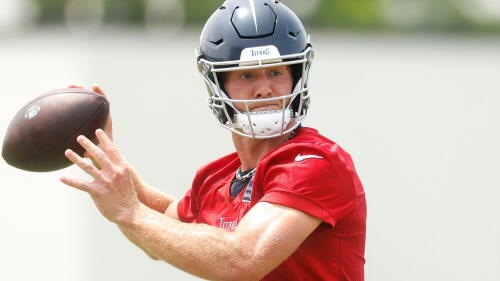
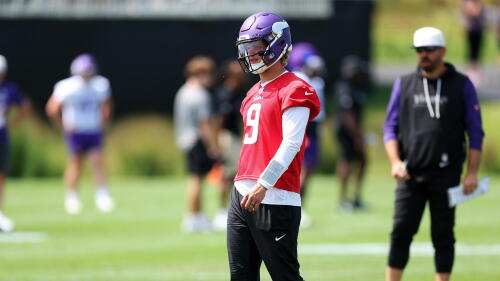
That said, all online indications based on Saturday’s practice are that Kyler Murray has begun to assert himself. Which makes sense. He’s objectively more talented than J.J. McCarthy. If it was close at first, Murray’s lack of knowledge and experience in the offense was a factor.
Murray’s speed and elusiveness have yet to move to the forefront. That gives him a clear advantage when it’s time to play, since the threat of Murray running will keep defenses honest. Which could open up passing lanes that, in practice, defenses aren’t going to abandon as quickly.
The Vikings, who passed on keeping Sam Darnold and Daniel Jones a year ago in lieu of giving McCarthy a full season as QB1, didn’t sign Murray to ride the bench. If he was going to be the backup, he likely would have cast his lot with the Rams, who wanted him to be the understudy to Matthew Stafford.
Consider the comments of Vikings quarterbacks coach Josh McCown regarding the extra dynamic Murray brings to the position.
“We’ve all seen SportsCenter, the stuff that he does with his legs — so you can’t discount that,” McCown said, via Jori Epstein of Yahoo Sports. “We want to coach him and kind of ask him, to a degree, to operate in our offense and then add his touch to it within that as those plays. The game gives you those opportunities. You don’t know when it’s going to happen, but those plays come up. And so we’re hoping that that’ll be a positive for us if/when that does happen. But it’s coaching him as if he’s just another Vikings quarterback that’s in our system, learning our system, trying to grow him in our system the right way. And then again, letting his God-given ability and skill set take over when he plays.”
Through all of the clips and snippets and quotes and scorecards from the first week of camp, the one thing that resonates the most for us came from an unnamed Cardinals coach, who gave this candid and telling comment to Alec Lewis of The Athletic: “I think you’re about to see the best version of Kyler Murray. And I’m fucking pissed that I’m not going to get to be a part of it. I’m going to be jealous when he’s in a good environment, his headspace is good, and he shows people who the fuck he is.”
So, yes, it’s a competition. But it would be a surprise if Murray doesn’t win it. Especially since he brings to Minnesota’s offense something it hasn’t had since the days of Daunte Culpepper — a quarterback who is a real threat to tuck the ball and run to daylight.
As NFL teams continue through the early days of training camp, August 1 provides an annual reminder of the risks of intense football practice in high temperatures and humidity.
Twenty-five years ago today, Vikings tackle Korey Stringer died from complications of heatstroke in the hours after practicing in extreme heat.
After struggling in warm temperatures on July 30, Stringer was one of six players who emerged from a 90-degree July 31 session with some form of heat-related illness. For Stringer, the situation spiraled out of control, culminating in his passing in the early hours of the next day.
Stringer’s death provided a reckoning for football at all levels, creating fresh sensitivity to the issues that can arise when players in full pads are exerting themselves under hothouse conditions.
Five years ago, Kevin Seifert of ESPN took a close look at the adjustments Stringer’s passing prompted. The culture changed. Teams moved practices away from the hottest hours of the day. Trainers and doctors became more sensitive to spotting and treating the signs of heatstroke.
In 2011, the Collective Bargaining Agreement made training camp less demanding than it used to be, with the days of double sessions in full pads gone for good. Still, teams are far more sensitive to spotting potential trouble from practicing in the heat, with efforts to ensure good hydration of players and to ensure that quick action is taken if any player seems to be having an issue.
Stringer’s former teammate, Todd Steussie, had left the Vikings for the Panthers in free agency. Steussie was still haunted by the incident when he spoke to Seifert in 2021.
“If you throw him in an ice tub, Korey is alive today,” Steussie said at the time. “It’s that simple, and that makes it so hard to think about.”
While it often takes a tragedy to fully open eyes about the extent of a given risk, the best outcome is to spot the issues and come up with a plan before the worst-case scenario unfolds. Most people, however, don’t fully appreciate the risk until there’s a tangible example that sends an unmistakable message.
Be proactive, not reactive. It’s always the ideal approach. And that’s the best culture change for any organization — a willingness to make changes before the need for change becomes obvious after a tragedy.