


The Bears are set to add a defensive lineman to their roster.
According to multiple reports, they have agreed to a deal with James Lynch. It’s a one-year deal in Chicago for the veteran lineman.
Lynch spent the last two seasons with the Titans and appeared in all 34 of the team’s games. He had 45 tackles and 1.5 sacks.
The move to the Bears will be a return to the NFC North for Lynch, who entered the league as a Vikings fourth-round pick in 2020. He had 53 tackles, two sacks and a fumble recovery while playing for Minnesota.
Titans Clips
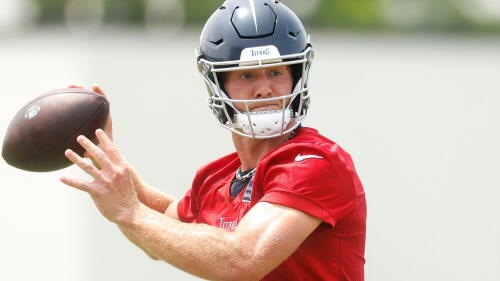


It didn’t take long for wide receiver Wan’Dale Robinson to find a team when free agency opened.
Robinson agreed to terms with the Titans shortly after the negotiating window opened last week and he said this week that it “felt like it was the perfect marriage, a perfect timing type thing.” The presence of offensive coordinator Brian Daboll — who coached Robinson with the Giants — and quarterback Cam Ward had something to do with creating that feeling because Robinson believes they can help him build off of a breakout 2025 season.
“I feel like this past year was the first year I’ve been able to play inside and outside, more so being allowed to do that and showcase different things within the route tree and what I can do in my game,” Robinson said, via the team’s website. “Now having that confidence, I have already done it once, and now you can go out there and get better.”
The four-year, $70 million contract the Titans gave Robinson suggests they also see the potential and room for growth during his time in Tennessee. Turning those hopes into reality would be a boost to the Titans’ chances of avoiding another season in the cellar.
The Vikings have agreed to terms with punter Johnny Hekker, the team announced Tuesday.
Hekker, 36, spent last season with the Titans, who signed Tommy Townsend last week.
He played in all 17 games and punted 78 times for a 46.8-yard average and a 40.3-yard net. Hekker had seven touchbacks and landed 22 punts inside the 20-yard line.
Ryan Wright punted for the Vikings last season, averaging 49.0 yards on 65 punts with a 45.4-yard net.
Hekker got his NFL start as an undrafted free agent with the Rams in 2012. He stayed with the team for 10 seasons and earned Pro Bowl nods following the 2013, 2015, 2016 and 2017 seasons.
Hekker punted for Carolina from 2022-24.
Free agent offensive tackle Austin Deculus reached an agreement today with the Titans, Adam Schefter of ESPN reports.
Deculus, 27, spent last season with the Chargers.
He started five games on the team’s injury-plagued line last season and set career-highs with 13 game appearances, 516 offensive snaps and 41 special teams snaps.
Deculus entered the NFL as a sixth-round pick of the Texans in 2022.
He spent three seasons in his hometown, playing 13 games with one start.
The Texans traded him to the Chargers last August.
The Titans have held onto another one of their own free agents.
Running back Julius Chestnut has agreed to re-sign with the team. It is a one-year deal and no other terms have been announced.
Chestnut initially signed with the Titans as an undrafted free agent in 2022 and has remained with the team for the last four seasons. He played in nine games over his first two seasons and has played in every game for Tennessee the last two years.
Chestnut has seen most of his playing time on special teams while with the Titans and has only played 160 offensive snaps. He has 42 carries for 154 yards in that action and has also been credited with 19 tackles while averaging 24.3 yards on kickoff returns.
Wide receiver Calvin Ridley took a pay cut to stay with the Titans. That was reported over the weekend.
But how much was unknown.
Paul Kuharsky of paulkuharsky.com reports that Ridley’s cap number will drop by $11 million for 2026.
The one-time second-team All-Pro was due a $19.24 million base salary and a $2 million roster bonus with a $26.45 salary cap hit. The Titans added incentives to the revised deal, allowing Ridley to recoup some of the lost money.
Ridley signed a four-year deal in Tennessee before the start of the 2024 season. He played in every game that year and caught 64 passes for 1,017 yards and four touchdowns, but a fractured fibula ended his 2025 season after seven games. Ridley had 17 catches for 303 yards before the injury.
The Titans now have Riley, Wan’Dale Robinson, Elic Ayomanor, Chimere Dike, Mason Kinsey and Bryce Oliver in their receivers room.
As the 2026 NFL draft order comes into focus, Notre Dame running back Jeremiyah Love is looking likely to be the No. 4 overall pick. Unless some team trades up to No. 3 to get him.
The current odds at DraftKings have Love at -115 to go fourth overall, meaning he’s got a better than 50-50 chance of being the fourth pick.
The odds have Indiana quarterback Fernando Mendoza as an enormous -20,000 favorite to go first, Ohio State linebacker Arvel Reese as a more modest -185 favorite to go second, and Texas Tech defensive end David Bailey as a more modest +290 favorite to go third.
With no clear favorite at the third overall pick, and the Titans widely believed to want Love at No. 4, another team that wants Love could try trading up with the Cardinals to take Love at No. 3. Love’s odds are currently +500 to go with the third pick.
No team has taken a running back with a Top 5 pick since 2018, when the Giants drafted Saquon Barkley No. 2 overall. But Love just might be a good enough prospect to make some team do it.
A day before Seahawks G.M. John Schneider addressed the potential impact of Washington’s looming “millionaire tax” on the defending Super Bowl champions, Simms and I stumbled into a conversation about state income taxes during PFT Live.
The spark came from the trade that has sent defensive tackle Osa Odighizuwa from the Cowboys (and Texas) to the 49ers (and California). In his last stop, there was no state income tax. At his new team, he’ll lose 13.3 percent, off the top.
It’s not as clean and simple as every penny of compensation being taxed, or not, by the state where the team plays. For road trips, the game check is taxed by the state in which the game happens. It gets more complicated as to per-game roster bonuses. As we hear it, some states try to tax the visiting player based also on a percentage of the full-year roster bonuses and/or the prorated portion of the signing bonus for the season in which the game is played.
And, yes, the lack of state income tax becomes a selling point in free agency, which explains Schneider’s concerns about Washington’s tax rate for millionaires increasing from 0.0 percent to 9.9. But, as Odighizuwa will learn the hard way, that doesn’t matter if the free-agent contract also doesn’t include a no-trade clause.
Regardless, the variations in state income tax create an imbalance as it relates to the most important aspect of anyone’s pay — how much they take home.
Simms mentioned on Thursday’s PFT Live that he heard something interesting from someone in the league who saw the tax discussion from the day before. (And, yes, plenty of people in the league watch PFT Live — probably because it features no phony debates, no false praise, no reckless hype, no minced words, and no performative antics.) There’s an argument to be made that the salary cap should take state income taxes into account.
It would be complicated, given that taxes depend on where games are played. Still, every team has eight or nine home games per year. That’s roughly half of the compensation, taxed based on where the team is located.
The real question is whether teams should get more to spend, given that more of what is paid will end up being taken off the top by the state government. Some teams may not want to do it, since having a higher cap means having a higher floor means spending more money that otherwise would be siphoned away as pure profit.
And the numbers would be significant. At a 2026 salary cap of $301.2 million, providing the Rams, Chargers, and 49ers with a 13.3-percent bump would push the cap to $341.2 million for those teams.
The deeper question is whether state income taxes make a competitive difference. As noted the other day, most of the teams in the no-tax states haven’t been to a Super Bowl this century. (The Seahawks and Buccaneers are the exception; the Titans, Cowboys, Dolphins, Jaguars, and Texans are not.)
Part of the problem is that most players don’t fret about state income taxes, even if they should. Players focus mainly on annual average, the true locker-room measuring stick that determines the pecking order among the most and least valuable players.
Although it would indeed be difficult to come up with the right way to determine cap credits, since the total tax burden depends on where games are played, that would be doable. The bigger challenge would be to get all teams in states with income tax to agree to a higher cap in order to account for it.
News flash: Not every team is as obsessed with winning as they pretend to be. For many owners, it’s about profit. Having more money to spend means having less to buy giant yachts or that much-needed tenth home. Especially since the owners of the teams in the high-tax states are also paying those increased rates, too.
Just kidding. The ultra-rich have seemingly cracked the code on eating nearly every ounce of what they kill. Which is another reason why the owners of the teams in the high-tax states won’t want to have more to spend — even if they have to say they do.
Wide receiver Calvin Ridley will be donning the Titans’ new uniforms this season.
Tom Pelissero of NFL Media reports that Ridley will remain with the team after agreeing to a revised contract with the team. The full details of the changes are not available, but Ridley was due to receive a roster bonus this weekend and it is likely part of any agreement between Ridley and the Titans.
Ridley was set to have a cap number of $26.45 million with a base salary of $20.24 million.
Ridley signed a four-year deal in Tennessee before the start of the 2024 season. He played in every game that year and caught 64 passes for 1,017 yards and four touchdowns, but a fractured fibula ended his 2025 season after seven games. Ridley had 17 catches for 303 yards before the injury.
The Titans signed Wan’Dale Robinson this week and he’ll join Ridley, Elic Ayomanor, Chimere Dike, Mason Kinsey, and Bryce Oliver in the receiver room.
Free agent defensive lineman Sebastian Joseph-Day is signing a two-year, $11 million deal with the Steelers, Adam Schefter of ESPN reports. The deal includes $6 million this year.
Joseph-Day, who turns 31 next week, spent the past two seasons with the Titans, appearing in all 34 possible games.
In 2025, he totaled 41 tackles, two sacks, six quarterback hits and a fumble recovery.
The Rams made him a sixth-round pick in 2018, and he has also spent time with the Chargers and 49ers.
Joseph-Day has recorded 314 tackles, 5.5 sacks, one interception, six pass breakups and two forced fumbles.
