Colts kicker Spencer Shrader, who injured his groin in pregame warmups, ended up playing the part of hero. He kicked field goals of 39, 58, 37 and 53 in the Colts’ 19-17 victory over the Texans.
His final field goal came with 16 seconds left.
The Colts are now 1-2, while the Texans fell to 0-3 for the second consecutive season. Houston rallied to make the playoffs last season, but the odds are against them to do it again.
The Colts, who led 13-7 at halftime and 16-7 midway through the fourth quarter, had the lead until 1:48 remained. C.J. Stroud directed a seven-play, 54-yard drive with Woody Marks scoring on a 1-yard run.
The Texans, though, botched the kickoff, with Ka’imi Fairbairn kicking it into the end zone. That allowed the Colts to start their game-winning drive at their own 35. DeMeco Ryans then botched the clock management, failing to use his first timeout after Jonathan Taylor’s run left more than a minute on the clock.
Ryans finally called the timeout with 29 seconds remaining. It left too little time for the Texans to get into field goal range, and Stroud’s Hail Mary throw on the final play was both short and out of bounds.
The Colts outgained the Texans 300 to 223 yards, with Daniel Jones going 24-of-36 for 235 yards with a touchdown and an interception. He also lost two fumbles, though the Texans turned it over on downs after the first one.
Jonathan Taylor had 23 carries for 68 yards, and Josh Downs caught five passes for 77 yards.
Adetomiwa Adebawore and DeForest Buckner each had 1 1/2 sacks of Stroud.
Stroud was 16-of-27 for 167 yards and a touchdown. David Montgomery had 11 carries for 33 yards, and Xavier Hutchinson caught three passes for 51 yards.
Texans defensive end Will Anderson had 2.5 sacks of Jones.
Texans Clips


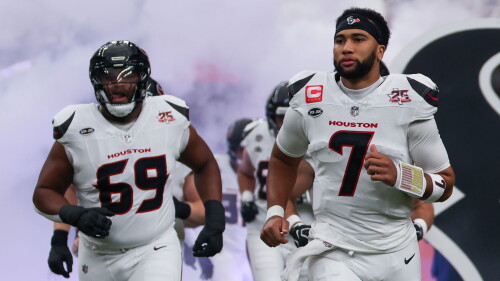


Daniel Jones fumbled on the Colts’ first drive, but he directed scoring drives on the next three.
The Colts lead the Texans 13-7 at halftime.
Keenan Allen caught his first touchdown pass with the team, a 6-yard throw from Daniel Jones. Spencer Shrader, who was questionable to play after injuring his groin in pregame warmups, has kicked field goals of 39 and 58 yards as well as an extra point.
The Colts have 159 yards, with Jonathan Taylor running for only 19 yards on nine carries. Jones is 14-of-22 for 123 yards, and Josh Downs has four catches for 72 yards in taking up the slack for the injured Alec Pierce.
The Texans couldn’t convert on fourth down from the Colts 31 after recovering Jones’ fumble and punted on three other drives. Their touchdown drive covered 68 yards in 12 plays with Fabian Moreau catching a 1-yard touchdown pass from C.J. Stroud.
Houston has 67 yards and is 3-for-7 on third down.
Stroud is 6-of-11 for 40 yards and a touchdown, with Jaylin Noel catching two for 17. David Montgomery has only 23 yards on eight carries.
Keenan Allen made seven receptions in his first two games with the Colts. He did not score a touchdown, though.
The wide receiver took care of that early in Sunday’s game against the Texans.
Allen caught a 6-yard touchdown pass from Daniel Jones on third-and-goal to complete a 12-play, 69-yard drive.
The reception was the 1,063rd of Allen’s career, putting him 12th all time ahead of Andre Johnson.
The Colts lead the Texans 10-0 with 11:08 remaining in the first quarter.
Spencer Shrader has kicked a 39-yard field goal and an extra point after injuring his groin in pregame warmups.
Colts defensive end Laiatu Latu has a chest injury, and his return is questionable.
The Texans list linebacker Azeez Al-Shaair (groin) as questionable to return.
Colts kicker Spencer Shrader apparently injured himself in pregame warmups.
The team announced before kickoff that Shrader is questionable to return with a groin injury.
Punter Rigoberto Sanchez kicked off to open the game.
Sanchez has never tried a field goal in his NFL career.
Thus, the Colts might have to go for it on fourth down in plus territory and go for 2 after touchdowns.
Bills wide receiver DJ Moore hurt his shoulder in a Week 2 win over the Lions, but he had more than a week to recover from the injury and that was enough time for him to get cleared for action.
Moore is active for the Bills as they try to move to 3-0 on the season at home against the 0-2 Chargers. The Bills will also get defensive tackle Ed Oliver back in the lineup. Oliver missed the Lions game after injuring his hip in pregame warmups and was listed as questionable along with Moore and wide receiver Keon Coleman.
Coleman is also active for Buffalo while backup quarterback Trey Lance is active for the Chargers. DJ Uiagalelei was summoned from the practice squad as insurance after Lance was listed as questionable, but there will be no change behind Justin Herbert.
Chargers at Bills
Chargers: S Elijah Molden, QB DJ Uiagalelei, OL Alex Harkey, G Kayode Awosika, TE Charlie Kolar, WR Brenen Thompson, DT Dalvin Tomlinson
Bills: WR Skyler Bell, OL Jude Bowry, OL Ar’maj Reed-Adams, DL T.J. Sanders, LB Mike Danna, S Jalon Kilgore
Panthers at Browns
Panthers: TE Ja’Tavion Sanders, QB Haynes King, WR Xavier Legette, S Nick Scott, LB Devin Lloyd, OT Albert Reese, DT Cam Jackson
Browns: CB Tyson Campbell, QB Taylen Green, LB Justin Jefferson, C Parker Brailsford, G Teven Jenkins
Jets at Lions
Jets: WR Adonai Mitchell, DB Minkah Fitzpatrick, TE Mason Taylor, RB Kene Nwangwu, CB Nahshon Wright, K Blake Grupe, LB Kiko Mauigoa
Lions: G Ben Bartch, TE Tyler Conklin, S Bishop Fitzgerald, DL Ahmed Hassanein, LB Devin White, DL Mekhi Wingo
Texans at Colts
Texans: TE Brevin Jordan, CB Collin Wright, WR Nico Collins, G Ed Ingram, DE Jadeveon Clowney, OL Nate Thomas
Colts: WR Ashton Dulin, WR Darius Slayton, DE George Gumbs, G Dailton Tucker, RB DJ Giddens, QB Riley Leonard
Patriots at Jaguars
Patriots: S Craig Woodson, LB Dre’Mont Jones, QB Behren Morton, OT Dametrious Crownover, TE Eli Raridon, DT Leonard Taylor
Jaguars: WR CJ Williams, S Jalen Huskey, LB Jack Kiser, OL Daniel Faalele, DE Wesley Williams, DT Albert Regis
Chiefs at Dolphins
Chiefs: TE Jared Wiley, QB Garrett Nussmeier, DB Chamarri Conner, DE Jack Pyburn, OT Josh Simmons, DE Tyreke Smith
Dolphins: QB Brady Cook, WR Caleb Douglas, RB Jaylen Wright, CB Marcellus Dial, OL DJ Campbell, DL Rob Beal Jr., OL Chukweubuka Godrick
Titans at Giants
Titans: OL Atonio Mafi, DL Jackie Marshall, OL Brandon Crenshaw-Dickson, TE Kylen Granson, DB Jaylon Jones, RB Michael Carter
Giants: RB Devin Singletary, TE Thomas Fidone, OL J.C. Davis, DL Josh Tupou, DL Bobby Jamison-Travis, CB Deonte Banks, S Tyler Nubin
Bengals at Steelers
Bengals: CB Josh Newton, C Connor Lew, OT Myles Hinton, TE Jack Endries, DT BJ Hill, DT Landon Robinson
Steelers: RB Rico Dowdle, QB Drew Allar, QB Will Howard, CB Joey Porter Jr., RB Eli Heidenreich, DT Kevin Jobity Jr., DT Gabriel Rubio
Seahawks at Commanders
Seahawks: S Julian Love, S Ty Okada, DT Brandon Pili, QB Jalen Milroe, WR Montorie Foster, CB Avery Smith, LB Connor O’Toole
Commanders: QB Jayden Daniels, LB Frankie Luvu, LB Javontae Jean-Baptiste, G Sam Cosmi, TE Chig Okonkwo
The Texans placed linebacker Jake Hummel on injured reserve, the team announced Saturday.
He injured his groin in the season opener and hasn’t played or practiced since.
Hummel will miss at least the next four games.
He played 17 special teams snaps in the Week 1 loss to the Bills.
The Texans elevated two players off the practice squad for Sunday’s game against the Colts, with wide receiver Lewis Bond and safety George Odum getting the call-up.
As the 0-2 Colts prepare for an AFC South showdown with the 0-2 Texans, Indy needs to hope for something better from the defense.
Through two games, the Colts have surrendered more than 1,029 yards. The Ravens gained 506 yards against the Colts in Week 1, and the Chiefs added 523 yards in Week 2
Via NBC Sports research, the Colts would become only the second team in the Super Bowl era to give up 500 or more yards in three consecutive games, if it happens again on Sunday.
The 2018 Bengals are the only team to give up 500 or more yards in three straight games.
The Colts have also lost four straight AFC South games, their longest streak of division losses since the division was created in 2002. And the Colts have lost nine in a row, the longest active streak in the NFL.
After the Texans’ Week 1 game against the Bills, the NFL fined linebacker Azeez Al-Shaair $11,941 for having the name “Hind Rajab” on his eye black strips. In Week 2, Al-Shaair was prevented from honoring a different Palestinian who was killed in the ongoing conflict with Israel.
Jonathan Jones of The Athletic reports that Al-Shaair was told to remove “Wafaa Akila” from his eye black early in the game against the Bengals. Wafaa Akila, 8, was killed during an Israeli airstrike earlier this month.
Jones adds that Al-Shaair was not fined for the message in Week 2.
The same thing happened during the 2025 postseason. After Al-Shaair wore “stop the genocide” on his eye black strips during the wild-card win over the Steelers, the league told him he wouldn’t be permitted to play if he tried to do it again in the divisional round at New England.
Al-Shaair explained his reason for honoring Hind Rajab in a session with reporters last week.
“We don’t have to have all the answers to everything to know that an innocent man, an innocent woman, an innocent child losing their life is not right,” Al-Shaair said. “Like, I don’t need anybody to gaslight me into saying that, ‘Well, you gotta ask. . . .’ I just know that’s not right, whether they’re here in America or somewhere halfway across the world.”
It’s a simple message that should be undeniable to anyone who has any basic regard for humanity. In any armed conflict, innocent civilians should not be killed — especially not children.
Colts head coach Shane Steichen said this week that the team will put wide receiver Alec Pierce on injured reserve and the team made the move official on Saturday.
Pierce will miss at least the next four games after aggravating the heel injury that caused him to have surgery this offseason.
The Colts filled Pierce’s spot on the roster by signing wide receiver Anthony Gould off of their practice squad. Gould was elevated for the Colts’ Week 2 loss to the Chiefs and he returned four kickoffs in that game.
The Colts also announced that they have elevated wide receiver Nick Westbrook-Ikhine from the practice squad on a temporary basis. He has 137 catches for 1,862 yards and 19 touchdowns in 93 career games.
Eight teams entered Week 3 at 0-2. One of them — the Falcons — avoided an 0-3 start. For the others, it becomes imperative to avoid starting the year with three straight losses.
In NFL history, only seven teams have made the playoffs after starting 0-3. The group includes the 2025 Texans, the 2018 Texans, the 1998 Bills, the 1995 Lions, the 1992 Chargers, the 1982 Buccaneers, and the 1981 Jets.
Only the ’92 Chargers made it to the postseason after starting 0-4.
It’s easier now than it once was, thanks to 17 regular-season games and seven playoff spots per conference. It’s still not easy.
For starters, plenty of teams that start 0-3 do so for a very good reason — they’re not very good. Those that are have a reduced margin for error over the final 14 games.
This year, one game features two 0-2 teams: the Texans at the Colts. The other winless teams are the Dolphins, the Titans, the Chargers, the Commanders, and the Buccaneers.