


Aaron Donald initially worked out at the Rams team facility on Aug. 5 to evaluate how he felt. He did so again Sunday.
According to the NFL personnel notice, the defensive tackle worked out in Woodland Hills.
The three-time Defensive Player of the Year began considering a comeback after the Rams traded for two-time Defensive Player of the Year Myles Garrett. He has not made a decision yet, and the Rams aren’t giving him any deadlines.
“I’m hopeful that it will be sooner than later, but I also want to respect when he does feel like that clarity will come,” coach Sean McVay said Saturday. “I don’t want to say too much or put some sort of invisible deadline on something that doesn’t exist in my mind for him.”
Donald has not played in the NFL since 2023.
Rams Clips

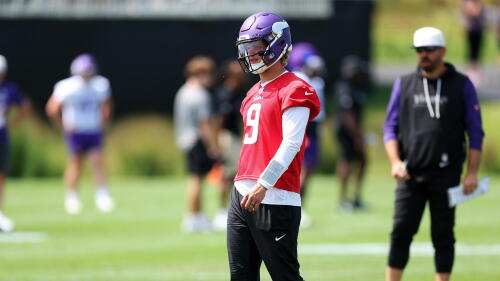


And now it’s becoming a little more apparent why the Rams used the 13th overall pick in the draft on quarterback Ty Simpson.
Yes, it was only the preseason. For rookie quarterbacks, it’s all about looking the part. Simpson looked the part on Saturday at Kansas City.
Simpson completed 21 of 25 passes for 190 yards and two touchdowns in three quarters of action.
“He took what the defense gave him,” coach Sean McVay said after the game. “You know, I thought he read the plays out, read with his feet. You know, I thought he did a really good job overall. And I thought, even on some of the keepers, where maybe the primary isn’t there, he attacks with the ball up. . . .
“I thought he kept the ball in play. You know, that’s the biggest thing, is keeping the ball in play. There was one situation there, we’ll have a great learning [opportunity] on a third down, where, you know, they kind of played a man coverage, we ended up throwing into the flat to [tight end] Max Klare. I’ve got to see — I think the pocket might allow him to be able to progress, but otherwise, it was a really good day for him. He just felt like he was in good command, and it was cool to see a good smile on his face.”
McVay may be smiling, too, if he thinks the rookie can be trusted to serve as the understudy to reigning MVP Matthew Stafford. The only other option is Stetson Bennett, who has no regular-season snaps in three seasons.
Ideally, the preseason will be Simpson’s only chance to get live reps. That likely explains the decision to give him three full quarters of playing time.
But it’s not just development for a post-Stafford future. They need to have someone ready, in the event Stafford’s back flares up or he has some other injury during the grind of a 17-game season.
The timetable for defensive tackle Aaron Donald’s decision on whether to play in 2026 has been shifting. Rams coach Sean McVay wants to give Donald all the space he may need.
“We have some loose things where we’ve identified you know dates that we’d like to be able to hit, but what I don’t want to have is any sort of unnecessary pressure on him if there’s some unforeseen circumstances,” McVay told reporters on Saturday, via Gary Klen of the L.A. Times.
It’s ultimately a no-lose situation for the Rams.
“I feel great about our football team as it currently stands, and I know he’ll add value if he decides to come,” McVay said. “And so if he’s put himself in a position to be able to say yes or no I think he’s earned that right to have clarity on that. We’re not at that point quite yet.”
Does McVay have a preferred timeline?
“I’m hopeful that it will be sooner than later but I also want to respect when he does feel like that clarity will come,” McVay said. “I don’t want to say too much or put some sort of invisible deadline on something that doesn’t exist in my mind for him.”
Donald still has time to join the team and be ready to play in Week 1. At some point, however, the clock will start ticking more loudly.
The only real deadline, as mentioned earlier today, is the Tuesday after Week 13. It all comes down to when Donald thinks he’s ready to get back to being the Aaron Donald everyone is accustomed to seeing on the field.
It still seems inevitable that Rams defensive tackle Aaron Donald will emerge from two years of retirement to play alongside Myles Garrett. But there has still been no announcement from Donald, which strongly suggests he has still not made a final decision.
His target has been shifting. It went from early this week (Monday-ish) to late this week (Friday-ish). Now that the weekend has arrived, Donald has yet to make a decision.
Donald wants to be sure that he’ll be the same guy he always was if he returns. But if Donald plans to make a firm and final decision before rejoining the Rams, he’ll need to make a projection as to whether his efforts to get himself in football shape will translate to dominance on the practice field, and eventually during games.
Donald won’t know for sure whether he can perform like he did until he tries to do it. And he seems to be taking as much time as he thinks he needs to decide whether, based on his workouts, he’ll be able to pull it off.
If he returns, the Rams would ramp him up in the same way they did after 2017 and 2018 contract-driven holdouts. With three weeks and five days until the Week 1 game against the 49ers in Australia, at some point there may not be enough time to get him ready to play.
There’s also the issue of a contract. Donald has one year remaining on the three-year post-Super Bowl deal that went into mothballs when he retired, at $30 million. The two sides will need to agree to payment terms and an acceptable structure for 2026 (if they haven’t already done so).
Until Donald decides to return, there’s a chance Donald won’t. At some point, the absence of a decision will become a decision, as it relates to Week 1 and, perhaps, Week 2 and beyond.
Donald could, if he chooses, let it ride all the way until the Tuesday after Week 13, the deadline for reinstatement from the reserve/retired list. Which would get him on the field just in time for the first of two showdowns with the Seahawks, in Week 15.
Regardless, Donald is taking his time to make a decision. And the Rams, who are already the favorites to win the Super Bowl without him, don’t seem to be inclined to force the issue.
Rams wide receiver Puka Nacua missed practice on Thursday after leaving the joint practice with the Cowboys two days ago with an injury.
Sean McVay revealed that Nacua has psoas soreness, Gary Klein of the Los Angeles Times reports. The psoas is a deep core muscle that is a primary hip flexor.
Nacua is expected back to practice next week, McVay added.
Pass rusher Myles Garrett also spent Thursday working off to the side with the Rams’ training staff. It was the seventh practice Garrett has missed with knee soreness.
The Rams remain confident that Garrett’s absence won’t linger.
McVay called Garrett’s knee at 85 percent on Tuesday.
Rams rookie quarterback Ty Simpson will make his preseason debut on Saturday against the Chiefs. But he will not be Los Angeles’ first signal-caller up.
Via multiple reporters, head coach Sean McVay said in his Thursday press conference that Stetson Bennett will start the preseason opener.
Bennett, a fourth-round pick in 2023, is currently in line to serve as Matthew Stafford’s backup, as Jimmy Garoppolo was not re-signed in free agency — though Garoppolo is still available.
Bennett has not yet appeared in a regular-season game. Last year, he completed 69 percent of his passes for 512 yards with five touchdowns and two interceptions in the preseason, good for a 105.7 passer rating.
Simpson is set to come in at some point after Bennett. The Rams also have rookie Matthew Caldwell on their roster at QB.
The Rams have not played starters in the preseason under McVay for the vast majority of his tenure with the team.
Additionally, McVay noted offensive coordinator Nate Scheelhaase will serve as the offensive play-caller for Saturday’s game. McVay handles those duties for L.A. in the regular season.
Two of the Rams key players are not participating in Thursday’s practice.
Via Sarah Barshop of ESPN, both receiver Puka Nacua and edge rusher Myles Garrett are working out off to the side with Los Angeles’ training staff during the session.
While Garrett is dealing with a knee issue, Nacua’s injury has not yet been disclosed. Nacua exited the joint practice with the Cowboys early this week.
But the fact that both players are doing something during practice is an indication that neither is dealing with something too serious.
We’ll see if head coach Sean McVay delivers an update on either or both players after practice concludes.
Playing football presents a constant risk of injury. The rest of real life does, too.
Appearing on the Impaulsive podcast, Rams receiver Puka Nacua said he collided with a glass window pane at Michael Rubin’s white party earlier this summer.
“Uh, the glass window pane won,” Nacua said, via Oliver G. of USA Today.
Nacua wasn’t the only one who had an encounter with the obstruction at the annual (in most years) event hosted by the Fanatics founder.
“They made me feel better when they said three other people ran into it,” Nacua said. “But nobody else ended up bleeding from it. So I don’t know if that made me feel much better or worse.”
The injury dovetails with a recent remark made by Aaron Rodgers regarding “weird-ass parties” where everyone wears white, which Rodgers says he won’t be attending when he retires.
In Nacua’s case, the white ended up having distinct hints of red.
The Rams have added a linebacker.
Los Angeles announced on Thursday that the club has signed veteran Monty Rice.
Rice, 27, was a Titans third-round pick in 2021 out of Georgia. He’s appeared in 39 career games with 11 starts for Tennessee, New England, and Detroit. In the last three seasons, most of his playing time has come on special teams.
Rice appeared in one game for the Lions in 2025.
He also spent time in 2026 with the UFL’s Louisville Kings.
The NFL’s secret, rigged, kangaroo court of arbitration continues to crumble.
On Wednesday, the Superior Court of California, County of Los Angeles found that an arbitration clause used by the Rams is unconscionable and, in turn, unenforceable.
The dispute arose from a lawsuit filed by Brittany Todd against the Rams. She claims that her March 10, 2026 termination happened after she complained that her immediate supervisors were consuming alcohol during work hours “to the point of extreme intoxication,” that they coerced subordinate employees to consume alcohol, that they berated employees “to an abusive level” after becoming intoxicated, and that they berated employees for their religious views.
The Rams filed a motion to compel arbitration. The court rejected the motion.
The arbitration agreement used by the Rams gives the NFL Commissioner, or his designee, the exclusive power to resolve the case, including the threshold question of whether the dispute is “football-related.”
The court found that reliance on an arbitrator who is employed by the NFL, which represents the 32 member teams, makes the agreement unconscionable.
It’s the third ruling in recent months invalidating the NFL’s arbitration provisions. Unlike the Jon Gruden and Brian Flores cases, however, the Todd case did not involve the NFL as a party to the litigation.
Todd’s lawyer, Mike Caspino, applauded the decision.
“We are happy that our client will be able to have her day in court,” Caspino said in a statement provided to PFT. “We are also happy that all of the employees of the 49ers, Chargers and Rams will no longer be subjected to the NFL’s biased arbitration system.”
The tide seems to be turning sharply against the NFL’s effort to serve as judge and jury in cases filed against the league and its teams. And to that we say, “It’s about damn time.”
It was never fair for the league to handle the lawsuits filed against the NFL and its teams. And the league should have never tried to even do it. After years of pulling it off, the courts are finally tearing it down.
